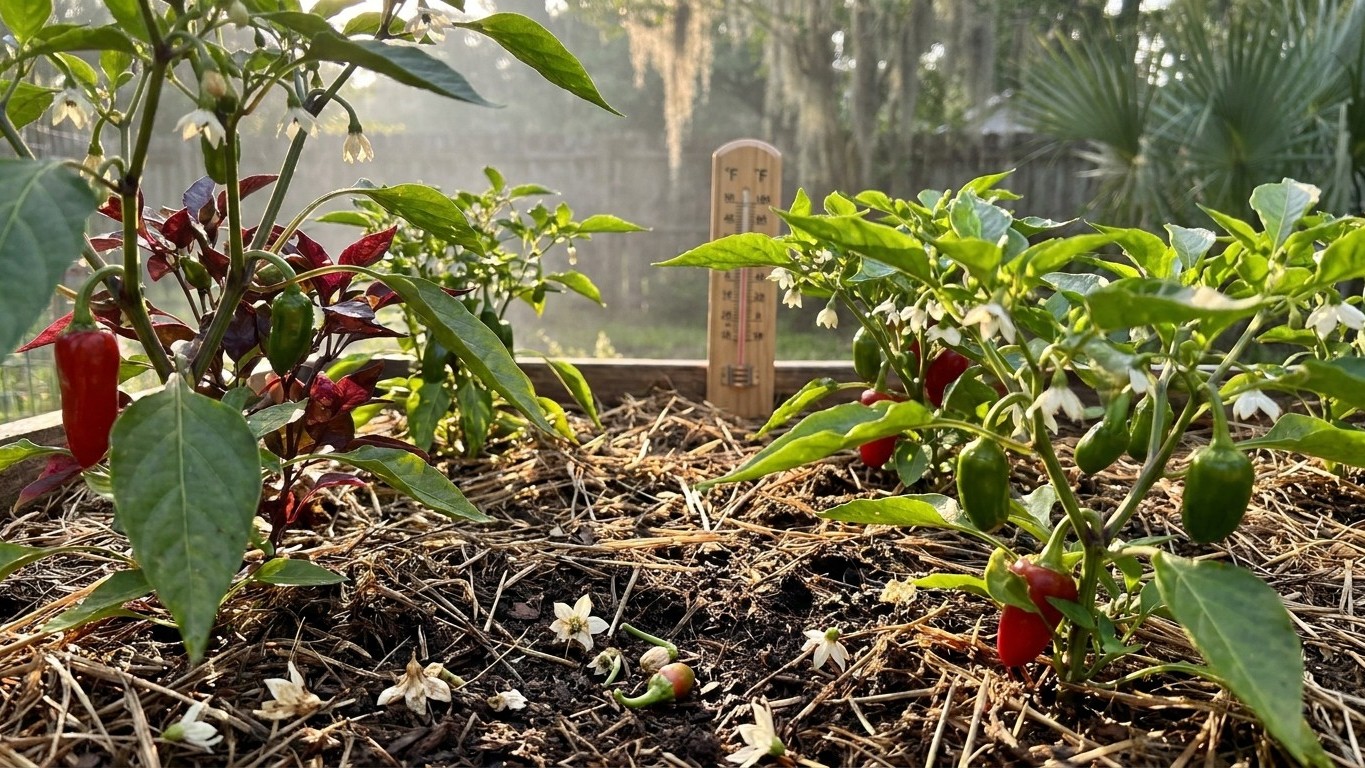

In Pennsylvania, weather takes more pepper blossoms than any insect does. Fruit set fails when days climb above 90 F or when nights drop below 55 F, and the calendar decides which one you meet. This page covers those climate losses and the timing behind them. Insect pests aren’t counted here, because this site holds no pest data for the state to report.
The short answer
The hot end
Twenty-four days. 24.0 days a year reach 90 F or more at the reference station in Philadelphia, according to NOAA NCEI Climate Normals. That is the equivalent of three and a half weeks of weather on the wrong side of the line for pepper blossoms. It measures heat load, meaning how often the thermometer crosses 90, and not how warm the summer feels on average. A summer can feel mild and still stack up a few of those days in a row.
The link to fruit is direct. According to Utah State University Extension, pepper fruit set fails at both ends: days above 90 F, and nights below 55 F. A flower that opens during a scorching afternoon may simply fall off instead of swelling into a pepper. The plant keeps growing, looks healthy, and produces nothing for a stretch. That is the pattern behind many “all leaves, no peppers” complaints, which Why Peppers Fail to Set Fruit in Pennsylvania covers in more detail.
One caution on the number. It comes from a single station. The state is large, and your county’s count may differ from Philadelphia’s. Treat 24.0 as a benchmark for how much heat the crop has to absorb, not as a promise for your backyard.
The cool end
Now the other side, which gardeners tend to forget. Nights under 55 F cause the same failure as hot days. This site does not carry summer night minima, so there is no number here to tell you how many such nights your area gets. Do not guess from latitude, and do not assume that because winters are cold, summer nights must be chilly or mild. Those inferences fail often.
The fix is cheap. Put a min/max thermometer near the plants and write down the overnight low every morning. Pay attention in the weeks after transplanting and again as summer winds down, when a clear sky and dry air can drop the temperature fast. A week of logged lows tells you more about your garden than any regional average.
Between the two ends sits a workable middle: warm days below 90 F, nights above 55 F. Varieties matter for how well a plant rides out the edges, and Pepper Varieties That Ripen in a Pennsylvania Season covers which ones suit a Pennsylvania calendar. For the wider picture, start with Growing Peppers in Pennsylvania.
When to start seed here
Start from the planting date and count backward. Pepper seed gets sown indoors so that the transplant meets warm soil, not cold ground. According to Utah State University Extension, transplants need 8 to 10 weeks indoors, and they go out when the soil reaches 60 F, after frost. Here is the arithmetic, step by step.
- Find your last spring frost. At the Philadelphia reference station, NOAA NCEI puts it between March 29 and April 6 (that is the 30 to 70 percent band of 32 F freeze probabilities). Philadelphia is the mildest corner of the state. The northern tier and the Alleghenies run two to four weeks later, which works out to roughly mid-April through early May if you add that gap to the same window.
- Wait for 60 F soil. Frost clearing is only the floor. Push a soil thermometer into the bed where the peppers will go and read it in the morning. The transplant date is whichever comes later: frost gone, or soil at 60 F. In most years the soil reading is the later one.
- Subtract 8 to 10 weeks. Count back from that transplant date. Eight weeks is 56 days, ten weeks is 70 days. The result is your sowing window.
- Check the far end. According to Clemson Cooperative Extension, peppers are ready for harvest about 70 to 85 days after transplanting. Add that to your transplant date to see roughly when the first fruit could be picked.
A worked example
Suppose, purely for illustration, that your soil reaches 60 F on May 10. Eight weeks earlier is March 15, and ten weeks earlier is March 1. So seed goes in between March 1 and March 15. Now run it forward: 70 days after May 10 is July 19, and 85 days is August 3. The first peppers would come between those dates.
Notice where that harvest window sits. The plants will be flowering in the middle of the season when the 90 F days are most likely, which is why the heat count from the first section matters to your timing. Swap in your own soil date and the same four steps give you your own calendar. A county in the northern tier just shifts every line later by the gap between its frost date and Philadelphia’s.
Starting too early has a cost. Seedlings held indoors past the 10-week mark get root-bound and leggy, and a late cold snap can leave you waiting with plants that have outgrown their pots. The 8 to 10 week range exists for a reason, so use the back half of it only if your spring tends to be cooler.
What goes wrong here
Pennsylvania summers hand peppers three recurring problems. Each has a cause you can see and a remedy you can apply, and two of them trace straight back to the temperature limits above.
- Blossom drop. Flowers fall off without setting fruit after a hot spell with days above 90 F, or after a cool night under 55 F. Nothing is wrong with the plant itself. The remedy is patience and protection. Shade cloth over the bed during a heat wave takes the edge off the afternoons, and a row cover or cloche on a cold evening holds a little warmth in. Keep watering evenly, and pick early fruit so the plant keeps making more. Flowers that open after the weather settles will usually set.
- Sunscald. Pale, papery, sunken patches show up on the side of the pepper facing the sun, and they turn tan or white before secondary rot moves in. It happens when fruit is exposed, often after leaves are lost to disease or pruned too hard. The remedy is leaf cover: leave the foliage alone, stake or cage the plants so the canopy stays full, and use shade cloth in the strongest afternoon sun.
- Blossom-end rot. A dark, leathery, sunken spot forms at the bottom of the fruit, opposite the stem. It is tied to uneven moisture that keeps calcium from reaching the fruit, and often not to a shortage of calcium in the soil. The remedy is steady watering. Mulch to hold moisture, water deeply instead of in frequent sips, and avoid letting the bed swing from bone dry to soaked.
Telling them apart
Look at where and when. Blossom drop shows up as missing flowers, often a week or so after the weather event that caused it. Sunscald appears on the sun-facing shoulder of the fruit. Blossom-end rot sits at the blossom end, the bottom, and follows patchy watering. Getting the diagnosis right keeps you from adding calcium to a bed that only needed a hose on a schedule.
Common questions
When can I put pepper transplants outside in Pennsylvania?
After the last frost and once the soil reaches 60 F, whichever comes later. At the Philadelphia reference station, NOAA NCEI puts the last spring frost between March 29 and April 6. The northern tier and the Alleghenies run two to four weeks later. Use a soil thermometer rather than the calendar to decide.
How many weeks indoors do pepper seedlings need?
According to Utah State University Extension, 8 to 10 weeks. Count back from your transplant date, not from the frost date, since soil warmth usually sets the planting day.
Can I keep harvested peppers in the refrigerator?
The fridge is too cold for peppers, and it is the mistake nearly everyone makes. According to Clemson Cooperative Extension, the best storage is 45 to 50 F with 80 to 90 percent relative humidity, which is warmer than a household refrigerator. Below about 45 F peppers pit and soften from chilling injury. The same source says two to three weeks under those ideal conditions, and that is a maximum, not a guarantee. A cool pantry or basement, if it holds near that range, beats the crisper drawer.
Is 90 F really a problem if my plants look healthy?
It can be. Healthy leaves do not guarantee fruit, since flowers can drop during hot days or cool nights while the plant looks fine. With 24.0 days a year at or above 90 F at the reference station, plan on some of those days landing during flowering, and keep your own log of overnight lows to cover the cool end.