
Pennsylvania gardeners can grow a full pepper crop from transplant to ripe fruit within a normal frost-free season, but the fruit-set window is narrower than the calendar suggests. Warm days and mild nights are the deciding factor, not the length of summer alone. Watch both ends of the thermometer, not just the frost dates.
The short answer

The Philadelphia reference station logs an average of 24.0 days a year at or above 90 F, based on NOAA NCEI Climate Normals for 1991-2020. That’s the heat-load number that matters for peppers, and it explains why a stretch of scorching afternoons in July or August can stall a plant that looked perfect in June. Pepper flowers abort when daytime highs push past 90 F for several days running, even if the plant itself looks healthy and green. The pollen turns sterile, blossoms drop, and the plant simply pauses fruiting until conditions ease. In a season with 24 heat-stress days scattered through summer, most of them clustered in July, that pause can happen more than once.
The other failure point sits at the opposite end. Nights that drop below 55 F stop pollen from developing properly, and the same blossom-drop shows up, just triggered by cold instead of heat. This site does not carry summer night-minimum data for Pennsylvania, and no reliable figure should be borrowed from latitude, elevation guesses, or the coldest month of the year, because none of those substitutes hold up. A river valley and a ridge ten miles apart can differ by several degrees on a still August night. Anyone growing peppers here needs to track their own overnight lows through the growing season, whether with a min-max thermometer on the porch or a basic weather station, rather than assume the daytime forecast tells the full story.
Put together, the two thresholds define a working range rather than a single ideal temperature. Fruit set happens reliably when nights stay at 55 F or above and days stay under 90 F. Pennsylvania’s climate normally offers plenty of days inside that range, which is why pepper crops here are dependable in most years. The exceptions are a hot mid-summer week that pushes several days past 90 F in a row, or a cool snap, common in the Alleghenies and the northern tier, that drops nights under 55 F even in July. Neither one ruins the season outright. Growth just idles until temperatures swing back into range, and the plant resumes setting fruit once they do.
When to start seed here
Working out a sowing date is mostly subtraction, and the same math works whether the garden sits in Philadelphia or up near the New York border, once the local frost date is swapped in.
- Start with the local last spring frost. At the Philadelphia reference station, the 32 F freeze-probability window runs March 29 to April 6, per NOAA NCEI Climate Normals 1991-2020. Philadelphia is the mildest corner of the state. The northern tier and the Alleghenies run two to four weeks later in spring, so a gardener in those regions should shift every date below by that same two-to-four-week margin.
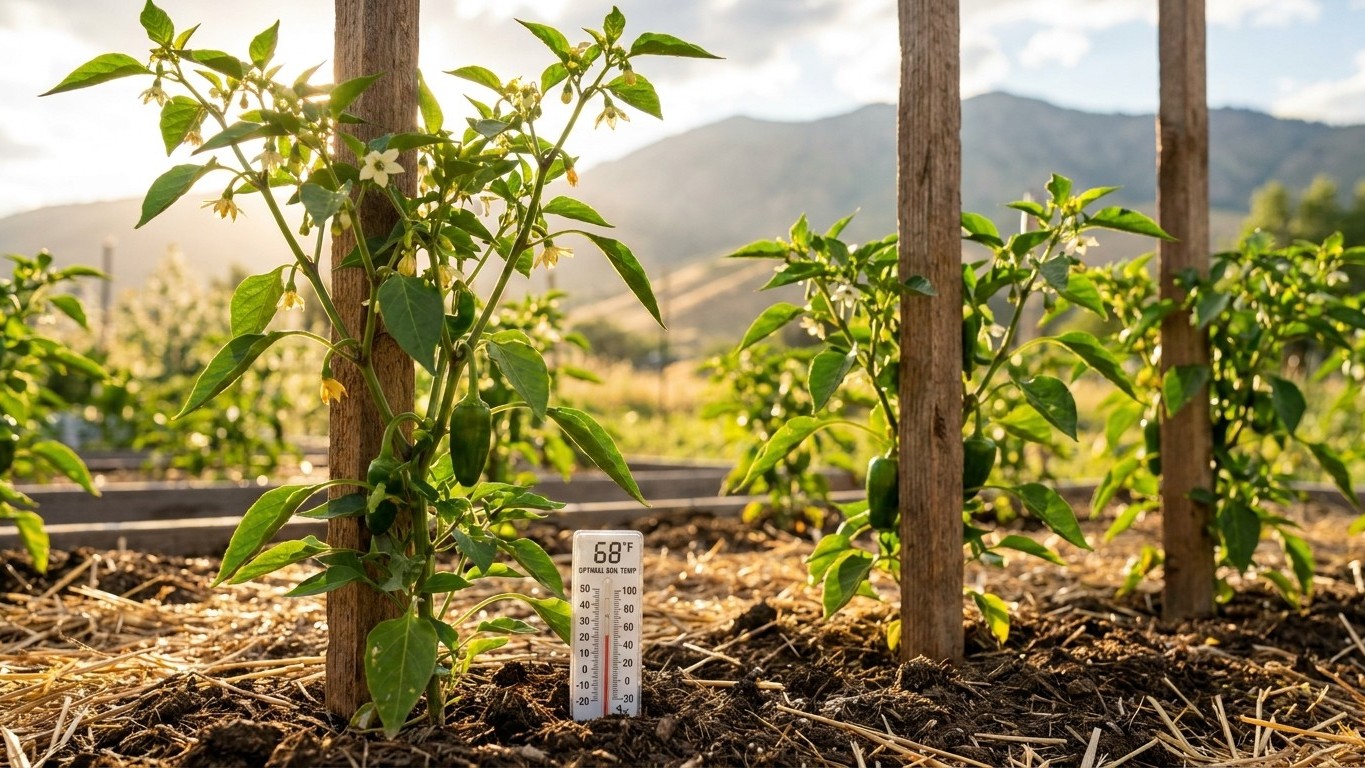
- Confirm soil temperature, not just the calendar date. Utah State University Extension’s guidance on peppers notes that transplants go into the ground when soil reaches 60 F, and only after frost risk has passed. Air can warm up well before soil does, especially in a wet spring, so a soil thermometer pushed a few inches down is a better guide than counting days on a calendar.
- Use whichever date comes later. If the frost-free date arrives but soil is still cool from a wet April, wait for the soil. If soil warms early but a late frost is still possible, wait for the frost date. The transplant date is the later of the two, not the average.
- Count back 8 to 10 weeks for indoor sowing. Utah State University Extension recommends starting pepper seed indoors 8 to 10 weeks before that transplant date. For a Philadelphia-area transplant target around early April, that puts indoor sowing in late January to early February. For a northern-tier or Alleghenies garden transplanting two to four weeks later, sowing shifts to mid-February through early March.
- Recheck the math against your own county. Because frost dates vary so much across Pennsylvania’s terrain, run this same subtraction using the local extension office’s frost data for your specific county rather than relying on a single statewide date.
The arithmetic is simple enough to redo every year: local frost-free date, adjusted for soil temperature, minus 8 to 10 weeks, equals sowing date. Nothing about it changes from one growing season to the next except the actual weather that arrives.
What goes wrong here
- Blossom drop from a hot spell. When daytime highs run above 90 F for several days in a row, which happens on average 24 days a year at the Philadelphia reference station, flowers abort and fruit set pauses. There’s no way to force fruiting during that stretch. The remedy is patience combined with steady watering and light afternoon shade cloth over the row, which takes the edge off leaf and flower temperature until the heat breaks and pollination resumes.
- Blossom drop from a cool night. The same symptom, dropped flowers and stalled fruiting, shows up when nights fall below 55 F, a threshold this climate can hit even in summer at higher elevations or in low-lying valleys. Because this site does not track night minimums, the only remedy is direct observation: log overnight lows at the actual garden site and expect a pause in fruit set whenever they dip under that mark, whether that’s a June cold snap or a September chill.
- Sunscald on exposed fruit. Pepper fruit that ripens on a plant with thin or storm-damaged foliage can develop pale, papery patches on the side facing full afternoon sun. Keeping the plant’s own leaf canopy intact, rather than pruning heavily, gives fruit natural shade and is the simplest fix. Where foliage has thinned from wind or disease, a loose shade cloth over the row during the hottest afternoons protects exposed fruit until leaf cover fills back in.
- Blossom-end rot on developing fruit. A sunken, leathery patch at the blossom end of the fruit points to inconsistent watering disrupting calcium uptake, not a soil calcium deficiency in most cases. Even, regular watering, especially during a dry stretch that coincides with one of those 90-degree-plus days, keeps the problem from starting in the first place.
Common questions
How many pepper varieties does Pennsylvania actually support in one season?
Utah State University Extension’s guidance on peppers names six varieties suited to home gardens, but does not publish a heat rating, a days-to-maturity figure, or a mature plant size for any of them. Rather than rely on a single number, gardeners should treat the 24-day heat-load figure and the 55 F to 90 F fruit-set range as the filter: any variety that stays within that range for its flowering period should finish a Pennsylvania season without trouble.
Does a longer indoor head start guarantee more ripe peppers?
Not on its own. The 8-to-10-week indoor window from Utah State University Extension sets up a healthy transplant, but fruit set from flowering to harvest still depends on hitting that 55 F to 90 F window during the plant’s flowering weeks. A plant started early but transplanted into a cold, wet April soil under 60 F often stalls and loses the head start entirely.
Why does my county’s frost date differ from the Philadelphia figure?
The March 29 to April 6 window comes from the Philadelphia reference station in NOAA NCEI’s Climate Normals, and Philadelphia sits in the mildest part of the state. Elevation and distance from the coast push frost risk later across the northern tier and the Alleghenies, by two to four weeks in most years, so a gardener there should check their own county’s data rather than use the Philadelphia dates directly.
Can I tell if my nights are too cool for fruit set without special equipment?
A basic min-max thermometer left outdoors overnight is enough. Since this site does not carry a night-minimum figure for Pennsylvania, and since guessing from latitude or from winter cold isn’t reliable, direct measurement at the garden site over a few nights during flowering is the only way to know whether the 55 F threshold is being met.