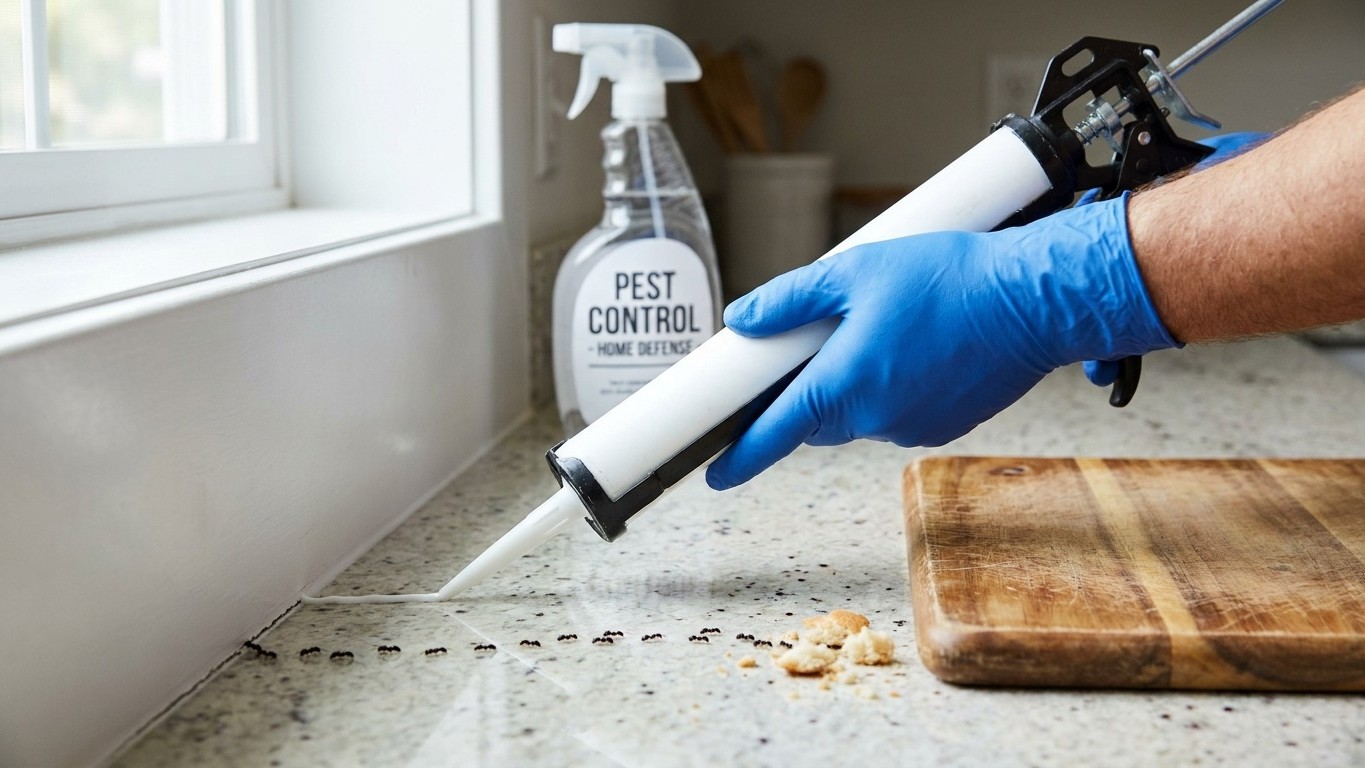

Getting rid of ants for good starts with a decision, not a spray: figure out why they’re inside (food, water, or shelter), remove that draw, seal the entry point, and only then decide whether a targeted bait is worth adding. Skip straight to a spray and the ants that survive scatter into new trails, while the conditions that brought them in the first place stay exactly as inviting as before.
The order that works

The U.S. Environmental Protection Agency lays out pest control as a sequence, not a single move. The agency calls its approach Integrated Pest Management, and describes it this way: “Integrated Pest Management (IPM) is an effective and environmentally sensitive approach to pest management that relies on a combination of common-sense practices.” That combination has a specific order, and the order is the point.
Step one is deciding whether action is even warranted. As the EPA puts it, “Before taking any pest control action, IPM first sets an action threshold, a point at which pest populations or environmental conditions indicate that pest control action must be taken.” A handful of scout ants on a kitchen counter isn’t automatically a crisis. A steady trail returning to the same spot every day is a different situation.
Step two is identification: “IPM programs work to monitor for pests and identify them accurately, so that appropriate control decisions can be made.” Ants vary a lot in behavior, so what stops one species does nothing for another. Step three, prevention, comes before any product touches a shelf: “As a first line of pest control, IPM programs work to manage the crop, lawn, or indoor space to prevent pests from becoming a threat.” Only after those three steps does control enter the picture, and even then the EPA specifies which controls come first: “Effective, less risky pest controls are chosen first, including highly targeted chemicals, such as pheromones to disrupt pest mating, or mechanical control, such as trapping or weeding.” The broad approach lands dead last. “Broadcast spraying of non-specific pesticides is a last resort.”
A household that opens its response with a can of spray has run that sequence backward. And the practical cost of skipping steps shows up fast: treatment applied to a house that still offers food scraps on the counter, a leaky pipe under the sink, and an unsealed gap behind the baseboard has to be repeated indefinitely, because none of the conditions that invited the ants in changed. The spray kills what it touches. It does nothing about the reason there was something to touch.
What works without a pesticide
Most of the ground the EPA’s doctrine covers before “control” involves no product at all, and for ants specifically, that ground does most of the real work.
Sealing entry points and cutting off supply
Exclusion means caulking gaps around windows, baseboards, and utility lines, the literal openings ants use to get inside. It stops new entry but does nothing for a colony already established in a wall void or under a slab. Sanitation, wiping counters, storing food in sealed containers, taking out trash promptly, removes the reward that keeps a trail active. It won’t dismantle a colony either, but it makes a house a much less useful destination, and colonies tend to abandon trails that stop paying off.
Moisture, traps, and manual removal
Moisture control, fixing a slow drip, running a bathroom fan, addressing damp crawl spaces, matters more than most homeowners assume, since several common household ant species are drawn to damp wood and moisture as much as to food. Bait traps fall under the EPA’s “mechanical control” category and can be effective precisely because they’re targeted rather than broadcast; the insects carry bait back to the colony instead of dying on contact. The tradeoff is patience: traps take days to weeks to show results, and moving or disturbing a trail before the bait reaches the colony can just scatter the problem into other rooms. Physical removal, vacuuming visible ants and wiping down the trail with soap and water to erase the scent path, buys short-term relief but doesn’t touch what’s happening behind the wall.
None of these methods requires a label, a registration, or a warning about children and pets, and the EPA’s own guidance backs the sequence: “Effective, less risky pest controls are chosen first.” The honest tradeoff is effort and time. Sealing gaps, fixing moisture, and staying consistent about food storage takes longer than pulling a trigger, and it doesn’t produce a dead ant to point to as proof it worked. For a lot of households, though, it’s also the difference between solving the problem once and repeating the same fight every few weeks.
When a product is warranted
Exclusion and sanitation solve most ant problems, but not all of them. A colony that’s already large, deeply nested in a wall void, or feeding on multiple trails that keep reappearing despite a cleaned-up kitchen is a situation where a targeted product, chosen and applied according to its label, becomes a reasonable next step rather than a shortcut.
What that product should be isn’t something a general article can answer responsibly. Products registered for ant control differ by state, by formulation, and by which species they’re labeled for, and those registrations change over time. The label on the package a reader is holding is the only one that governs how it can legally and safely be used, not a recommendation written months or years earlier for a general audience. That’s not a hedge, it’s the actual legal standard: the label is the law.
It’s also worth taking seriously why the EPA frames control as a last step rather than a first one. Pesticides are designed to be toxic to the pest they target, and that toxicity doesn’t stop being real when the product is inside a home. The EPA identifies certain groups as especially vulnerable to pesticide exposure: children, older adults, and people with compromised immune systems. That’s a direct reason to read a label fully before use, follow placement instructions exactly (many baits are designed to be inaccessible to curious hands and pets while still reaching the ants), and store any unused product exactly as directed rather than transferring it to another container.
Anyone unsure whether a particular product is appropriate for their situation, or has questions about safe use, storage, or disposal, has a direct line to ask rather than guess: the National Pesticide Information Center, reachable at 1-800-858-7378, exists specifically to answer public questions about pesticide products. That’s a better source than a general article or an unverified opinion, because the answer can be matched to the actual product and the actual situation.
When to stop and call someone
There’s a point where continuing to treat an ant problem alone stops being resourceful and starts being a waste of time and money, and it’s worth naming plainly rather than hinting at.
Repeated failure is the clearest signal. If exclusion, sanitation, moisture fixes, and a properly applied targeted bait haven’t reduced activity after a couple of treatment cycles, the colony is likely bigger, better hidden, or more established than a household product is built to handle. At that point, a licensed pest control professional has access to identification tools, inspection methods, and formulations that aren’t available over the counter, and can find nest locations a homeowner has no way to reach.
Structural damage is a second, harder line. Certain ant species hollow out damp or damaged wood to nest, and while that’s a different destructive pattern than termite damage, the presence of soft, crumbling, or hollow-sounding wood near an ant trail is a sign the problem has moved past a cosmetic nuisance into something that needs a professional inspection, not another bait station.
A health question is the third line, and it’s one where guessing is the wrong move. If someone in the household has had a reaction to a bite or sting, or if there’s any uncertainty about a product’s safety around a specific medical condition, the household should not try to answer that question with a home remedy or a forum post. The National Pesticide Information Center (1-800-858-7378) can address product-specific safety questions, and a healthcare provider is the right resource for a physical reaction. Those two calls cost nothing and remove the guesswork that home treatment can’t responsibly replace.
Common questions
How long does it take to get rid of ants without a pesticide?
It depends on how established the colony is, but sealing entry points and removing food and moisture sources typically shows a noticeable drop in activity within one to two weeks. A colony that’s already large may take longer to fully disperse, since ants abandon a food source gradually once it stops paying off.
Do home remedies like vinegar or cinnamon actually work?
They can disrupt a visible trail temporarily by masking the scent path ants use to navigate, which is a form of physical removal. They don’t reach or affect a colony’s nest, so trails often reappear once the scent fades unless the underlying food, water, or entry issue is also addressed.
Is it normal to see a few ants even after treatment?
A small number of scout ants can appear for a short period after treatment as a colony searches for new resources; this doesn’t necessarily mean the treatment failed. A returning, steady trail to the same spot after a week or two is the signal that the approach needs to be reassessed.
Are ants dangerous to have in the house?
Most common household ant species are a nuisance rather than a health threat. Any concern about a bite, sting reaction, or product safety around a specific health condition should go to a healthcare provider or the National Pesticide Information Center (1-800-858-7378) rather than being answered by general guidance.