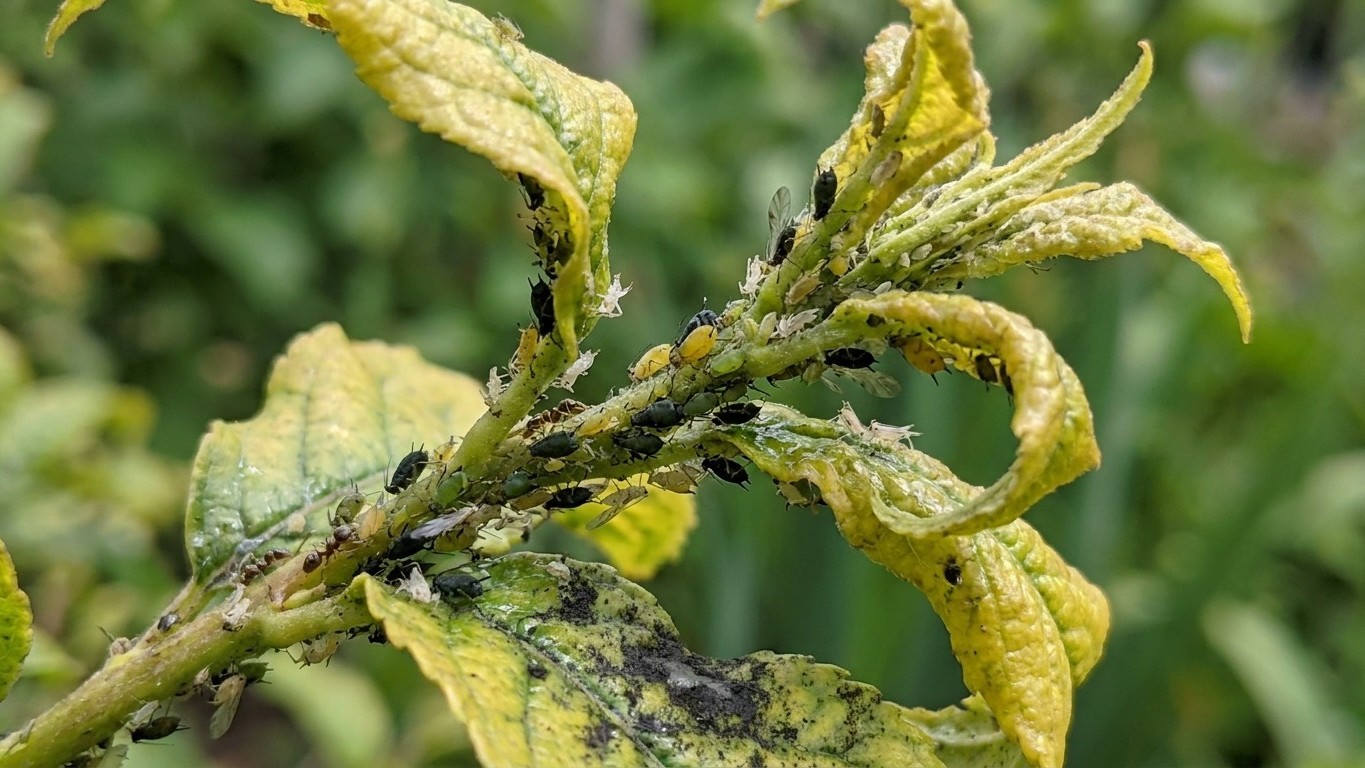

Curled, yellowing leaves with a sticky film on top and a cluster of tiny soft-bodied insects clinging to new growth is the classic aphid signature. Add a black, sooty coating on the leaves below that cluster and ants marching up and down the stem, and the identification is confirmed. The insects themselves are pear-shaped, rarely bigger than a pinhead, and come in green, black, yellow, or gray depending on the species and the plant they’re feeding on.
What the damage looks like

From a few feet away, an infested plant just looks tired. New shoots droop instead of standing upright, leaves cup downward or twist along the midrib, and the whole top of the plant can take on a faint shine, as if someone splashed it with sugar water. That shine is honeydew, the sugary waste aphids excrete after feeding, and it’s often the first thing a gardener notices before they ever spot the insect responsible.
Move closer and the picture sharpens. Growing tips, flower buds, and the undersides of young leaves are packed with small, soft-bodied insects, often dozens on a single shoot. Some are winged, most are not. Scattered among the live insects you’ll usually find pale, dry, empty skins, the cast-off exoskeletons left behind after each molt. That detail matters: it’s physical proof of a colony that’s been established for a while, not a one-day visitor.
The reason numbers explode so fast comes down to reproduction. Most aphid colonies through spring and summer are made up entirely of females that reproduce without mating, giving live birth to nymphs that are already feeding within hours. A single female can produce several offspring a day, and those offspring are capable of reproducing themselves within about a week. That’s how a handful of insects on a Tuesday becomes a visible infestation covering an entire stem tip by the following weekend.
On the plant part itself
Look at individual leaves and the damage tells its own story. Feeding punctures drain fluid unevenly, so the leaf grows lopsided, puckered, or rolled tightly enough to hide insects inside the fold. Flower buds attacked early may never open properly, staying small and distorted. On woody stems and trunks, heavy feeding near a graft union or a pruning wound can leave a sticky ring that attracts wasps and flies long after the aphids have moved on. Fruit close to a heavy colony sometimes develops a sooty, black surface film, the same fungus that grows on any honeydew, whether from aphids or another sap-feeding insect. None of this kills a mature plant outright, but it stunts growth, reduces yield, and on ornamentals it ruins the look gardeners are growing them for in the first place.
What it is confused with
Sticky leaves and stunted new growth aren’t unique to aphids, and mixing them up with a look-alike sends a lot of gardeners toward a treatment that does nothing. The most common wrong diagnosis is blaming the sooty black film on a fungal disease and reaching for a fungicide. The fungus is real, but it’s just growing on honeydew left by a sap-feeding insect; spraying fungicide leaves the actual pest, and the honeydew, untouched.
| Could be | How to tell it apart | Why it matters |
|---|---|---|
| Whiteflies | Tiny white, moth-like insects that scatter in a cloud when the plant is disturbed; aphids stay put | Different feeding pattern and different natural enemies to protect |
| Scale insects | Flat, immobile bumps fused to stems or leaf undersides, no visible legs once settled | Scale needs a different control window tied to its crawler stage |
| Mealybugs | Covered in a white, cottony wax, clustered in leaf axils and crevices rather than open shoots | The waxy coating blocks contact treatments aphids don’t have |
| Spider mites | Fine stippling and webbing, no honeydew or sooty mold, visible with a hand lens as specks that scurry | Mites are arachnids, not insects, and respond to a different set of controls |
| Psyllids | Jump readily when disturbed, produce waxy tubules or granular honeydew rather than a wet sheen | Some psyllids carry plant diseases aphids don’t transmit |
The honeydew and sooty mold combination is shared by whiteflies, some scales, and mealybugs too, so that clue alone doesn’t clinch it. What separates aphids is the shape and behavior: soft, pear-shaped bodies clustered densely on actively growing tips, moving slowly rather than jumping or flying off in a swarm. A hand lens turns a guess into a confirmed identification in under a minute.
Where to look to confirm
Confirming aphids means checking the plant in the right order, not just glancing at the first leaf within reach. Start at the growing tips, the newest, softest leaves at the end of each branch or stem. That’s where the highest concentrations of feeding insects gather, because young tissue is easiest to pierce and richest in sap. Flip a few of those young leaves over and check the underside; aphids often colonize the shaded side of a leaf before they’re visible from above.
Work down to the joints where a leaf stalk meets the stem, and to unopened flower buds. Both are tight, sheltered spots that aphids favor for the same reason they favor new growth: soft tissue and some cover from weather and predators. On roses, this is often the crease right below an unopened bud. On vegetable seedlings, it’s the base of the topmost leaves, where the stem is still soft.
Early morning, before the day heats up and before wind or watering disturbs the plant, tends to be the easiest time to spot a colony, since aphids are less active and less likely to have been knocked loose. Look also for the secondary evidence: ants traveling up and down the stem to collect honeydew, the pale cast skins mentioned earlier, and any winged aphids scattered among the wingless majority, which often signal the colony is crowded enough that some individuals are dispersing to found new colonies elsewhere.
What you should not do is compare what you find against a fixed number to decide whether action is warranted. Action levels, and the point at which a colony justifies intervention, are set locally and change by crop, season, and region. Your state’s cooperative extension service is the authority for that number, not a generic online guide.
What to do once you are sure
Once the identification is solid, timing becomes the next question, and that depends on which stage of the aphid’s life cycle you’re looking at right now: eggs overwintering on a host, the fast-multiplying wingless females of the growing season, or the winged individuals that disperse in fall. The site’s dedicated life-cycle page walks through each stage and when it typically occurs, so treatment lines up with the biology instead of guessing.
Biological control does a lot of the work before any spray is even considered. Lady beetles (both adults and their spiky, alligator-shaped larvae), green lacewing larvae, parasitic wasps in the genus Aphidius, and the larvae of syrphid flies (also called hover flies) are the natural enemies that actually move the needle on aphid numbers in most home gardens and landscapes. Encouraging them mostly means restraint: avoiding broad-spectrum insecticides that kill the predators along with the pest, and planting a few flowering species nearby that give adult lacewings and syrphid flies the nectar they need to stay in the area. A garden that supports these predators often sees aphid colonies collapse on their own within a couple of weeks of a population spike.
For the specific tactics that work once natural enemies aren’t keeping pace, the control page on this site covers the options in detail, from strong water sprays that dislodge colonies to targeted treatments and when each makes sense. And because emergence timing, degree-day thresholds, and locally recommended products vary by state, the page for your own territory names the cooperative extension service to contact for guidance specific to where you garden, rather than a one-size-fits-all number.
Common questions
Can aphid damage kill an established shrub or tree?
Rarely on its own. Mature woody plants usually tolerate aphid feeding without lasting harm, though repeated heavy infestations over several seasons can weaken growth and make the plant more vulnerable to other stresses. Young plants and seedlings are more at risk because they have less reserve to draw on.
Does sticky honeydew mean the plant has a disease?
No. Honeydew is insect waste, not a plant pathogen. The black sooty mold that sometimes grows on it is a separate fungus feeding on the sugary residue, and it typically wipes or washes off once the insects producing the honeydew are gone.
Why do I see winged aphids mixed in with wingless ones?
Winged individuals usually appear when a colony gets crowded or when the host plant starts declining. They’re the dispersal stage, aphids capable of flying to a new plant to start another colony, which is one reason a small infestation can suddenly show up on a plant several feet away.
Are all the small insects on my plant the same aphid species?
Not necessarily. Different aphid species specialize in different host plants, and it’s possible for more than one species to turn up in the same garden at the same time. The feeding pattern and general appearance described above apply across the group, even if the exact species varies from plant to plant.