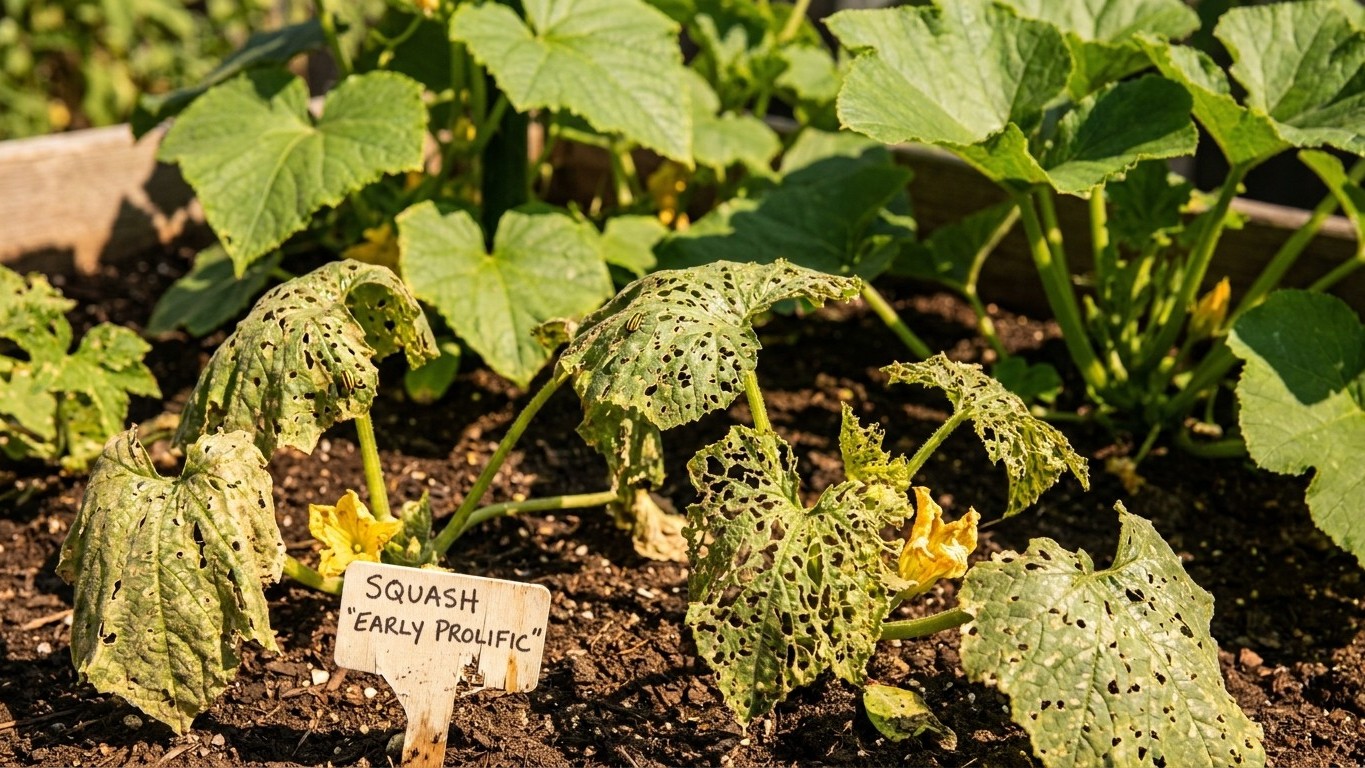

Striped cucumber beetle damage on cucumbers, melons and squash rarely amounts to much chewing on its own: a handful of shot-holes in the leaves, a few scars on the rind, some nibbling at the blossoms. The real signal is what happens next. Individual leaves wilt during the heat of the day and don’t recover by morning, then an entire vine collapses within days. That domino-effect wilting, not the leaf damage, is the surest sign you’re dealing with the striped cucumber beetle (Acalymma vittatum) and the bacterial disease it carries.
What the damage looks like
Stand back from the bed first. A healthy squash or melon patch has uniform, glossy leaves that stay upright through the afternoon sun. A patch under attack shows patches of dullness: one or two vines drooping while their neighbors look fine. That patchiness matters. Drought stress and nutrient problems tend to hit the whole planting evenly. This does not.
Move closer and the beetle’s own feeding becomes visible, though it’s easy to underestimate. Leaves show small, ragged holes, sometimes clustered near the veins, occasionally skeletonized down to the lace of the leaf’s structure on younger plants. Stems near the soil line can carry shallow scarring where beetles have grazed the surface tissue. Blossoms often show chewed petals and damaged pollen structures, which can reduce fruit set even before any disease shows up.
What happens on the plant itself
The fruit rind sometimes carries feeding scars, thin brown grooves or pockmarks where beetles fed directly on the surface. These marks are cosmetic on their own; they don’t rot the fruit by themselves. Seedlings are a different story. On young cucurbits, especially right after emergence, beetles can strip cotyledons and first true leaves fast enough to stunt or kill the seedling outright, well before any wilt disease has a chance to develop.
The detail that separates this pest from ordinary leaf-chewers is the wilt itself. A vine infected through beetle feeding wounds will show one leaf or one runner wilting first, looking fine at dawn and limp by mid-afternoon. Cut the stem near the wilted section and you may notice a sticky, stringy ooze, a sign of the bacteria clogging the plant’s water-conducting tissue. Left alone, the wilting spreads down the vine until the whole plant collapses, often within one to two weeks of the first wilted leaf. This progression, small feeding marks followed by a wilt that never reverses, is what should point you toward this specific pest rather than a general leaf-eating insect.
What it is confused with
Misidentifying this damage sends a lot of gardeners toward a fix that does nothing. The most common mix-up is with plain water stress: a wilting vine on a hot afternoon looks exactly like a plant that needs a drink, so people water more. If the cause is bacterial wilt spread by beetle feeding, extra water doesn’t slow the collapse at all, and soggy soil around already-stressed roots can invite rot on top of the original problem.
Two other insects produce damage that overlaps enough to cause confusion, and one plant disease mimics the symptom without any beetle involved at all.
| Could be confused with | How to tell them apart | Why it matters |
|---|---|---|
| Spotted cucumber beetle (Diabrotica undecimpunctata) | Twelve black spots on a yellow-green wing cover instead of three lengthwise black stripes; body shape is slightly broader | Same family of risk, but this species also attacks corn and beans as larvae, which changes rotation and monitoring decisions on a mixed vegetable plot |
| Squash bug (Anasa tristis) | Flat, shield-shaped, brownish-gray body; damage shows as speckled yellowing on leaves rather than shot-holes, and no consistent bacterial wilt link | Squash bug feeding calls for different scouting timing and egg-mass checks on leaf undersides, not the seedling-stage vigilance striped cucumber beetle needs |
| Squash vine borer (Melittia cucurbitae) | Wilting looks similar, but the base of the stem shows a small entry hole with sawdust-like frass, not a clean cut with sticky sap | Borer damage is internal and mechanical; treating for beetles alone leaves the actual borer larva undisturbed inside the stem |
| Plain drought or heat stress | Whole planting wilts evenly and recovers overnight once watered; no scarring, no stringy sap when a stem is cut | Watering more won’t reverse a bacterial wilt that’s already established, and it does nothing to stop the beetles still feeding on unaffected plants |
The frustrating part is that these problems can overlap on the same plant in the same week. A vine can carry both squash bug feeding and beetle scarring, which is why identification has to rest on the pattern (patchy wilting plus a sticky cut stem) rather than on a single leaf hole.
Where to look to confirm
Confirmation happens by narrowing down where and when you check, not by counting how many beetles you see. Numbers that matter for action decisions are set state by state through university extension programs, and they shift with the season, so this section only covers where to look, not how many is too many.
At the seedling stage
Right after cucurbit seeds germinate or transplants go in the ground, check the cotyledons and the first true leaves early in the morning while temperatures are still cool. Striped cucumber beetles are more sluggish in cool air and tend to sit still on the leaf surface or hide near the soil line rather than fly off, which makes them easier to spot and count accurately.
Inside open blossoms
Once plants flower, adults often retreat into the blossom itself during the hottest part of the day, tucked down among the petals where they’re shaded and hard to see from outside. Gently pulling back the petals of a few open flowers on different plants across the bed gives a more honest picture than scanning leaves alone.
At the base of the stem
When a leaf or runner is already wilting, check the stem near the soil line. Cut through a wilted section and press the two cut ends together, then slowly pull them apart. A thin, sticky string of ooze connecting the two pieces is the classic sign of the bacterial wilt this beetle transmits, and it’s a more reliable confirmation than the beetles themselves, since adults move around the garden and may not be on the exact plant you’re inspecting.
Larvae live in the soil around cucurbit roots and are rarely seen without digging, so most home confirmation relies on adult sightings at the seedling and blossom stages combined with the stem test on wilting vines. For anything beyond that, a local extension office can help identify life stage and timing specific to your area.
What to do once you are sure
Once the pattern checks out, patchy feeding plus a stringy, wilting vine, the next decisions depend on timing and on what actually suppresses this pest without wiping out the insects working in your favor.
Biological control does play a real role here, more than most gardeners expect. Ground beetles and other soil-dwelling predators feed on cucumber beetle eggs and larvae before they ever reach the leaf surface. A parasitic tachinid fly, Celatoria diabroticae, attacks adult beetles directly, and naturally occurring soil organisms can suppress larvae underground as well. None of that protection survives a broad-spectrum insecticide applied without regard to timing. Keeping some undisturbed ground cover or mulch near the bed, and avoiding blanket sprays when beetles first appear, gives these natural enemies a chance to keep populations down on their own.
Timing the rest of your response matters more than the response itself. Adult emergence, egg-laying windows and the periods when young plants are most vulnerable all shift by region and by year, which is exactly the kind of detail covered on this site’s life-cycle page for this pest. Once you know where you are in that cycle, the control page lays out which physical barriers, cultural practices and treatment options actually match that stage, rather than applying a generic response at the wrong moment.
Because emergence dates, degree-day thresholds and locally approved products vary by state, check this site’s page for your own territory, where your state’s extension service is named directly. That’s the source built to tell you when beetles are active in your specific climate and what action level applies where you garden, information no general damage guide can responsibly provide.
Common questions
Does striped cucumber beetle damage kill plants directly?
Rarely from feeding alone. The scarring and holes it causes are usually cosmetic. The real threat is the bacterial wilt disease it can transmit while feeding, which is what actually kills vines once it takes hold in the plant’s water-conducting tissue.
Can one beetle spread bacterial wilt to an entire garden?
A single beetle can transmit the pathogen to the plant it’s feeding on, and infected plants don’t recover once symptoms show. Whether it spreads further through the bed depends on how many beetles are moving between plants, which is a question best answered through regular scouting rather than assumption.
Are all cucurbits equally at risk?
No. Cucumbers and muskmelons tend to show stronger reactions to both feeding and the wilt disease than winter squash or pumpkins, though none of these crops are immune, and damage can still show up on any cucurbit planted nearby.
If I see wilting but no sticky sap, is it still this beetle?
Not necessarily. Absence of the stringy ooze when you cut a wilted stem points more toward drought stress, root damage, or another pest like squash vine borer. Recheck the base of the stem for an entry hole and frass before ruling the beetle back in or out.