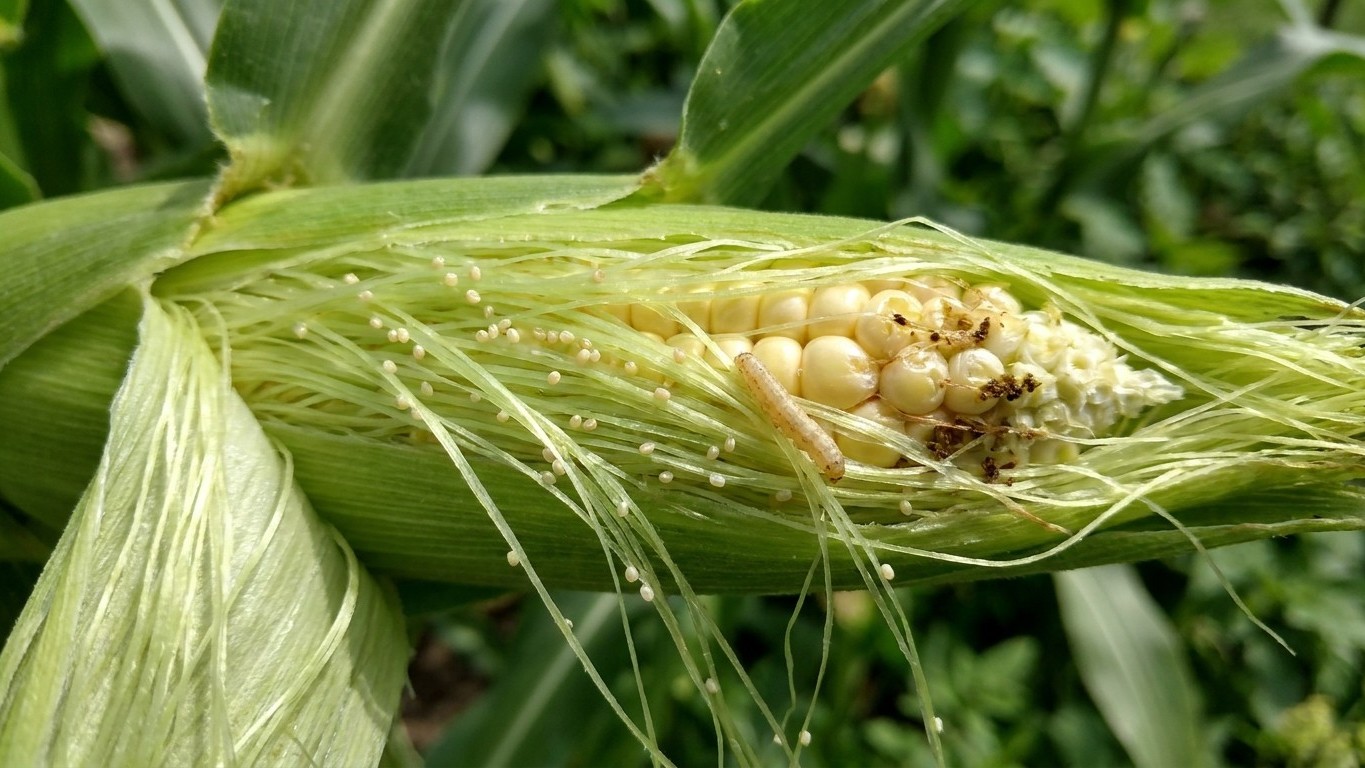

Corn earworm damage hides in plain sight: the kernels at the tip of the ear look fine from outside, but pull back the husk and you’ll find chewed rows, frass, and sometimes the culprit itself still feeding. The insect responsible, Helicoverpa zea, moves through four stages between spring and fall, but only one of them ever touches your corn. Knowing which stage does what, and when new moths are likely to arrive, is the difference between catching an infestation early and finding out at harvest.
The stages, in order

A female moth lays her eggs one at a time, almost always on fresh green corn silk while it’s still moist and receptive. The egg is tiny, pale, and easy to miss unless you’re looking directly at the silk mass with a hand lens. Within a short window it hatches, and the newly emerged larva does the one thing that matters to a gardener: it crawls straight down the silk channel toward the tip of the ear.
That larva is the stage you actually see, and the only one that causes damage. It feeds on developing kernels near the ear tip, molting through several growth stages as it grows. One detail surprises a lot of gardeners: corn earworm larvae are cannibalistic. When two hatch on the same ear, they often fight, and usually only one survives to full size inside a given ear. That’s part of why damage tends to be concentrated at the tip rather than spread evenly through the cob.
What you never see
Once the larva finishes feeding, it drops to the soil and pupates a few inches underground, out of sight for the rest of that generation’s development. The adult that eventually emerges is a night-flying moth, tan to olive with darker wing markings, and it doesn’t feed on corn at all. It sips nectar, mates, and seeks out fresh silk on another plant to start the cycle again. Between the underground pupa and the moth that mostly flies after dark, two of the four stages are essentially invisible to a home gardener. The larva inside the husk is what gives the pest away, and by the time you find one, the egg and the flight that produced it are already history.
When it appears, and why that varies
Corn earworm doesn’t operate on a calendar. Every stage, from egg to larva to pupa to moth, develops at a speed set by accumulated warmth, not by the date on the wall. Warmer days push development faster; cool stretches slow it down or pause it. That’s why the same insect can be actively laying eggs on silk in one region while it’s barely stirring a few hundred miles away.
Latitude and elevation both play into this. Corn planted early in a warm southern valley silks weeks before corn planted at the same calendar date farther north or at higher elevation, and moth activity tracks the crop’s growth stage more than the season’s start date. Local weather in a given year matters too: a hot, dry spring accelerates everything, while a cool, wet one delays it.
Extension services in each state track this with degree-day models and moth trap counts specific to their region, because a threshold that triggers action in one state can be meaningless in another. There’s no single national date, and any number that claims to be one should be treated with suspicion. The reliable move is to check the corn earworm page for your own territory on this site, which links to your state’s extension service and its current trap counts and degree-day accumulation, rather than relying on a fixed date that may be off by weeks in either direction.
One generation or several
Corn earworm is not a one-and-done pest. It produces multiple overlapping generations in a single growing season, generally more of them the farther south you garden, because a longer warm season allows extra generations to squeeze in before frost. In the Deep South, several generations can cycle through before the season ends; farther north, fewer generations fit into the shorter warm window, but the pest still isn’t limited to a single flight.
That matters for how long you need to keep watching. A single-generation pest gives you one narrow window to manage and then it’s over for the year. Corn earworm keeps sending new moths to lay eggs on fresh silk as long as silking corn is available, which means scouting has to continue through the entire silking period of every planting, not just once early on. Successive plantings of sweet corn, a common strategy for a longer harvest window, can each face a fresh wave of egg-laying as they come into silk.
Natural enemies worth protecting
Because the pest cycles through repeated generations, biological control has more time to compound in your favor than it would against a single-flight pest. Tiny parasitic wasps in the genus Trichogramma attack corn earworm eggs directly, while minute pirate bugs and lacewing larvae feed on eggs and newly hatched larvae before they reach the silk channel. Other parasitic wasps target the larval stage itself. None of this works if broad-spectrum insecticides are applied on a schedule regardless of need, since those products knock out the predators and parasitoids along with the pest. Scouting before spraying, and reserving treatment for when egg or larval counts actually justify it, is what keeps these natural enemies working generation after generation.
Where it spends the winter
Overwintering is what makes next year’s pressure predictable, and for corn earworm the answer depends heavily on where you garden. The insect overwinters as a pupa in the soil, but that pupa can only survive where winters stay mild enough. In regions with a hard, sustained freeze, overwintering pupae are generally killed off, meaning the local population doesn’t carry through winter on-site at all.
| Region type | Winter survival of pupae | What happens the following spring |
|---|---|---|
| Mild-winter areas (Gulf Coast and similar southern zones) | Pupae in soil can survive winter | Local moths emerge from overwintering pupae as temperatures rise |
| Cold-winter areas (much of the Midwest and North) | Pupae are typically killed by hard freezes | Population is reestablished by adult moths migrating in from southern breeding areas |
That split explains two very different management priorities. In milder climates, fall cleanup, especially turning under crop debris and disturbing the soil where larvae dropped to pupate, directly reduces the number of moths that emerge on-site the following spring. Farther north, the same fall tillage does far less for this particular pest, because next year’s moths aren’t coming from your garden soil at all. They’re arriving on wind and weather systems from populations that survived farther south, which is exactly why northern gardeners lean more heavily on scouting and trap counts as the season progresses rather than treating autumn soil work as their main defense against this species.
Common questions
What does corn earworm damage actually look like on the ear?
Chewed, hollowed kernels concentrated at the tip of the ear, often mixed with dark, crumbly frass, and sometimes a single larva still feeding when you peel back the husk. The outside of the ear and the husk itself usually show no obvious sign, which is why damage is often discovered only at harvest.
Is corn earworm the same insect as tomato fruitworm or cotton bollworm?
Yes. Helicoverpa zea goes by different common names depending on which crop it’s attacking at the time, but it’s the same species whether it’s found in corn silk, a tomato, or a cotton boll.
How do I know when to start scouting my corn?
Start watching as soon as silks begin to emerge, since that’s what draws egg-laying moths in. Because timing shifts with regional warmth rather than the calendar, check your state extension service’s current trap counts and degree-day updates for the specific window relevant to your area this season.
Can corn earworm survive winter where I live?
It depends on your winter, not on the insect changing its habits. Where freezes are mild or absent, overwintering pupae can survive in the soil. Where winters are harder, local pupae are generally killed off, and the population that shows up each summer has migrated in from milder regions farther south.