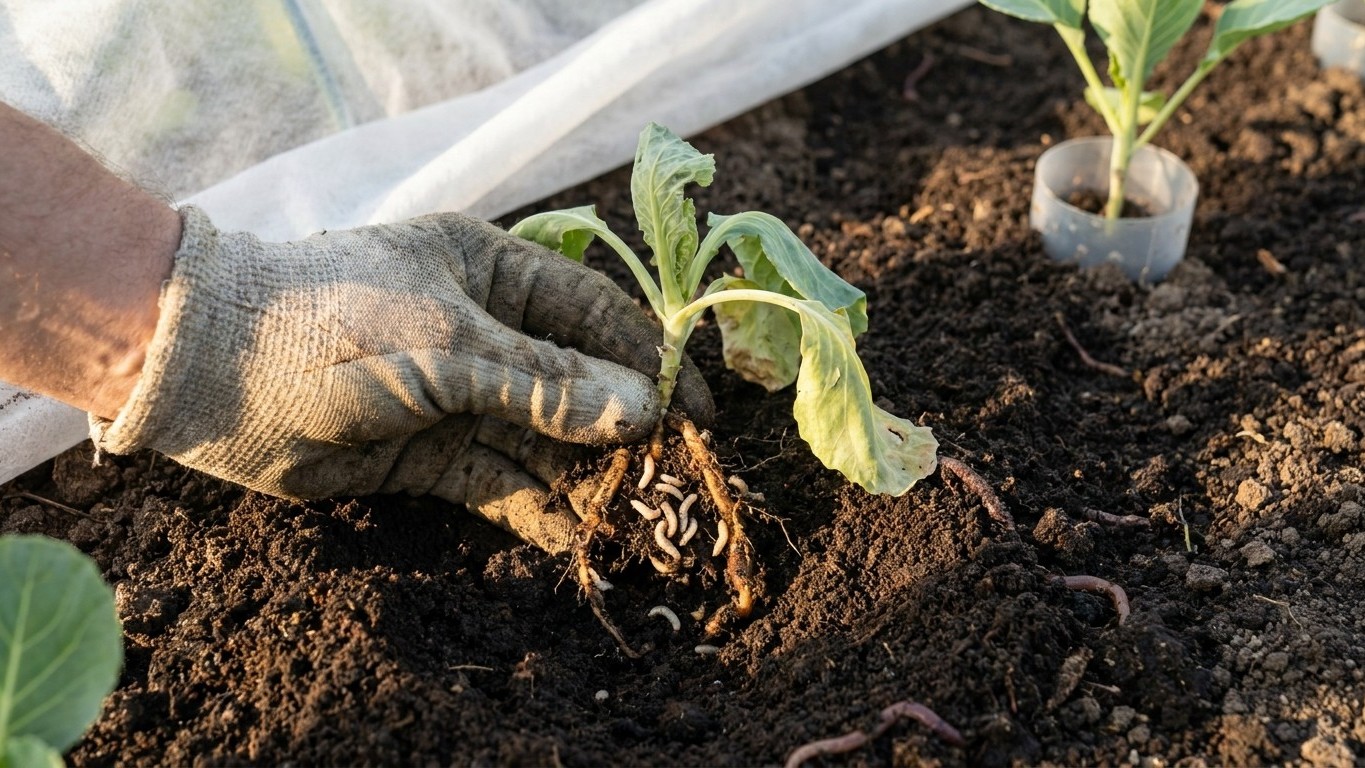

Cabbage maggot control works best as a layered system, not a single fix: row covers timed to adult fly emergence, physical collars at the stem base, crop rotation, and encouraging the predators already living in your soil. Pesticides have a role, but only as a targeted rescue when a state extension service confirms the pest and the stage. Spraying foliage after wilting shows up is almost always too late, because the damage is already done underground.
Timing beats product

Here’s what most advice skips: with cabbage maggot (Delia radicum), the calendar matters more than what’s in the bottle. Adult flies, which look like small gray houseflies, emerge from pupae that overwintered in the soil. They lay eggs right at the base of young brassica stems, sometimes in the cracks of the soil surface. Eggs hatch into larvae that tunnel straight down into the roots. By the time a plant wilts in the afternoon sun, or seedlings simply keel over for no visible reason, the maggots have already been feeding underground for days.
That’s the trap gardeners fall into. They see a wilted seedling, assume a foliage pest, and reach for a spray aimed at leaves. But the insect doing the damage is never on the leaves. It lives in root tissue and in the soil around the crown, invisible from above until the plant is already compromised. An application made after wilting appears doesn’t reach the larvae and doesn’t stop the ones still developing in nearby roots.
The window that actually matters is the few days around adult emergence and egg-laying, before larvae have bored into the root. Miss that window and no product, organic or synthetic, changes the outcome for that generation. This is also why guessing at a date from memory or from a gardening forum in another state doesn’t work. Emergence timing shifts with soil temperature and degree-day accumulation, and it differs by region and by season. Before doing anything else, check the cabbage maggot life cycle page on this site, which lays out the stages in order and explains how the generations overlap through a growing season. Understanding that sequence is what makes every method below actually land at the right moment instead of a week too late.
One more mechanical detail worth knowing: brassicas can produce new roots and partially outgrow light feeding if the growing point survives and soil moisture is adequate. That’s why some plants recover after a mild attack while others near them collapse entirely. Root health at the time of egg-laying, not just the presence of maggots, decides which plants make it.
What works without a product
Several methods control this pest without any label to read, and they’re worth trying first, precisely because timing is on their side rather than against them.
- Row covers block adult flies from reaching the stem base to lay eggs. They only work if installed before adults arrive and if the edges are sealed into the soil, not just draped over hoops. A gap of an inch is enough for a fly to get under.
- Collars made from cardboard, tar paper, or foam, fitted snugly around the stem at soil level, block egg-laying at the one spot the fly targets. They need to go on at transplanting, not after.
- Trap crops, typically a fast-growing radish planted slightly ahead of the main crop, can draw egg-laying flies away from the brassicas you actually want to harvest. This works best when the trap crop is up and attractive before the main planting emerges.
- Adjusted planting dates that avoid the peak emergence window shift the whole crop out of sync with the fly’s schedule. It’s the least labor-intensive option, but it depends entirely on knowing local emergence timing rather than a fixed calendar date.
- Sanitation, meaning pulling and destroying cull roots and crop debris right after harvest, removes the overwintering sites pupae rely on. This one is genuinely tedious, and it’s also the method most gardeners skip, which is a large part of why the pest returns every year in the same bed.
None of these require a purchase beyond fabric or cardboard, but they do require showing up at the right moment. That’s the trade being made: labor and attention instead of a product label.
The allies you already have
Two natural enemies do real, measurable work against this species, and most gardeners have never heard of either one. The rove beetle Aleochara bilineata lays its own eggs near maggot-infested roots, and its larvae seek out and parasitize the pest’s puparia in the soil, killing the next generation before it ever becomes a fly. A parasitic wasp, Trybliographa rapae, does something similar, laying eggs inside maggot larvae so the wasp offspring develops at the pest’s expense. Generalist ground beetles add another layer, preying on eggs and small larvae near the soil surface whenever they find them.
None of this is theoretical garden folklore. It’s documented biological control that happens in ordinary garden soil without any purchase or release program, provided the soil isn’t sterilized by broad-spectrum insecticide use.
That’s the part worth saying plainly: a broad-spectrum spray aimed at cabbage maggot, or at any other pest in the same bed, kills rove beetles, ground beetles, and parasitic wasps right along with the target. Those insects don’t reproduce as fast as flies do. So the predator population that would have suppressed next month’s generation is gone, while the pest’s own reproductive rate lets it rebound faster. That’s how one spray decision turns a manageable pest into a worse problem within a few weeks, in the same bed, the same season.
Practical preservation is simple: avoid soil-drenching insecticides as a first response, keep some undisturbed soil and mulch nearby where ground beetles can shelter, and reserve any targeted treatment for confirmed, threshold-level infestations rather than as routine prevention.
When a product is the answer
There’s an honest case for treatment, and it’s narrower than most product labels imply. A product can matter when egg-laying has been confirmed, or is expected within days based on local emergence data, and the goal is to protect the stem base and root zone before larvae tunnel in. Once maggots are established inside root tissue, no soil treatment reliably reaches them, which loops back to the timing problem covered earlier on this page.
What actually gets approved for that narrow window differs by state, and it changes from one season to the next as products are reviewed, restricted, or replaced. A material permitted in one state’s vegetable production guide may not be labeled for home garden use in another, and application timing tied to degree-days is calculated differently depending on regional climate data. That’s not a small technicality. Using an unapproved product, or using an approved one at the wrong stage, wastes the application and can still knock back the beneficial insects described above for no benefit.
This is why the right next step isn’t a product name, it’s a phone call or a website visit to a state land-grant university extension service. They publish current, state-specific guidance on what’s labeled, what the action threshold is for that region, and when the application window actually falls based on that year’s weather. This site carries a dedicated page for finding your territory’s extension resource, with the direct link to the office that covers your county.
Treat any product decision as the last layer, not the first: covers and collars in place, cleanup done, beneficial insects left undisturbed, and a targeted material used only if extension guidance confirms the pest, the stage, and the threshold for your specific location.
Common questions
How do I know it’s cabbage maggot and not another problem?
Look at the root, not the leaves. Pull a wilted seedling and check for tunneling and slimy, brown feeding scars near the crown and upper root. Cutworm damage severs the stem at soil level instead, and clubroot causes swollen, distorted roots rather than tunnels. If the roots show narrow channels and small white larvae, that points to Delia radicum.
Can I still eat cabbage or roots with maggot damage?
Lightly affected roots can often be trimmed and used if the damage is superficial and the plant otherwise looks healthy, but heavily tunneled roots with rot or a strong off smell should be discarded. When in doubt, cut the root in half and check how far the damage extends before deciding.
Do row covers actually stop this pest, or just slow it down?
Properly sealed covers, installed before adult flies emerge and buried at the edges, can prevent egg-laying entirely because the fly simply can’t reach the stem. Gaps at the soil line are the usual failure point, so check the seal after rain or wind rather than assuming it’s still intact.
How long can cabbage maggot pupae survive in the soil between crops?
Pupae overwinter in the soil and that’s exactly why crop rotation and post-harvest cleanup matter. Leaving cull roots and debris in place gives the next generation an undisturbed place to develop, which is a major reason the same garden bed sees repeat infestations year after year.