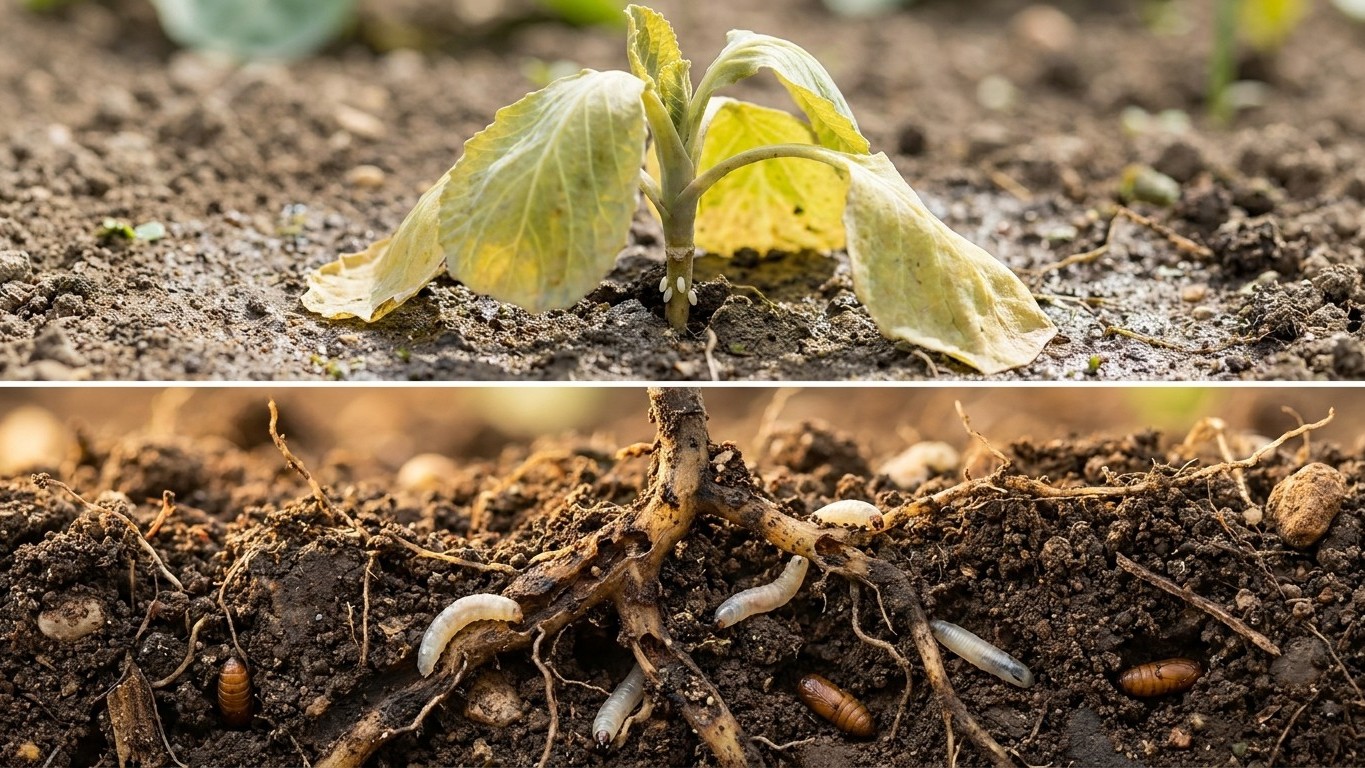

The cabbage maggot (Delia radicum) spends most of its short life out of sight, which is exactly why gardeners get caught off guard. A healthy-looking seedling collapses almost overnight, and there’s no visible insect anywhere on the leaves. That’s because the damage happens below the soil line, where the larval stage tunnels through roots while the adult fly, egg, and pupa stages pass through the yard largely unnoticed.
The stages, in order

Four stages make up the cycle, and only one of them ever shows up where a gardener is looking. The adult is a small gray fly, roughly the size of a house fly but slimmer, that hovers low around the base of cabbage-family plants. Females lay tiny white eggs in the soil right against the stem, often in the cracks and crevices near the crown where the plant meets the ground.
Those eggs hatch into legless white larvae, the actual “maggots,” and this is the stage that does every bit of the damage. The larvae tunnel into roots and the lower stem, feeding for one to three weeks depending on temperature and host quality. A young transplant with a maggot-riddled taproot simply can’t pull enough water, so it wilts in the heat of the day even when the soil underneath is moist. Pull up a dying seedling and you’ll usually find the roots scarred, tunneled, or gnawed down to threads, sometimes with the larvae still feeding.
Once mature, the larva forms a hardened brown pupal case, called a puparium, right in the soil near where it fed. The adult fly emerges from that case weeks later to start the cycle again.
| Stage | Where it lives | Visible to gardener? | Damage caused |
|---|---|---|---|
| Egg | Soil surface, at stem base | Rarely, easy to miss | None |
| Larva (maggot) | Inside roots and lower stem | Almost never | All root and stem tunneling |
| Pupa | Soil, near feeding site | Only if soil is disturbed | None |
| Adult fly | Hovering near plant base | Sometimes, if you look closely | None (lays eggs only) |
The practical takeaway: by the time a gardener sees wilting, the maggot has already been feeding for days. Scouting for adult flies near the soil surface, rather than waiting for symptoms, is the only way to catch this pest before the roots are compromised.
When it appears, and why that varies
Cabbage maggot flies don’t check a calendar before emerging. They respond to accumulated soil warmth, the same way many soil-dwelling insects do, which means the first flight can show up weeks apart depending on where you garden. A cool, wet spring in the northern half of the country pushes emergence later than a mild one, and a warm early spring in the South can bring flies out well before northern gardeners have even hardened off their transplants.
This is part of why generic planting advice (“watch for cabbage maggot in April”) falls apart so easily. Two gardens three states apart can have completely different emergence windows in the same year, and the same garden can vary by two or three weeks from one year to the next depending on how the soil warmed up that spring. Soil temperature, not air temperature, drives the biology, so a shaded, slow-to-warm bed can lag behind a sunny one just a few yards away.
Why a fixed date won’t help you
Extension entomologists track this pest using degree-day accumulation models, tallies of accumulated soil warmth from a starting point each year, because that method actually predicts biology instead of guessing at a date. Those thresholds, and the specific starting dates used to calculate them, are published and updated by university extension services on a state-by-state basis, since a degree-day target that works in one region simply doesn’t translate to a different climate.
Rather than rely on a single national date, the more reliable approach is to check the degree-day tracking or emergence guidance published by the extension service in your own state or region. This site maintains a dedicated page for cabbage maggot by territory, with a link to the relevant extension resource, precisely because that’s where the numbers that actually apply to your garden live. Watching for the first adult flies hovering at soil level in early spring, rather than counting days on a calendar, remains the most reliable home-garden signal regardless of where you live.
One generation or several
Cabbage maggot is a multi-generation pest, typically producing two to four generations across a single growing season depending on the length and warmth of the region’s growing period. That single fact changes the whole management mindset. A one-generation pest is a single window: protect the crop through that stretch and the threat passes for the year. A multi-generation pest like this one keeps producing new flies, new eggs, and new root-feeding larvae as the season rolls on, which means vigilance can’t stop after the first flush of damage.
The first generation, emerging from overwintered pupae, tends to be the most damaging one because it targets young spring transplants with small, tender root systems that have little tolerance for tunneling. Later generations in summer often find less suitable conditions, since many cabbage-family crops have matured and developed sturdier roots by then, but a second or third planting of radishes, turnips, or fall broccoli can walk right into another wave of egg-laying.
What this means for the length of the watch
Gardeners growing a spring crop and calling it done for the season are only accounting for one generation out of several. Fall plantings of cabbage-family crops, increasingly common as a way to dodge summer heat and some other pests, can run straight into a later generation of cabbage maggot flies, especially in regions with a long enough season to support three or four cycles. Continuous cropping of the same family in the same bed, without rotation, essentially guarantees that each new generation has a fresh host waiting nearby.
The practical response is to keep scouting through the season rather than treating one early inspection as sufficient. Row covers installed at transplanting protect against the first generation, but they only keep working if they stay sealed at the soil edge through subsequent flights too, since a single gap lets a later generation of flies right back in.
Where it spends the winter
Overwintering is what makes next year’s infestation predictable, and this pest overwinters as a pupa in the soil, typically at a shallow depth in the same bed where the last generation fed. Those puparia can survive cold winter soil in surprising numbers, sitting dormant until spring warmth triggers adult emergence to start the cycle over again.
Crop debris left in the ground after harvest matters more than most gardeners assume. Old cabbage-family roots and stems left in place through fall and winter don’t just decompose quietly; they can host pupae that survive right where they formed, giving the population a running start the following spring in that exact bed. Nearby wild mustards, cresses, and other weedy relatives in the same plant family can also serve as an alternate host, letting the pest persist even in a garden that rotates its cultivated crops carefully.
Why fall cleanup actually changes next year’s pressure
Pulling and removing cabbage-family debris promptly after harvest, rather than leaving roots to rot in place over winter, physically removes a share of the overwintering pupae before they get the chance to survive the cold season undisturbed. Tilling the soil in fall can also expose puparia to weather and predators, though this comes with a tradeoff worth weighing: tillage disturbs the same soil layer where beneficial predators and parasitoids also overwinter.
Biological control does real work against this pest, more than a lot of gardeners realize. Rove beetles in the genus Aleochara parasitize cabbage maggot pupae directly in the soil, and the parasitoid wasp Trybliographa rapae attacks the larvae before they finish feeding. Both depend on undisturbed soil habitat and nearby flowering plants that supply nectar to the adult parasitoids, which is one more reason a garden managed with reduced tillage and some flowering diversity nearby tends to carry a lower cabbage maggot load year over year than a bed that’s stripped bare and heavily worked every fall.
Common questions
Can you see cabbage maggots on the leaves?
No. The larvae feed exclusively below ground, inside roots and the lower stem. Leaf wilting and stunted growth are the visible symptoms; the insect itself stays hidden unless you dig up the root ball.
How many cabbage maggot generations happen in one year?
Typically two to four, depending on the length and warmth of the local growing season. The first spring generation usually causes the most damage because it attacks young, tender transplant roots.
Does cold winter weather kill off cabbage maggot populations?
Not reliably. The pest overwinters as a pupa in the soil, a stage built to withstand cold, so a harsh winter alone doesn’t eliminate the population the way it might for a more exposed insect.
Do wild plants keep cabbage maggot alive between garden crops?
Yes. Wild mustards, cresses, and other relatives in the same plant family can host the pest even in years when no cabbage-family crop is growing nearby, which is part of why eliminating those weeds near the garden helps reduce carryover pressure.