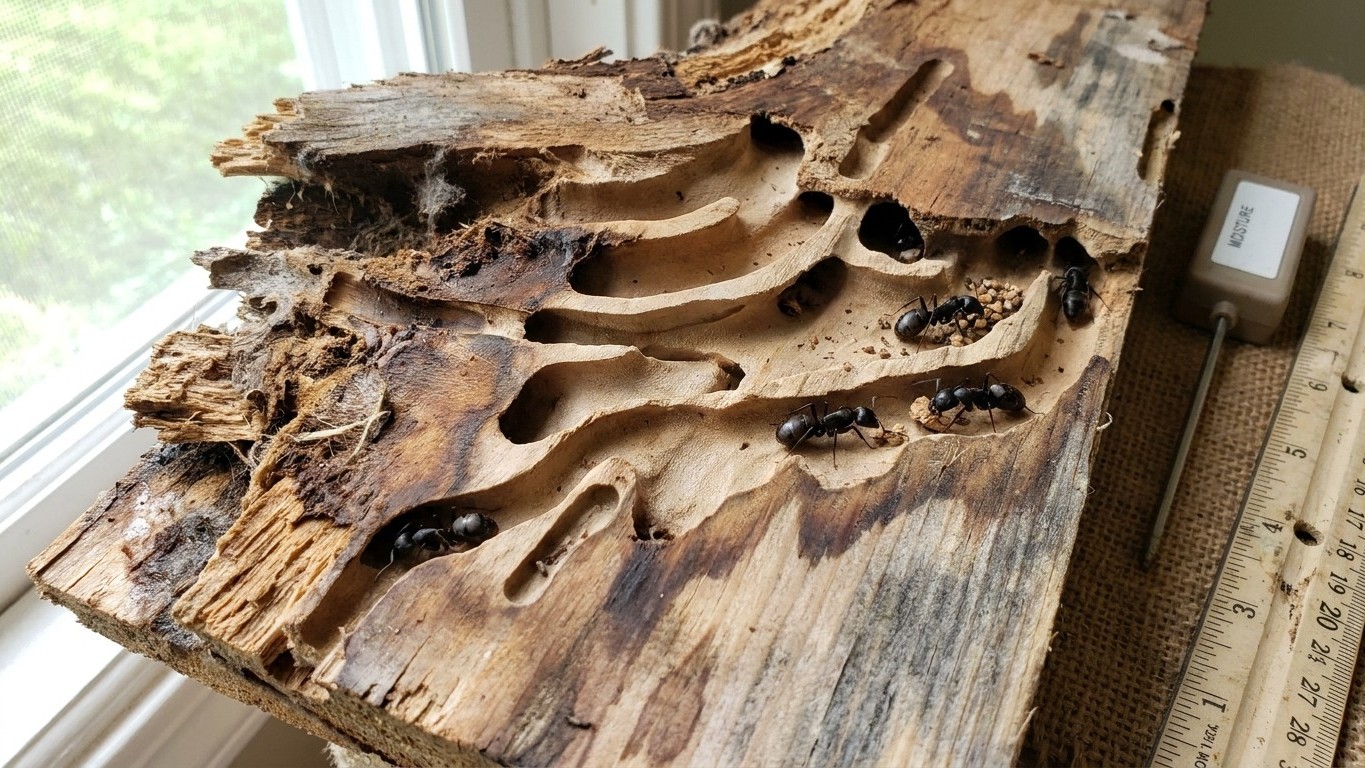

Carpenter ants inside your house almost always mean one thing: wood somewhere nearby has stayed damp long enough for them to hollow it out. They don’t eat the wood, so their tunnels are a symptom, not the disease. Spotting them early, tracing why they picked your walls, and knowing which fixes actually work (versus which just scatter the colony) are the three things that separate a solved problem from a recurring one.
What you are dealing with

Carpenter ants belong to the genus Camponotus, and the detail that matters more than their color or size is what they do to wood once they’ve moved in. Termites eat cellulose for food. Carpenter ants don’t touch it as a food source at all. They chew galleries through wood purely to create nesting space, which means the wood they choose has to be soft enough to excavate without much resistance. In practice, that means wood already compromised by moisture: a sill plate that’s absorbed years of gutter overflow, a window frame with a failed seal, a porch post sitting in standing water, or the soft, water-stained plywood behind a shower wall.
That single fact reframes the whole problem. Finding carpenter ants in a wall isn’t primarily an insect question, it’s a moisture question that happens to have ants in it. A colony rarely starts inside sound, dry lumber. It moves into wood that’s already failing, then expands the damage as it tunnels further. So a homeowner dealing with this is really trying to answer three separate questions, and each one deserves more room than a single page can give it.
The first is recognition: how do you tell carpenter ant activity apart from termites, from other large black ants, or from ordinary sawdust left by a drill bit. The second is cause: why this house, why this wall, and what conditions invited the colony to settle there instead of moving on. The third is control: what sequence of actions actually removes an established colony rather than just killing the ants you can see while the nest keeps growing behind the drywall.
Each of those questions gets its own full treatment elsewhere in this guide. The signs page covers the visual and audible evidence in detail, the causes page walks through the moisture and access conditions that draw colonies indoors, and the control page lays out the sequence of steps that actually works, in the order that gives you the best odds of solving it once. This page is the map of how those three pieces fit together.
Recognizing them
The clearest evidence isn’t the ant itself, it’s what’s left behind. Carpenter ants push debris out of their galleries as they excavate, and that debris, called frass, looks like coarse wood shavings mixed with tiny fragments of dead ants and insect parts. Finding a small pile of it beneath a windowsill, behind a baseboard, or under a hollow-sounding section of trim is a stronger signal than seeing a single ant cross the kitchen floor at night. Carpenter ants forage mostly after dark, so a nighttime trail along a baseboard or up a foundation wall is typical behavior, not an anomaly.
Winged ants indoors in spring are another marker worth taking seriously, since a swarm inside the house usually means a mature colony is already established somewhere in the structure and is producing reproductive ants to start satellite nests. That’s a different situation than a few foraging workers coming in through a gap under the door in search of food.
The confusion homeowners run into most often is separating carpenter ants from termites and from other large ants, like field ants or odorous house ants, that also show up indoors. Frass versus mud tubes is one useful distinction; termite evidence tends to include mud-like shelter tubes along foundations, while carpenter ant evidence is dry, wood-colored debris. Body shape matters too, but it’s easy to misjudge from across a room. The signs page goes through each of these distinctions with the specific visual cues to check, since misidentifying the pest at this stage tends to send people toward the wrong fix entirely.
Why they are here
Every colony that sets up indoors is answering the same three needs: food, water, and a stable place to nest. Carpenter ants forage widely for sugars and proteins, sweet spills, pet food left out overnight, honeydew from aphids on nearby trees, and they’ll travel a surprising distance from an outdoor nest to reach a reliable food source inside a house. But food alone rarely explains why a colony moves its nest indoors rather than just visiting for meals. That decision comes down to moisture and access.
Wood that stays wet, whether from a slow roof leak, a downspout dumping water against the foundation, condensation around poorly insulated pipes, or a deck ledger board that traps rain against the house, becomes soft enough to excavate and stays humid enough to support a colony long-term. Once that wood is compromised, gaps around utility lines, chimney flashing, and foundation cracks give workers a direct route from an outdoor parent colony into the structure, where they can extend a nest or establish a satellite colony closer to the food and moisture they’ve already found.
This is the same logic behind every pest-prevention program the EPA outlines for structural pests. As the agency puts it, “As a first line of pest control, IPM programs work to manage the crop, lawn, or indoor space to prevent pests from becoming a threat.” For carpenter ants specifically, that means managing moisture and closing entry points before they become established, rather than waiting to react once a colony is already inside a wall. The causes page breaks down the specific moisture sources, entry points, and outdoor conditions that most often lead a colony to move indoors, along with what to check first.
What works
The EPA frames pest management inside a structure through Integrated Pest Management, describing it as “an effective and environmentally sensitive approach to pest management that relies on a combination of common-sense practices.” The order those practices happen in isn’t arbitrary, and skipping straight to a spray inverts the entire approach.
The first step is deciding whether action is even warranted yet. The agency describes this as an action threshold: “Before taking any pest control action, IPM first sets an action threshold, a point at which pest populations or environmental conditions indicate that pest control action must be taken.” A handful of foraging workers seen occasionally isn’t the same situation as frass piles and nighttime trails appearing daily.
Next comes accurate identification, since treating the wrong pest wastes time and money: “IPM programs work to monitor for pests and identify them accurately, so that appropriate control decisions can be made.” Once moisture sources are addressed and entry points sealed, per the prevention step covered above, the remaining decision is which control method to use, and here the EPA is specific about sequencing: “Effective, less risky pest controls are chosen first, including highly targeted chemicals, such as pheromones to disrupt pest mating, or mechanical control, such as trapping or weeding.” Broad chemical treatment sits at the bottom of that list, not the top: “Broadcast spraying of non-specific pesticides is a last resort.”
Pesticides are formulated to be toxic to the organisms they target, and the EPA notes they can be toxic to people when used improperly, with children, older adults, and people with compromised immune systems named as especially vulnerable. Any product used indoors should be matched to what’s labeled for that specific pest and location, since registered products vary by state and the label on the container in hand is the only one that legally applies. Questions about a specific product are better directed to the National Pesticide Information Center at 1-800-858-7378 than answered by guesswork.
A professional is the right call once the colony’s nest location can’t be confirmed, once damage extends across multiple framing members, or once satellite colonies are suspected, since removing an entire colony usually requires locating the nest inside wall voids or framing, something a homeowner can’t always do without opening walls. The full sequence, including how to monitor after treatment, is laid out on the control page.
Common questions
Do carpenter ants mean my house has termites too?
Not necessarily. Both pests are drawn to moisture-damaged wood, so it’s possible to have one without the other, but the conditions that attracted carpenter ants (leaks, wood-to-soil contact, poor drainage) are the same conditions termites look for. Confirming which pest is present matters, since the two require different control approaches entirely.
Can I get rid of carpenter ants without finding the nest?
Killing visible foragers rarely solves the problem, since the nest keeps producing new workers. Locating the colony, or at minimum the moisture source feeding it, is the step that actually stops recurrence rather than just thinning the numbers you can see.
Why do I mostly see carpenter ants at night?
Carpenter ants forage primarily after dark, moving along established trails from the nest to food and water sources. Seeing them at night isn’t unusual behavior, it’s when they’re most active, which is also why checking baseboards and window frames after dark can reveal activity that’s invisible during the day.
Will fixing a leak alone solve a carpenter ant problem?
Repairing the moisture source stops the wood from staying attractive to new colonies and keeps an existing one from expanding, but it doesn’t remove ants already nesting in wood that’s already softened. Moisture control is necessary, but an established colony still needs to be located and addressed directly.