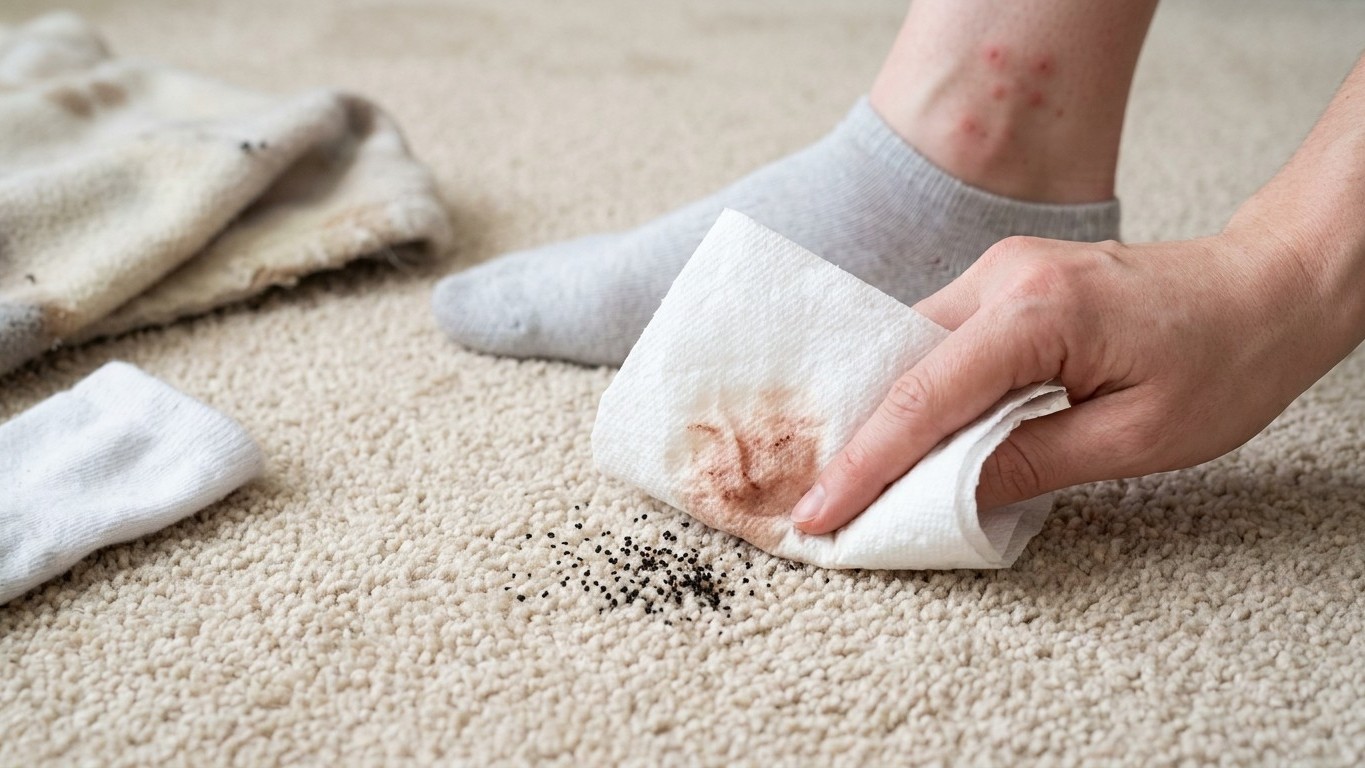

Flea signs show up in a predictable order, and the order matters more than any single clue. Bites on ankles come first, then a pet scratching more than usual, then tiny dark specks in the carpet that don’t brush away like dust. The catch: by the time you spot an adult flea jumping, the floor beneath your feet may already hold hundreds of eggs, larvae, and pupae you can’t see at all.
What you notice first

The itch usually arrives before the insect does. Ankles and lower legs get small, red, intensely itchy bites, often in a cluster of two or three, because fleas feed and move rather than settling in one spot the way a mosquito does. If a dog or cat lives in the house, the animal often signals trouble before the person does: excessive scratching at the base of the tail, biting at the fur, or restlessness that wasn’t there a week earlier.
Flea dirt is the next clue, and it’s the one homeowners most often mistake for something else. It looks like fine black pepper scattered on pet bedding, light-colored carpet, or a white sock after walking across the floor. Wet a paper towel and press a few specks onto it. If it turns reddish-brown, that’s digested blood, and it confirms fleas rather than ordinary dirt or debris.
Live adult fleas are the sign people expect, but they’re actually the smallest fraction of the population in an infested home. Adults make up roughly 5 percent of the flea life cycle present at any given time; eggs, larvae, and pupae hiding in carpet fibers, floor cracks, and pet bedding make up the rest. That’s the mechanism that trips up so many households: the visible problem is a fraction of the real one.
Signs that are easy to miss
- Small, dark specks in the folds of a pet bed that get vacuumed up without a second look
- Bite clusters on ankles dismissed as mosquito bites from an evening outdoors
- A pet’s mild hair thinning near the tail, mistaken for seasonal shedding
- A single flea seen once and never seen again, assumed to be a fluke
This is exactly why identification comes before any response. As the U.S. EPA puts it, “IPM programs work to monitor for pests and identify them accurately, so that appropriate control decisions can be made.” Guessing at this stage, or skipping straight to a product, is how households end up treating the wrong problem entirely.
What it is confused with
Flea signs overlap with several other household issues, and the mix-ups aren’t harmless. Someone who mistakes carpet fibers for flea dirt might spend money and time treating a home that never had fleas. Someone who mistakes flea bites for bed bug bites might tear apart a bed frame looking for insects that were never there, while the actual source, a pet or a crawl space, goes unchecked.
| What it looks like | What it might actually be | How to tell them apart |
|---|---|---|
| Small red bites on ankles/legs | Mosquito bites | Fleas bite low on the body and often in a line or cluster; mosquito bites appear anywhere skin was exposed, usually singly |
| Small red bites on ankles/legs | Bed bug bites | Bed bug bites tend to appear on skin exposed while sleeping (arms, shoulders, neck), not concentrated at the ankles |
| Dark specks on bedding or carpet | Ordinary dirt or debris | Flea dirt turns reddish-brown when wet; dirt and lint don’t change color |
| Pet scratching and hair loss | Seasonal shedding or dry skin | Flea-related scratching is localized (base of tail, belly) and persistent, not tied to weather changes |
| Tiny jumping insects near baseboards | Carpet beetles or springtails | Fleas move in quick, erratic jumps; carpet beetles crawl and springtails hop in short, low bounces near moisture |
The most expensive mix-up tends to be the bed bug one. Bed bug treatment, whether DIY or professional, is a different process entirely from flea control, often more costly and more disruptive to a household. A homeowner who misreads ankle bites and spends weeks preparing for a bed bug treatment, only to find the actual source was a cat that goes outdoors, has lost time and money on the wrong problem. Getting the identification right the first time isn’t a formality. It’s the step that decides whether the next move works at all.
Telling a sighting from an infestation
One flea on a windowsill isn’t an infestation. It might have hitched a ride on a shoe, a delivery box, or a visiting dog, and it might never reproduce indoors. What separates a random sighting from a real problem is a combination of location, count, and life stage, not just the fact that something jumped.
Look at where the activity concentrates. A true infestation clusters around pet resting spots, carpeted areas with soft flooring, and shaded outdoor spots near the foundation, not scattered randomly through the house. Count matters too: seeing one flea over a week is different from seeing several a day, or from a pet that scratches constantly regardless of where it sits. The presence of flea dirt in multiple rooms, rather than a single speck near the door, points toward breeding rather than a one-time hitchhiker.
The life stage question is the most reliable marker. A stray adult flea proves nothing about reproduction. Finding flea dirt alongside live fleas on a pet, or noticing bites accumulating over several days in the same part of the house, points to an established population working through eggs, larvae, and pupae in the carpet or bedding. That’s the difference between “I saw something” and “something is breeding here.”
This judgment call is exactly what the EPA’s own framework is built around. Before spending money or applying anything, the agency’s guidance is direct: “Before taking any pest control action, IPM first sets an action threshold, a point at which pest populations or environmental conditions indicate that pest control action must be taken.” Acting before there’s anything to act on wastes effort and, often, money on unnecessary products. Waiting past that threshold, on the other hand, lets a small population turn into hundreds of eggs hidden in the carpet within a couple of weeks. The goal is catching the middle ground, not reacting to the first thing you see or ignoring a pattern that’s already established.
What to do once you are sure
Once the signs add up to a real infestation rather than a one-off sighting, the next questions are what’s drawing fleas into the house in the first place, and how to remove an established population without wasting money on the wrong approach. Both deserve their own look: what attracts fleas to a home and yard, and the practical steps for getting rid of an infestation once it’s confirmed.
There’s a health side to this that shouldn’t be brushed aside or exaggerated. Fleas are documented to transmit tapeworms to pets (and occasionally to people, mostly children) and, in specific regions, to be involved in the transmission of murine typhus and other flea-borne illnesses. These outcomes aren’t the everyday experience of a household dealing with fleas, but they’re documented, not hypothetical. For guidance specific to a region or a suspected illness, the CDC and local health departments are the right source, not a home remedy or a guess.
Heavy, established infestations, especially ones that have spread through carpet, crawl spaces, or a yard, are often beyond what a single round of vacuuming and pet treatment can resolve. In those cases, calling a pest control professional is a reasonable first move rather than a last resort. If a store-bought product is the chosen route instead, EPA guidance is clear that the label is the final word on how it’s used, and the National Pesticide Information Center (1-800-858-7378) answers public questions about specific products rather than leaving households to guess. As the EPA frames the broader approach, “Effective, less risky pest controls are chosen first, including highly targeted chemicals… or mechanical control, such as trapping or weeding,” with “broadcast spraying of non-specific pesticides” treated as a last resort, not a first step.
Common questions
Can you have fleas without a pet in the house?
Yes. Fleas can enter on clothing, through a crawl space, or via wildlife (raccoons, opossums, rodents) that pass close to the foundation, even in homes with no cat or dog.
How long after noticing bites should I check for an infestation?
Within a few days. If bites continue appearing in the same area, or if flea dirt turns up in more than one room, that pattern (not a single bite) is what indicates an established population worth addressing.
Do flea bites look different from mosquito bites?
Flea bites tend to cluster on the ankles and lower legs and stay small and intensely itchy, while mosquito bites can appear anywhere exposed skin was and are typically more scattered.
Is it possible to have fleas and not see a single live one?
Yes, and it’s common. Since adults make up a small share of the population at any time, a household can have active breeding in the carpet while adults stay hidden in pet bedding or deep in fibers, which is why flea dirt and bite patterns matter as much as spotting a live insect.