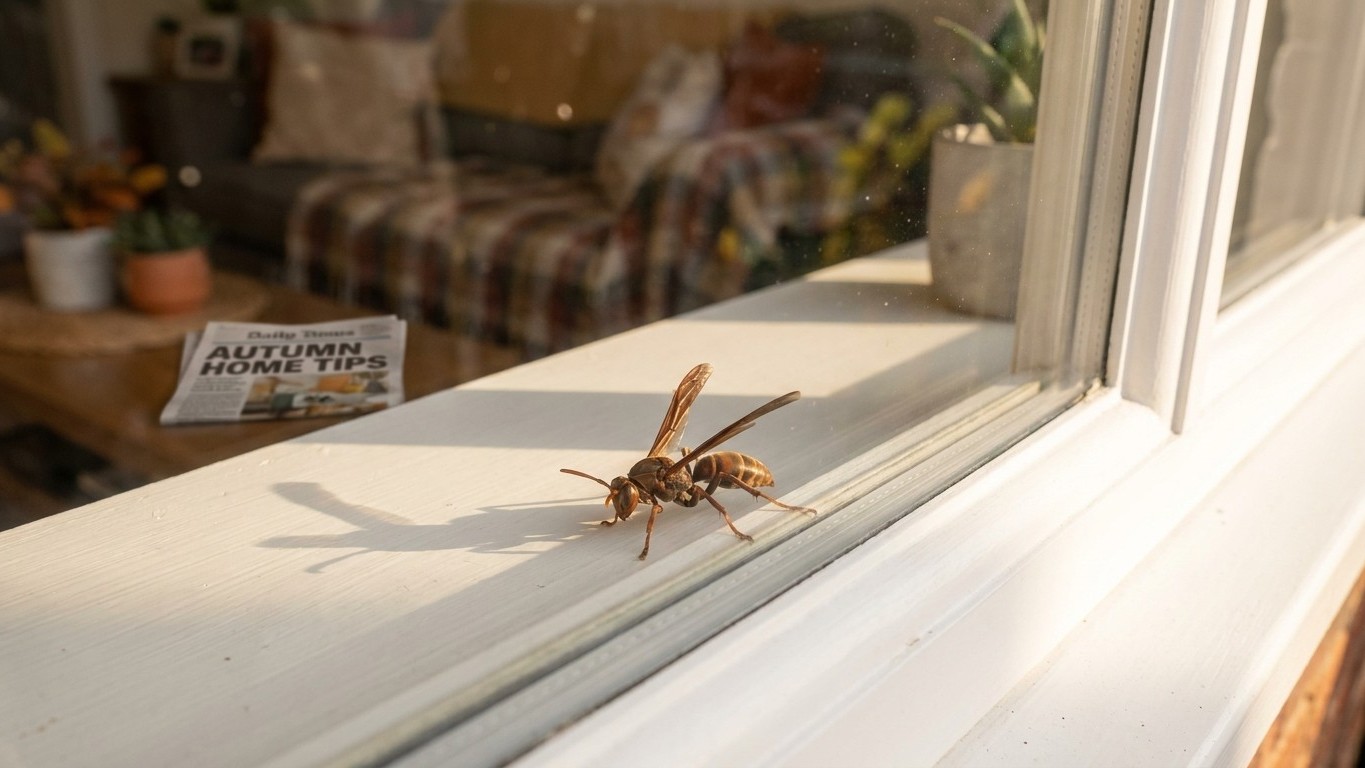

A wasp or two crawling along a windowsill in September usually means a gap somewhere in the siding or a nest tucked under the eaves, not a house-wide infestation. Spring sightings point to a single queen scouting for a nesting cavity; late-summer sightings point to a mature colony chasing sugar. The fix depends entirely on which stage you’re seeing, and that’s the question worth answering before doing anything else.
What you are dealing with

Most of the wasps that turn up inside U.S. homes are paper wasps, yellowjackets, or the occasional mud dauber. All three build outside, but all three will happily use a wall void, an attic corner, or a hollow porch post as the shell around their paper or mud nest. The single fact that decides how a colony behaves toward you is timing, because what a colony needs changes across the season and its temperament changes right along with it.
In spring, a lone queen who survived winter is doing everything herself: finding a cavity, building the first cells, laying the first eggs. She’s not defending a colony yet, because there isn’t one. She’ll investigate a soffit vent or a gap around a chimney flashing, and if she likes it, she starts building. This early-season wasp is easy to miss and rarely aggressive, since she has nothing yet worth dying to protect.
By midsummer the colony has workers, and by late summer it can have hundreds of them. That’s the point where behavior flips. The colony’s priority shifts from raising brood to feeding itself, and wasps in that phase go looking for sugar wherever they can find it: soda left on a patio table, fruit fallen under a tree, an open trash can. This is also when people report wasps getting inside through open doors, kitchen windows, or gaps around AC units, and it’s why late-summer wasps read as so much more aggressive than the same species in May. They’re not meaner. They’re hungrier and more numerous, and a nest with that much to lose reacts fast to anything that gets close to it.
Answering “what’s actually happening in my house” takes three separate questions, and each one has its own page in this guide: what you’re actually seeing (a few strays, a visible nest, or noise in a wall), why the wasps picked your house over the one next door, and what you can safely do about it without making things worse. The rest of this page walks through the short version of all three, with links to the full answer on each.
Recognizing them
The signs people notice first are the wasps themselves, but the details matter more than the sighting. A slow, deliberate wasp cruising along a baseboard is a different situation than a cluster darting in and out of a hole in the fascia board. Paper wasp nests look like an open umbrella of hexagonal cells, usually under an eave or a deck railing. Yellowjacket nests are almost always hidden, in a wall void, under a shed floor, or in an old rodent burrow in the yard, and the first sign is often just wasps flying in and out of a gap at a fairly constant rate. Mud daubers leave a hard mud tube stuck to siding or a beam, and they’re solitary enough that finding one nest rarely means finding a colony.
People confuse wasps with bees more often than you’d think, and the mix-up matters because the two call for different responses. A fuzzy, rounder body usually means a bee; a smoother, more angular body with a narrow waist points to a wasp. Confusing a bumblebee nest under a shed with a yellowjacket nest in the same spot leads to the wrong control decision, and bees deserve different handling given their role as pollinators.
The clearest tell that a colony has moved into the structure itself, rather than just visiting from an outdoor nest, is a faint buzzing or scratching sound coming from inside a wall or ceiling, particularly on a warm afternoon. That sound, paired with two or three wasps a day appearing near the same window or vent, is a strong enough pattern to act on. The full breakdown of what each sign means and how to tell one species from another is covered on the signs of wasps in the house page.
Why they are here
Wasps don’t need much to settle into a house: a dry, sheltered cavity to build in, and, later in the season, a reliable food source close by. A gap around a utility pipe, a loose vent screen, a crack in mortar, any of these reads to a scouting queen as a ready-made wall for her first cells. Once the colony is established, workers will range a good distance from the nest for food, but they keep coming back to the same entry point, which is why the same spot on a house tends to attract activity year after year unless it’s physically closed off.
Food draws them in a very specific way compared to other household pests. Early in the season, workers are hunting other insects to feed the brood, so a yard with aphids or caterpillars can pull in foraging wasps without any sugar involved at all. Later, as the colony’s priorities shift, it’s ripe fruit, spilled soda, uncovered trash and even pet food left outside that keep them circling the same porch or patio. Water matters too, especially for mud daubers, which need wet mud to build, so a dripping outdoor faucet or a low spot that holds water after rain can be enough of a draw on its own.
The U.S. EPA frames the fix in terms that apply just as well to wasps as to any other pest: “As a first line of pest control, IPM programs work to manage the crop, lawn, or indoor space to prevent pests from becoming a threat.” For a house, that means sealing the gaps that look like nesting cavities, keeping trash and pet food covered, and fixing the drips and puddles that give mud daubers what they need. The specific entry points, food sources and seasonal triggers that apply to each species are laid out in full on the why wasps get into the house page.
What works
The EPA describes Integrated Pest Management as “an effective and environmentally sensitive approach to pest management that relies on a combination of common-sense practices,” and the order those practices happen in is the part people tend to skip. The first step isn’t a spray. It’s deciding whether action is even warranted: “Before taking any pest control action, IPM first sets an action threshold, a point at which pest populations or environmental conditions indicate that pest control action must be taken.” A single wasp caught in a screen door once a week is a different threshold than a visible nest three feet from a back door used daily by kids or a pet.
Once you’ve decided action is warranted, the next step is confirming exactly what you’re dealing with. “IPM programs work to monitor for pests and identify them accurately, so that appropriate control decisions can be made.” A paper wasp nest under a porch roof, in plain sight and away from foot traffic, can often be left alone or removed with basic precautions. A yellowjacket nest inside a wall void is a different problem entirely, because the colony is hidden, the entry point may be the only visible clue, and disturbing the wrong spot can push wasps into living space instead of away from it.
After prevention, the EPA’s own order of operations puts the least risky option next: “Effective, less risky pest controls are chosen first, including highly targeted chemicals, such as pheromones to disrupt pest mating, or mechanical control, such as trapping or weeding.” Broad chemical treatment sits at the very end of that list, not the front of it: “Broadcast spraying of non-specific pesticides is a last resort.” Any product used against wasps is registered differently state by state, and the label on that product is the only guide that applies, since the EPA notes that pesticides are meant to be toxic to pests and can be toxic to people when used improperly, with children, older adults and people with compromised immune systems named as especially vulnerable. Questions about a specific product are best answered by the National Pesticide Information Center at 1-800-858-7378, not by a guess.
A nest inside a wall, ceiling void, or anywhere with unclear access is a job for a licensed pest control professional, not a home remedy. So is any situation involving a known wasp allergy in the household. The step-by-step version of this order, including how to tell a job you can handle from one you shouldn’t, is covered on the how to control wasps in the house page.
Common questions
Are wasps in the house dangerous? A stray wasp or two is mostly a nuisance, but a nest inside a wall near living space raises the odds of a sting, and anyone with a known allergy should treat any nest close to the house as a priority, not a wait-and-see situation.
Will wasps leave on their own once fall arrives? Colonies do die off with the first hard frost, and old nests are not reused the following year, but that’s weeks away from a late-summer sighting and doesn’t address wasps that have already found a way inside.
Can I just seal up the hole and forget about the nest? Not if wasps are still active inside it. Sealing an occupied entry point traps the colony inside the wall, which can push wasps further into the house through outlets or light fixtures as they search for another way out.
Do wasps come back to the same spot on a house every year? The exact nest isn’t reused, but the entry point often is, since whatever made that gap attractive in the first place (a loose vent, a gap in trim) is usually still there unless it’s been physically repaired.