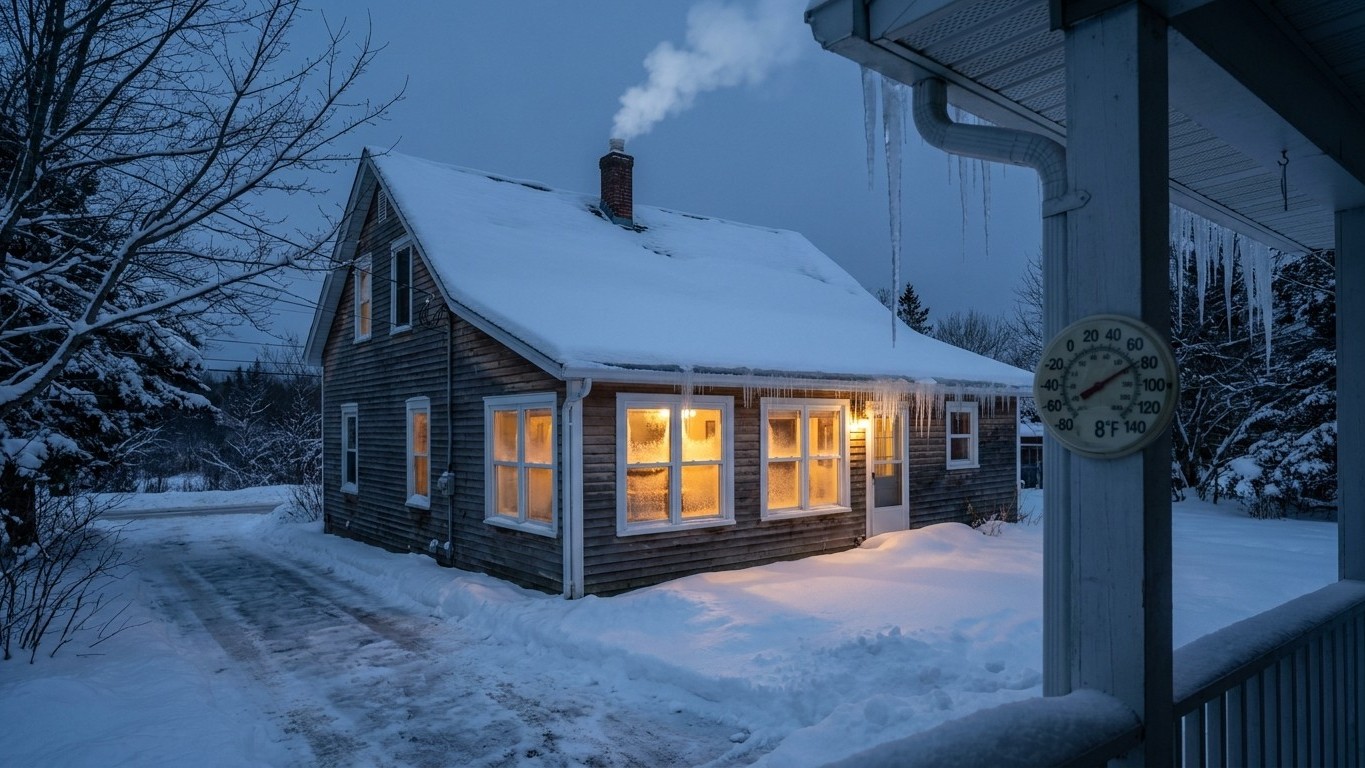

Charlottetown’s coldest month averages a low of 10.3°F, and that single number shapes everything about heating a home on Prince Edward Island: how long the furnace runs, how much wood a woodstove burns through, and how much margin a household needs between “enough” and “just barely enough.” Here’s what that number actually means on the ground.
How cold it gets, and for how long

A mean daily minimum of 10.3°F in the coldest month isn’t a record low, it’s the average low across the entire month, which is a more useful number for planning than a one-night extreme. It tells you the furnace or woodstove isn’t fighting an occasional cold snap. It’s fighting a baseline that sits well below freezing, night after night, for the length of an entire month, and it doesn’t ease up gently on either side of that peak.
That distinction matters more than people think. A winter that hovers just under 32°F for four straight months asks different things of a heating system than one that plunges to single digits for six weeks and then breaks. The first rewards steady, moderate output and good insulation. The second rewards a system with real reserve capacity for the worst stretch, because equipment sized only for the “average” day will fall behind the moment the average moves ten degrees the wrong way.
Prince Edward Island’s winter leans toward the first pattern but with real bite. Charlottetown’s coldest-month low of 10.3°F sits in territory where a woodstove needs to be sized for sustained output, not just occasional top-ups, and where a furnace’s recovery time after a cold night matters as much as its rated capacity. Houses here spend a long stretch of the calendar below the temperature where a building simply holds its heat without help. That’s the practical translation of the number: not just “how cold,” but “how long you’re committed to fighting it.”
What this means for equipment choices
For anyone burning wood as a primary or supplemental heat source, that stretch of cold means the stove is doing real work for a genuine winter season, not a few weeks around the holidays. Knowing When Does the Heating Season Start in Prince Edward Island? helps frame just how long that commitment lasts. That’s the backdrop for the next two questions: how much wood a cord actually delivers, and how long that wood needs to sit before it’s ready to burn.
What a cord of wood is worth here
A cord is a volume, not a weight, and that’s the detail that trips up most first-time buyers. It’s a stack measuring 4 feet by 4 feet by 8 feet, which works out to 128 cubic feet, full stop, regardless of species. The trick is that dense hardwoods pack more actual wood mass into that same stack than softer species do, so two cords sitting side by side, identical in size, can hold very different amounts of burnable energy. That’s why “a cord” alone never tells you what you’re getting. The species does.
According to Michigan State University Extension, a cord of well-seasoned hardwood delivers roughly 20 million BTU. To put that in terms a household can actually use, MSU frames it as the rough equivalent of 145 gallons of #2 fuel oil, or 215 gallons of LP gas. That’s a meaningful chunk of a heating season, though how far it stretches depends entirely on the house, the stove’s efficiency, and how much of the season it’s expected to cover on its own versus supplementing a furnace.
| Measurement | Value |
|---|---|
| Cord dimensions | 4 ft x 4 ft x 8 ft |
| Cord volume | 128 cubic feet |
| Heat content (well-seasoned hardwood) | about 20 million BTU |
| Rough fuel-oil equivalent | about 145 gallons of #2 fuel oil |
| Rough LP gas equivalent | about 215 gallons |
None of that 20 million BTU figure shows up if the wood is still wet. MSU is direct about this: wood needs to burn at 20 percent moisture or less to deliver anything close to its potential, and green wood fresh off the tree can run over 60 percent moisture. Every bit of that water has to boil off before the fire produces usable heat, which means wet wood spends a good share of its own combustion energy just drying itself out mid-burn. You get less warmth, more smoke, and a stove working harder for a worse result. That’s the whole argument for buying ahead and stacking properly rather than burning what arrived last week.
How long wood takes to dry in Prince Edward Island
Seasoning time isn’t a fixed number stamped on every species everywhere. It’s a function of local humidity and how much genuine summer heat a region gets to pull moisture out of split wood. MSU’s baseline is that split, stacked green wood typically reaches that 20-percent target after one full summer season, provided it’s stacked in a way that lets air move freely through the pile, not left in unsplit rounds where the bark seals moisture in.
Prince Edward Island’s maritime summers bring humidity that can slow that process compared with a drier inland climate, which is a reason to treat “one summer” as a floor, not a guarantee, especially for wood cut or delivered late in the season. Splitting wood smaller increases surface area and speeds drying, and stacking it off the ground, in a single row rather than a solid pile, with the top covered but the sides open to wind, makes a real difference.
Red oak is the named exception worth remembering: MSU notes it dries slowly because of its cell structure, so it needs more time than most hardwoods to reach burnable moisture, even under good stacking conditions. Burning too soon doesn’t just waste wood. It shows up as a duller, cooler fire, more smoke rolling out of the flue, and a heavier buildup of creosote inside the chimney, which means more frequent sweeping and a higher long-term risk if that buildup goes unaddressed. None of that is dramatic on any single night. It just adds up, load after load, across a winter this long.
Where to check before you buy
Every figure above traces back to Charlottetown as the reference point, and Prince Edward Island’s terrain, while modest in elevation compared with much of Canada, still varies enough in exposure and coastal influence that conditions on the North Shore won’t perfectly match conditions further inland or along the Northumberland Strait. Species availability shifts with that too. What a firewood dealer near Charlottetown stocks isn’t necessarily what’s common elsewhere on the Island.
Before buying, it’s worth checking with the Prince Edward Island agriculture services for guidance specific to your area, including which species are locally available and reasonably priced. Burn restrictions are also worth confirming directly rather than assuming. These rules are set at the local level and can change from one year to the next depending on air quality conditions, drought risk, or municipal bylaws, so what was allowed last winter isn’t automatically fine this one. A quick check before stacking a season’s worth of wood saves a headache later.
What each heat source costs to run in Prince Edward Island
At Prince Edward Island’s average residential prices, this is what one million Btu of heat delivered into the house costs with each system (Canadian dollars). It compares fuels on the same unit: it is not a yearly bill, and it leaves out the price of the equipment.
| System | Cost per million Btu delivered |
|---|---|
| Electric resistance (baseboard, 100% efficient) | C$57.71 |
| Heat pump at 8.1 HSPF2 (seasonal COP about 2.4) | C$24.31 |
Cheapest to run in Prince Edward Island: heat pump, C$33.40 less per million Btu than the electric resistance.
Prices: Hydro-Québec, 2025 Comparison of Electricity Prices in Major North American Cities. Efficiencies: ENERGY STAR criteria. A heat pump’s figure is a seasonal average; in the coldest weather its efficiency drops.