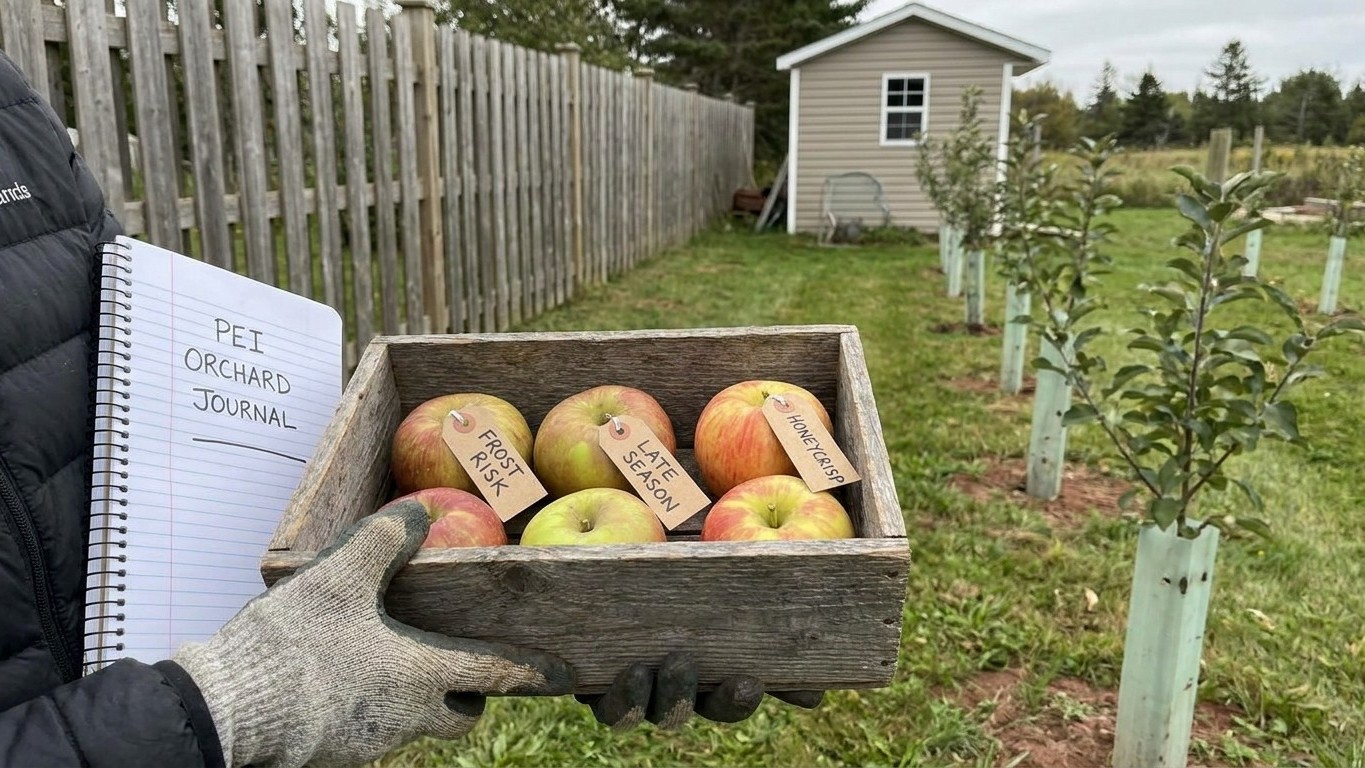

A “hardy to zone 5” apple tree planted on Prince Edward Island can look fine for two winters, then split at the graft union or die back to the roots the year the cold snap goes deeper than usual. That’s the trap: PEI’s coldest month regularly dips near 10°F, and a rating that works in southern Ontario simply doesn’t cover this ground. The costly mistake isn’t the variety you pick, it’s trusting a hardiness number that was never tested against this island’s winter.
Which varieties suit this climate

Charlottetown’s coldest month averages a minimum of -12.1 °C, according to Environment and Climate Change Canada’s 1981-2010 climate normals for station Charlottetown A. That figure sets the floor. Whatever cultivar you plant needs a catalogue hardiness rating that reaches roughly Canadian plant hardiness zone 4, and inland or upland ground away from Charlottetown’s coastal moderation can run colder still, so treat that number as a minimum rather than a guarantee.
Cold hardiness: the first filter
A handful of standard apples carry catalogue hardiness ratings that reach zone 3 or 4 and have a long history in cold Canadian orchards: ‘McIntosh’, ‘Cortland’, ‘Honeycrisp’, ‘Wealthy’, ‘Norland’ and ‘Goodland’. Nursery catalogues list all six as hardy to zone 3 or 4, which covers Charlottetown’s winter minimum with room to spare. No provincial or extension source we can cite recommends a specific short list for Prince Edward Island by name, so treat catalogue hardiness zone as the first checkable fact, not a local endorsement; for a deeper breakdown of how these cultivars perform here, see The Best Apple Varieties for Prince Edward Island.
| Variety | Catalogue hardiness zone | Winter chill need | Harvest season |
|---|---|---|---|
| ‘McIntosh’ | Zone 4-8 | High | Early-mid fall |
| ‘Cortland’ | Zone 4-8 | High | Mid fall |
| ‘Honeycrisp’ | Zone 3-8 | High | Early-mid fall |
| ‘Wealthy’ | Zone 3-7 | High | Late summer-early fall |
| ‘Norland’ | Zone 2-7 | High | Late summer |
| ‘Goodland’ | Zone 3-7 | High | Early fall |
Winter chill: the filter most guides skip
Hardiness tells you whether the tree survives the winter. Winter chill tells you whether it flowers properly the following spring, and it is a different measure entirely; to see how these factors play out month by month, check The Prince Edward Island Apple Calendar, Stage by Staget number entirely: the hours the tree needs below about 45°F before it can break dormancy cleanly and bloom in a tight flush. A low-chill variety bred for the Deep South, such as ‘Anna’ or ‘Dorsett Golden’, satisfies its chill requirement by midwinter almost anywhere in Canada, then sits waiting through the rest of a long winter, which produces a thin, ragged bloom rather than the even flowering a grower wants. Prince Edward Island sits at the long-chill end of the scale, so the standard northern apples in the table above, bred for exactly this kind of winter, are the safer choice. Growers further south, in a state like Illinois, are working from a much wider chill range because their winters run shorter and milder, which is why a variety list built for Illinois does not transfer directly to Charlottetown.
Planting a pair that works here
Apples do not reliably self-pollinate. Plant two compatible varieties that flower in the same window, and make sure at least one of them produces fertile pollen.
Among the cold-hardy varieties that suit Charlottetown’s winters, ‘McIntosh’ and ‘Cortland’ bloom together and cross well, which makes them a practical pair for a two-tree planting. ‘Honeycrisp’ also overlaps in bloom timing with both, though it is a weaker pollen source than either, so pair it with a stronger pollinizer such as ‘Cortland’ rather than counting on it to pollinate a neighbouring tree.
Watch for the triploid varieties. Several familiar dessert apples produce sterile or near-sterile pollen and cannot pollinate anything at all. Planted as one of only two trees, a triploid leaves both trees fruitless even if they flower together, so a two-tree planting built around a triploid needs a third, fertile variety nearby to close the loop.
If you only have room for one tree, check whether a neighbour within bee range already grows an apple, crabapple or ornamental Malus that blooms at the same time. Bees will cross the gap on their own, and a flowering crabapple is often the most dependable pollen source in a mixed dooryard planting because its bloom period tends to run long.
Keep the pair close enough that pollinating insects move freely between them, ideally within the same yard rather than across a road or a solid windbreak, and give both trees sun for most of the day. A shaded tree blooms later than its neighbour and can miss the peak of a partner’s flowering entirely.
The frost that costs a crop here

At Charlottetown, Environment and Climate Change Canada’s 1981-2010 climate normals put the average last spring frost at May 16, at station Charlottetown A. That date is a midpoint, not a safe line: in one year out of two the last frost falls later than May 16, sometimes well later. Inland and upland districts away from Charlottetown’s coastal moderation typically run days to weeks behind that date.
Why a late frost is worse than it sounds
Apple wood tolerates real cold. It is the flowers that are fragile. Once the buds show pink and open into bloom, a frost of only a few degrees kills the flowers outright while leaving the tree completely undamaged. The wood breaks dormancy again the next year as if nothing happened, but that season’s crop is simply gone. A grower can lose an entire year’s apples to one cold night without a single branch showing damage. The risk window is the bloom period, not the whole spring, so the practical question each year is whether bloom lands before or after the last realistic frost date, not whether the tree survived winter.
What actually helps
- Site the tree on high ground or a slope, since cold air drains downhill and pools in low spots on a clear, calm night.
- Avoid planting in a hollow or against a solid wall or fence that blocks air drainage.
- Cover a young or small tree with row cover or a sheet on a night with a frost forecast during bloom, removing it once temperatures rise.
- Choose a later-blooming variety where frost is the main worry, since delaying bloom by even a few days can move it past the riskiest nights.
Growers in Quebec face a similar spring frost risk on a similarly short season, and the same rule applies there: a late-blooming cultivar is the real insurance, not a frost-fighting trick applied on the night itself. Because the Charlottetown figure is a single reference point, a grower on high ground inland or near the shore should watch a local frost forecast each spring rather than counting on a calendar date, and should not assume bloom is safe just because May 16 has passed.
The apple year in Prince Edward Island
Track the tree by its stage, not by the calendar, and anchor each stage against Charlottetown’s own frost dates from Environment and Climate Change Canada: an average last spring frost of May 16 and an average first fall frost of October 17, both normals for station Charlottetown A covering 1981-2010.
From dormancy to harvest
| Stage | Roughly when | What to do |
|---|---|---|
| Dormancy | Through winter, with the coldest month averaging a minimum of -12.1 °C at Charlottetown | Prune while wood is fully dormant. Check trunk guards against rabbits and voles. |
| Green tip | Before the May 16 average last frost | Watch for a late cold snap. Hold off on early fertilizer if a hard freeze is forecast. |
| Pink | Just before bloom, still inside the frost-risk window around May 16 | Have frost cover ready. This is the last stage before flowers are exposed. |
| Bloom | Around the average last frost date, later in many years | The most frost-sensitive stage. Protect if a freeze is forecast, otherwise let pollinators work. |
| Petal fall | Shortly after bloom | Frost risk to the flowers has mostly passed. Thin fruit clusters once set is visible. |
| Fruit set | Early summer | Confirm pollination succeeded. Remove weak or damaged fruitlets. |
| Harvest | Before the October 17 average first fall frost, earlier for early-season varieties | Pick by firmness and background colour, and get fruit in before a hard freeze. |
Because these are averages from a single Charlottetown station, a grower further inland or on higher ground should expect every stage to run a little later in spring and to close a little earlier in fall, which shortens the safe harvest window on the calendar even though the underlying frost normals are the same.
Bloom timing is the hinge of the whole season here. A spring that turns warm early can push bloom ahead of May 16, tucking it into the safer, less frost-prone tail of the window, while a slow, cold spring can push bloom past the average and into a year when frost is still statistically more likely than not to occur again.
Local help
For an up-to-date variety list and spray guidance suited to the province’s orchards, contact Prince Edward Island’s provincial agriculture office. Do this before you order nursery stock, since extension staff can confirm which cultivars are performing well in current trials and flag any disease or pest pressure specific to the current growing season, information that changes year to year in a way no article can.
Common questions
Is Prince Edward Island too cold to grow apples?
No. Charlottetown’s coldest month averages a minimum of -12.1 °C according to Environment and Climate Change Canada, which is well within the range that hardy, high-chill cultivars such as ‘McIntosh’, ‘Cortland’ and ‘Norland’ are bred to handle. The limiting factor is choosing the right variety and site, not the province as a whole.
Can I plant just one apple tree and still get fruit?
Usually not, unless a neighbour’s tree, crabapple or ornamental Malus is already blooming nearby within bee range. Most apple varieties need cross-pollination from a genetically different tree flowering at the same time, so a single isolated tree in an area with no other apples or crabapples nearby often blooms heavily and sets little fruit.
I already planted a low-chill southern variety. Will it still fruit here?
It may bloom unevenly rather than fail outright. A low-chill variety satisfies its winter chill requirement well before spring in a climate like Charlottetown’s, then sits dormant through the rest of the winter, which tends to produce a straggling, drawn-out bloom instead of a tight flush. It is not a guaranteed failure, but it is working against the climate rather than with it.
How do I protect bloom from a late spring frost?
Cover small or young trees with row cover or a sheet on any night a frost is forecast during bloom, and choose a site with good air drainage so cold air does not pool around the trunk. Neither trick is as reliable as picking a variety that blooms later in the season to begin with, since a covered tree still needs the cover applied and removed correctly on the right night.
How many years before a new apple tree bears fruit?
It depends mainly on rootstock rather than on the province. A tree on dwarfing rootstock generally bears its first fruit sooner than the same variety grafted onto a full-size standard rootstock, which takes longer to mature into bearing age. Ask the nursery which rootstock a tree is grafted onto before you buy, since that detail is printed on the tag and matters more than the variety name alone.