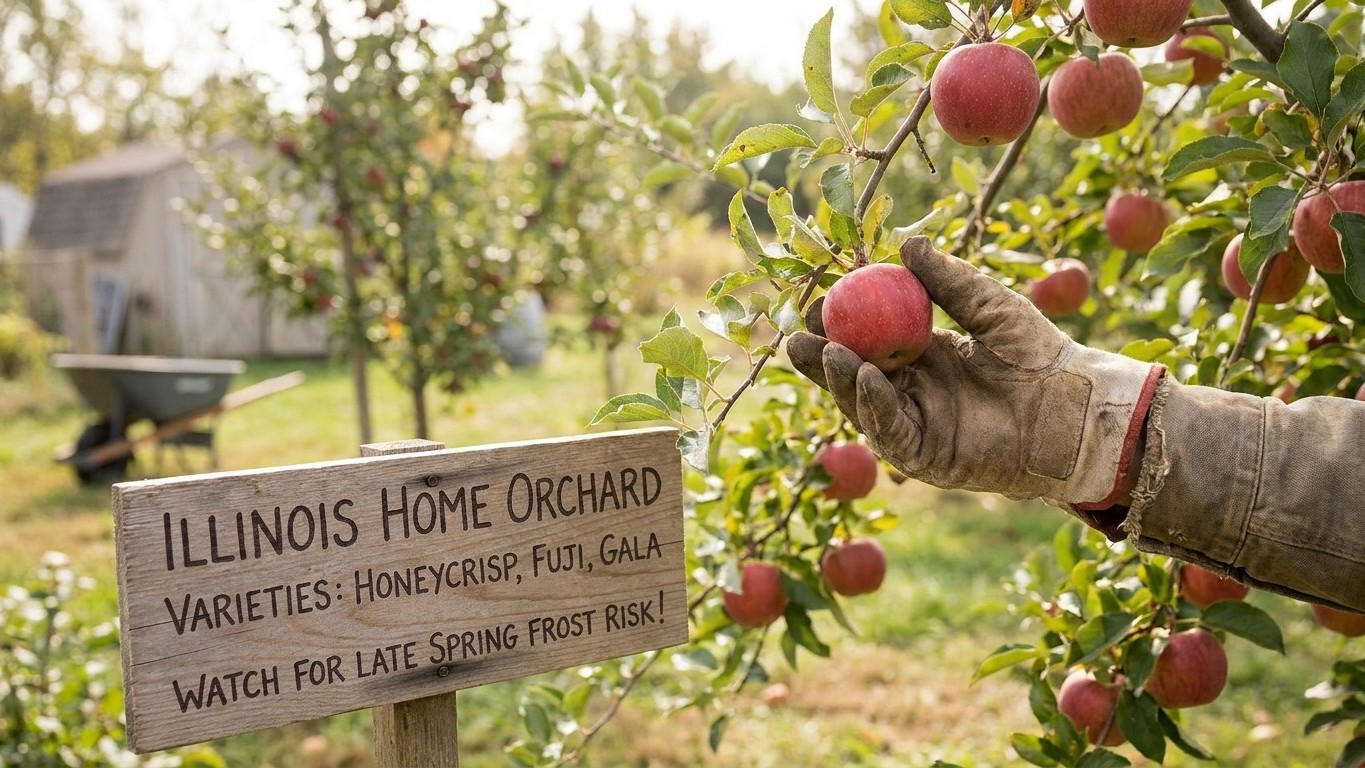

Illinois can absolutely grow apples, but the state stretches from zone 5a near the Wisconsin border to 7b down near Cairo, and that gap decides whether a tree lives or dies more than anything written on the nursery tag. A variety picked for the wrong end of the state will struggle no matter how well it’s planted. Find your county’s zone first, then choose a variety rated hardy to that number, not to “Illinois” as a whole.
Can you grow apples in Illinois
Apples are one of the most dependable fruit crops for Illinois gardens, and the state’s long history of commercial orchards along the river bluffs and around the southern tip near Cairo backs that up. The USDA Plant Hardiness Zone Map (2023 edition, based on 1991-2020 normals) spans zones 5a through 7b across the state, from the cold shoulder near the Wisconsin line down to the milder ground near Cairo. That is a wide spread, and a variety chosen for the north will not necessarily do well in the south, or the other way around.
NOAA’s NCEI 1991-2020 climate normals put the coldest month’s mean nightly minimum at Chicago at 16.5°F. That figure describes the airport weather station, not the whole state, and it is a monthly average of daily lows, not the record cold snap a hard winter can bring. It stands in well for the cold end of Illinois apple country: cold enough that a genuinely hardy rootstock and scion matter, and cold enough to rule out varieties bred for warm-winter regions.
Farther south, winters run milder and the hardiness zone climbs toward 7b, opening room for varieties that would struggle to survive a winter near the Wisconsin border. The practical takeaway is that apples work across nearly all of Illinois, as long as the variety and rootstock match the local zone rather than the statewide average. A grower in the Chicago suburbs should treat zone 5a as the design limit. A grower near Cairo has more latitude, but should still check a nursery’s rated hardiness range against the county’s own zone before ordering, since the state figure hides real differences from one river valley to the next.
What the zone figures actually predict
A hardiness zone predicts whether the tree’s wood and buds survive winter cold, nothing more. It says nothing about how many frost-free days the growing season offers, how wet the spring is, or how humid the summer gets, all of which affect disease pressure on the leaves and fruit. A grower choosing between two apple varieties both rated for the same zone should also weigh disease resistance, since Illinois summers bring enough humidity to favor apple scab and fire blight in susceptible cultivars. Consulting a guide to The Best Apple Varieties for Illinois can help narrow the choices before comparing rootstocks, and reviewing The Illinois Apple Calendar, Stage by Stage shows how these season-length differences play out month by month. Rootstock, not just the named variety, carries much of the winter-hardiness rating on a nursery tag, so check both figures before ordering.
Which varieties suit this climate

Illinois growers have a long list of proven cultivars to choose from, but the state’s swing from zone 5a to 7b (USDA Plant Hardiness Zone Map, 2023 edition) means the right pick depends on which end of the state a garden sits in. The varieties below are commonly rated hardy across most or all of that range in standard nursery catalogs, though a grower near the Wisconsin border should lean toward the lower end of each variety’s published zone range, and a grower near Cairo has more room to experiment.
| Variety | Published USDA hardiness zones | Winter chill need | Typical bloom timing |
|---|---|---|---|
| ‘Honeycrisp’ | 3-7 | High | Mid-season |
| ‘Liberty’ | 4-8 | Moderate to high | Mid-season |
| ‘Enterprise’ | 4-8 | Moderate to high | Late mid-season |
| ‘Zestar!’ | 3-7 | High | Early to mid-season |
| ‘Cortland’ | 4-7 | Moderate to high | Mid-season |
| ‘Gala’ | 5-8 | Moderate | Early to mid-season |
‘Liberty’ and ‘Enterprise’ carry strong scab resistance bred in, worth weighing given the humid Illinois summer mentioned above. ‘Honeycrisp’ and ‘Zestar!’ are both Minnesota-bred selections built for cold survival, which suits the northern part of the state especially well.
Matching chill to this climate
Hardiness zone answers whether the wood survives winter. Winter chill, the number of cold hours a tree needs before it can flower normally, is a separate question, and it is the one most guides skip. A tree that never gets enough chill produces a thin, ragged bloom instead of a full one, a problem that shows up mainly in the Deep South, where winters run too warm for high-chill northern varieties.
Illinois sits toward the high end of the chill scale, not the low end. Its long, genuinely cold winters accumulate far more chill hours than any of the varieties above require, so chill shortfall is rarely the failure mode here. The risk runs the other way: a low-chill variety bred for a mild-winter state can still get plenty of chill in an Illinois winter, but it may lack the cold-hardiness of wood and bud that Illinois temperatures actually demand, which is a hardiness problem, not a chill one. That is why the hardiness rating still matters more than chill for this state.
No Illinois-specific trial list is cited here. For cultivars actually trialed in the state’s own orchards, check Illinois Extension’s county offices, covered in the Local help section below, rather than relying on catalog descriptions alone.
Planting a pair that works here
Apple trees need a second, genetically different apple tree blooming at the same time nearby, and at least one of the two has to produce fertile pollen. Most nurseries sell diploid varieties with fertile pollen, but a handful of well-known apples, including ‘Jonagold’, ‘Winesap’ and ‘Stayman’, are triploids whose pollen is sterile. Planting one of those as your only second tree leaves both trees unpollinated even though they flower at the right time.
From the table above, ‘Honeycrisp’ and ‘Liberty’ pair well in most of Illinois: both bloom mid-season, both carry fertile pollen, and both are commonly stocked by nurseries serving this region. ‘Enterprise’ and ‘Zestar!’ also overlap enough in bloom timing to work as a pair, with the added benefit of ‘Enterprise’ bringing scab resistance to a planting that will see humid Illinois summers. Where a triploid variety is wanted for its fruit, such as ‘Jonagold’, it needs two other pollen-fertile varieties nearby rather than one, since it cannot return the favor to either.
Distance matters as much as timing. Keep the two trees within easy range of the same pollinators, close enough that a bee moving from one canopy to the other during a single foraging trip is likely rather than an accident. Growers just across the state line in Indiana are working with almost the same bloom windows and the same pollination math, and the pairing logic covered in Growing Apples in Indiana: Varieties, Timing and Frost Risk carries over directly.
The frost that costs a crop here

The frost that actually threatens an Illinois apple crop comes in spring, after growth has already started, not in the depths of winter. NOAA’s NCEI 1991-2020 climate normals put the last spring freeze at Chicago in the window of April 11 to April 22, based on the 30 to 70 percent probability band for a 32°F freeze at that airport station. Gardens outside the city, especially in suburban and rural low spots, typically see their last frost later than that window, sometimes by one to two weeks, and elevation makes the gap wider still. Check your own county’s frost history rather than assuming the Chicago date applies to your yard.
Why timing matters more than the calendar date
A frost that lands while the buds are still tightly closed does little damage. One that lands after the buds show pink, or after the flowers have opened, kills the flowers themselves. The tree survives and looks perfectly healthy through the summer, but there is no crop that year, because the flowers carrying next fall’s apples are gone. That gap between what the tree looks like and what it will actually produce is the single most common frost mistake home growers make, mostly by assuming a tree that leafed out fine must be fine altogether.
That April 11 to April 22 window is a probability band, not a guarantee. Frost can still arrive earlier or later than either edge in any given year, which is exactly why NOAA frames it as a range of odds rather than a single date. Treat the whole window, and the week or two beyond it that many suburban gardens experience, as the stretch to watch a weather forecast closely once trees reach the pink stage.
There is not much a home grower can do to stop a hard freeze once buds have opened, short of small-scale tactics: covering a young or dwarf tree with frost cloth overnight, or simply accepting that some seasons will lose bloom to a late cold snap. The more durable fix is choosing a late-blooming variety in the first place. ‘Enterprise’ and ‘Liberty’ both tend to bloom on the later side of mid-season, giving them a better chance of flowering after the frost risk has mostly passed, compared with an early bloomer that opens flowers while frost is still a real possibility.
Growers further north, across the Great Lakes in Ontario, face an even later and less certain frost window, and the same logic about bloom timing and variety choice applies there too, covered in Growing Apples in Ontario: Varieties, Timing and Frost Risk.
The apple year in Illinois
The apple growing calendar in Illinois runs by the tree’s own stage, not by a fixed date on a wall calendar, because the exact week each stage arrives shifts with the weather every year. Anchoring each stage against the Chicago-area frost dates from NOAA’s NCEI 1991-2020 normals still gives a useful frame, as long as it is read as a guide to when to start watching the tree closely, not a schedule to follow blindly.
- Dormancy (roughly November through late winter): prune while the tree is bare and the wood structure is easy to see, finishing before buds start to swell.
- Green tip: the first green shows at the bud tip, usually in the weeks running up to the Chicago area’s average last frost window of April 11 to April 22. This is the point to start checking overnight lows against a forecast.
- Pink: buds show color a few days before they open. A frost at this stage can still cost real bloom, so this is the highest-stakes stretch of the whole year for a home orchard.
- Bloom: flowers open, ideally once the frost-risk window has largely passed, though a late cold snap after the Chicago-area date can still catch an early bloomer.
- Petal fall: petals drop and pollinated flowers begin swelling into young fruit. Thin out crowded clusters now if the tree set heavily.
- Fruit set and June drop: the tree sheds some fruit naturally, which is normal and not a sign of a problem on its own.
- Harvest: pick before the first fall frost, which NOAA’s NCEI 1991-2020 normals put at Chicago between October 24 and November 3, though many varieties are ready well before that window and rural gardens often see frost earlier than the airport station does.
Later-ripening varieties such as ‘Enterprise’ can hang on the tree closer to that fall frost window, while earlier ones like ‘Zestar!’ come off well ahead of it, so harvest timing depends on the variety planted as much as on the calendar.
Local help
Illinois Extension is the best local resource for variety lists trialed in the state’s own conditions and for spray timing tailored to the season’s disease pressure. Their county offices, reachable through Illinois Extension, can also confirm frost dates and hardiness guidance specific to your part of the state.
Common questions
Can I grow apples in a container in Illinois?
Dwarf apple trees on dwarfing rootstock can be grown in large containers, but the roots get far less insulation from cold than they would in the ground. A containerized tree needs to be moved against a wall, into an unheated garage, or otherwise sheltered for winter, since a pot exposes roots to cold well beyond what the same variety would tolerate planted in the ground.
How many years until a new apple tree bears fruit?
Most apple trees on dwarfing or semi-dwarfing rootstock start bearing a light crop within two to four years of planting, while trees on full-size rootstock can take longer, sometimes five years or more. Exact timing depends on rootstock, variety, and how hard the tree is pruned in its early years.
My tree bloomed fine but set almost no fruit. What happened?
The most common causes are a pollinator problem or cold, wet weather during bloom that kept bees from flying. If there was no compatible second variety blooming at the same time, or if a late cold spell hit after the flowers opened without an obvious hard freeze, poor pollination is the likely explanation rather than anything wrong with the tree itself.
Will one apple tree produce fruit on its own?
A few varieties are marketed as self-fertile, but even those tend to set a heavier, more reliable crop with a second compatible variety nearby. Relying on a single tree, especially a triploid variety with sterile pollen, is the most common reason a home orchard produces little or no fruit for years.
Does hardiness zone tell me whether a variety will flower well here?
No, hardiness zone only predicts whether the tree’s wood survives winter cold. Winter chill hours are the separate measure that governs whether flowering happens normally, and in Illinois, chill is rarely the limiting factor since winters here run cold and long enough to satisfy nearly every commercially sold variety.