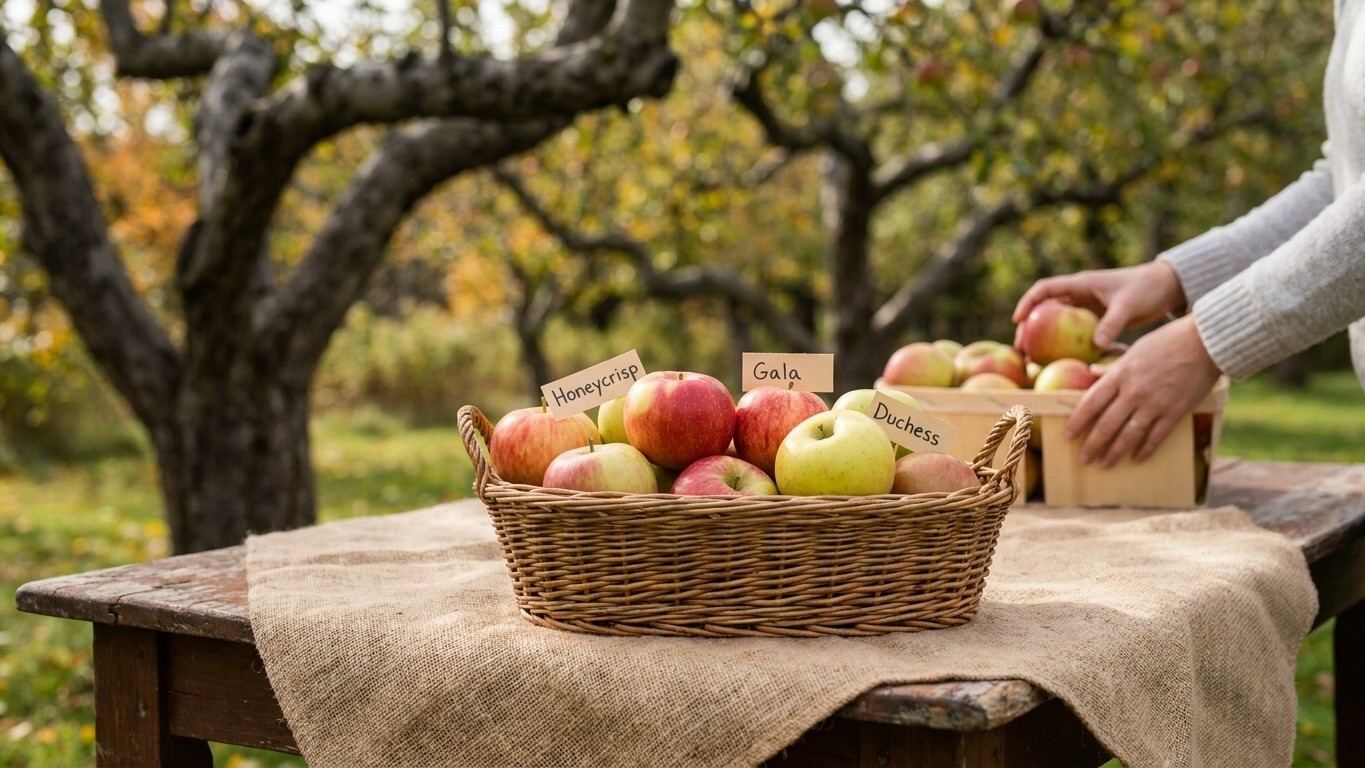

The apples that succeed on Prince Edward Island are the ones bred to survive a winter where the coldest month’s average daily minimum runs to -12.1 °C at the Charlottetown reference station (Environment and Climate Change Canada, 1981-2010 normals), not the ones picked off a nursery’s prettiest photo. That figure is a mean, not the record low, so treat it as a floor rather than a worst case. Before you order rootstock, confirm with the seller that both the scion and the rootstock are rated to survive colder than that number, and check flowering timing against the region’s frost window.
The short answer for Prince Edward Island
An apple tree earns a place on Prince Edward Island by clearing two separate hurdles, and a variety name alone answers neither of them. The first is winter survival: the tree’s wood, and especially its rootstock, has to tolerate a cold season where Charlottetown’s average daily minimum in the coldest month sits at -12.1 °C (Environment and Climate Change Canada, 1981-2010 climate normals). That is a mean figure, not the record low for the coldest night of a hard winter, so a scion or rootstock rated only just above it is a gamble, not a safe margin.
The second hurdle is chill: the tree needs enough accumulated cold hours over winter to break dormancy evenly and flower on schedule, or it blooms late, thin, and uneven. PEI’s winters are long enough that under-chilled types bred for milder regions are rarely the risk here. The risk runs the other way: a variety that also needs a long, reliably warm summer to finish its fruit may not get one before the average first fall frost, put by ECCC at October 17 for the Charlottetown A station.
Neither hurdle is answered by a single named cultivar in this piece, because no PEI extension bulletin in our sourced records recommends specific apple varieties by name for the province. What the two hurdles do answer is the shopping list: ask any nursery selling into Atlantic Canada for the hardiness zone rating and the chill requirement of both rootstock and scion, in writing, before you plant. For the steps that come before this decision, including site and soil prep, see Growing Apples in Prince Edward Island.
Working through it

Ranking realistic choices for this climate means ranking traits, not brand names, since the hardiness and chill data attached to any specific cultivar you might buy has to be checked against Charlottetown’s own numbers before you trust it. Three broad categories cover almost everything sold as an apple tree in the Maritimes, and each comes with a different cost.
Cold-hardy dessert types
These are bred or selected specifically for northern climates and are rated by nurseries to survive winters at or below the kind of minimum PEI records. They generally trade some of that hardiness for a shorter storage life off the tree and, in some cases, a plainer flavor than a variety bred for a milder growing region. This is the safest starting category for a first planting here, but “cold-hardy” on a tag is a claim to verify against the -12.1 °C figure, not to take on faith.
Crabapple pollinizers
Most dessert apples are not self-fertile and need a second, overlapping-bloom tree nearby to set fruit at all. A cold-hardy crabapple planted as a pollinizer costs a bit of orchard space and produces fruit you likely will not eat fresh, but it buys reliable pollination in a season when a late frost or a cool, wet bloom period keeps bee activity low, both of which happen on PEI often enough to plan around.
Cider and processing types
Some of the hardiest apple stock available for northern climates was selected for cider or cooking rather than fresh eating, and it tends to tolerate PEI’s winter minimums with the widest margin of the three categories. The cost is in the kitchen, not the orchard: fruit bred for tannin and acid rather than sweetness is a poor substitute if what you actually want is a dessert apple off the tree.
| Category | Winter hardiness | Chill need | What it costs you |
|---|---|---|---|
| Cold-hardy dessert | Bred for northern minimums | Moderate to high, met easily here | Shorter storage, milder flavor |
| Crabapple pollinizer | Very high | High, met easily here | Fruit not meant for fresh eating |
| Cider or processing | Very high | High, met easily here | Tannic, sharp fruit, not dessert quality |
Whichever category you buy into, the calendar that decides when to act is built on stage, not month. Bud break, bloom, and petal fall each move earlier or later than the average dates depending on the spring you actually get, and the sequence matters more than the date on the wall. The full stage-by-stage breakdown, anchored on Charlottetown’s frost normals, is laid out in The Prince Edward Island Apple Calendar, Stage by Stage, and it is worth reading before you commit to a bloom-timing bet on any one variety.
What changes across Prince Edward Island
The -12.1 °C winter minimum and the May 16 and October 17 frost dates above all come from the Charlottetown A station, sited on the Island’s central south coast. Prince Edward Island is small and low-lying, but it is not one climate, and the water around it does most of the work of setting local difference.
Coastal ground close to the Northumberland Strait and the Gulf of St. Lawrence is buffered by the surrounding water, which moderates both the depth of winter cold and the speed of spring warm-up. Inland ground, away from that moderating effect, tends to hold cold air longer into spring and pick it up sooner in fall, which pushes the practical bloom and frost-risk window later and earlier respectively than the Charlottetown normals suggest. Low-lying inland spots that collect cold air on a still night are the ones most likely to see frost when the official date has already passed on the coast.
Site inside a single property matters as much as region. A slope that drains cold air away, or a planting on the south or west side of a windbreak, will run measurably milder at bloom time than a hollow fifty yards away that pools frost every clear night. Since no station-level normals exist for every corner of the province, the safest approach is to treat the Charlottetown dates as a starting midpoint and watch your own site’s actual frost behavior for a season or two before trusting it with a full planting.
Prince County, Queens County, and Kings County each cover a mix of coastal and inland ground, so a county line by itself tells you less than the specific site does. A field a few miles from the water in any of the three can run noticeably colder at bloom time than a coastal one in the same county, and only your own observation will tell you which side of that divide your planting falls on.
The mistakes this climate punishes
Three mistakes account for most of the failed apple plantings and disappointing crops we hear about in this climate, and each one shows up at a different point in the tree’s life.
Buying on hardiness zone alone, without checking the actual minimum
A rootstock or scion rated for a zone that technically includes Charlottetown can still fail here if its rated minimum sits close to the region’s -12.1 °C coldest-month average, because that average is not the coldest night the tree will ever see. A hard winter runs colder than the mean, and a tree with no margin above the mean has none left when a genuinely cold week arrives. This mistake shows up in year two or three, when a tree that leafed out fine the first spring dies back to the rootstock after its first real cold spell.
Trusting a bloom date instead of a bloom stage
Prince Edward Island’s average last spring frost falls on May 16 at the Charlottetown A station, and that is a mean date: in roughly half of all years, frost arrives later than that. A variety that blooms early relative to the local average is betting its whole crop on the half of years that run mild. This mistake shows up as an empty tree in a year that otherwise looked like a good growing season, because the blossoms opened during a frost that came exactly on schedule for the other half of the historical record.
Feeding or pruning late into the season
Nitrogen applied in mid to late summer, or pruning cuts made close to fall, push a tree into soft new growth right when it should be hardening off for winter. With an average first fall frost on October 17 at Charlottetown, that soft growth has little time to toughen before the cold arrives, and it is the first tissue to die back. This mistake shows up the following spring as blackened tips on last year’s newest wood, even when the rest of the tree looks fine.
Checking this against your county
Prince Edward Island’s three counties, Prince, Queens, and Kings, each run a mix of coastal and inland ground, so the Charlottetown figures above are a starting point, not a verdict on your own field. Before you commit to a variety or a planting date, check current guidance with the Prince Edward Island government’s agriculture section, which can point you toward local extension contacts and any updated hardiness or variety information for your part of the province.
Keep a simple record of your own site’s first and last frost for a couple of seasons. That local log will tell you more about your specific yard than any province-wide average ever will.
Common questions
Can apples actually survive winter on PEI?
Yes, provided the rootstock and scion are rated to tolerate winters colder than the Charlottetown area’s coldest-month average minimum of -12.1 °C (ECCC, 1981-2010 normals), since that figure is a mean and not the coldest night you will ever see. Ask the nursery for the hardiness rating in writing rather than relying on a general “cold hardy” label.
Do I need more than one apple tree?
Most apple varieties are not self-fertile and need a second tree, often a crabapple, blooming at the same time within a reasonable distance to set fruit reliably. A single isolated tree may produce a light crop in some years from a neighbor’s tree or a wild crabapple nearby, but planting a dedicated pollinizer removes that uncertainty.
When is the safe date to plant a new apple tree?
There is no single safe date, only a window built around the region’s average last spring frost of May 16 and average first fall frost of October 17, both from Environment and Climate Change Canada’s Charlottetown normals. Spring planting after the ground has thawed and before leaf-out, or fall planting well before the ground freezes, both work, and the choice depends more on when you can get a healthy tree into the ground than on a fixed calendar date.
Why didn’t my tree flower this year even though it survived the winter fine?
Surviving winter and flowering on schedule are answered by two different things, hardiness and chill. A tree that lived through the cold but bloomed late, thin, or unevenly likely did not accumulate the winter cold hours it needed in the right pattern, which is a chill problem rather than a hardiness one, and it is worth asking the nursery you bought from about the chill requirement of that specific cultivar.