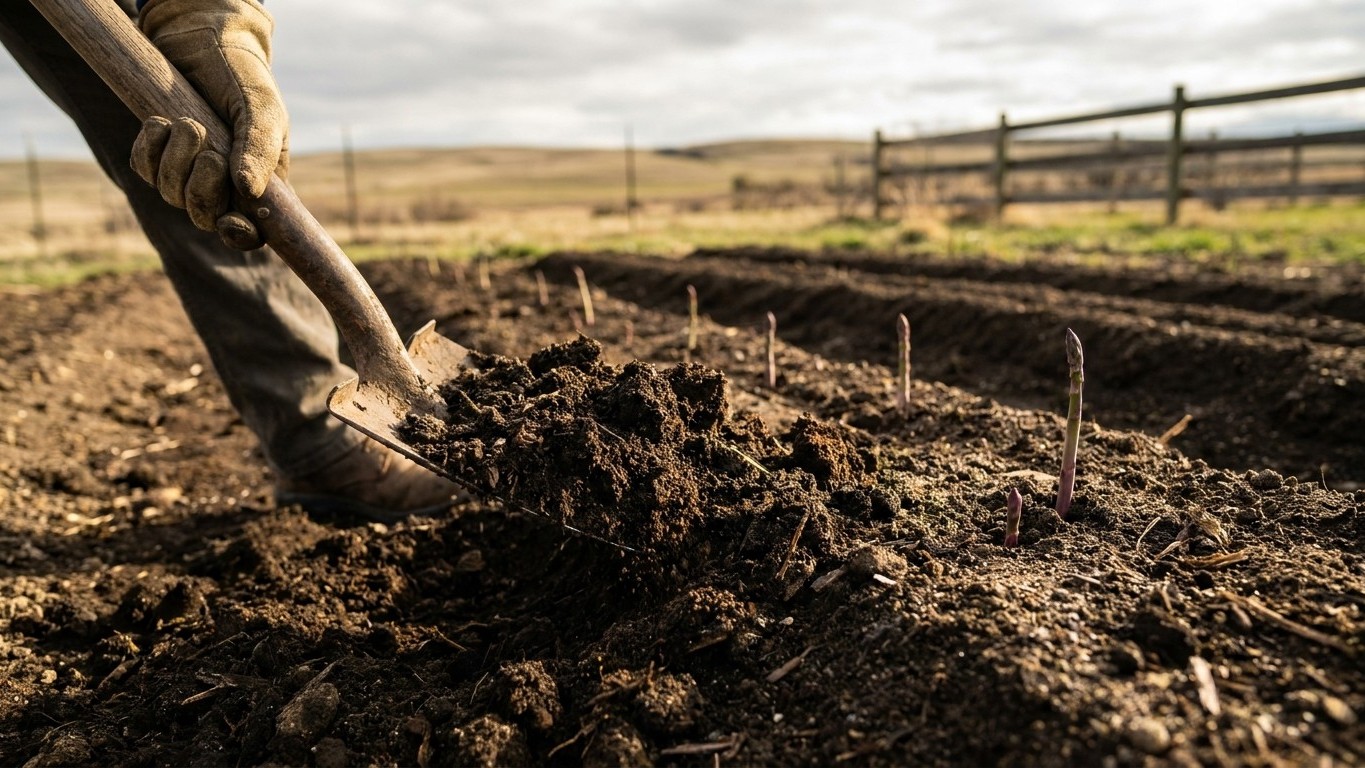

an Asparagus Bed planted in Prince Edward Island’s sandy soil this spring will still be producing spears the year that soil has cycled through fifteen winters, which raises the real question: Will Prince Edward Island Soil Hold an Asparagus Bed for Fifteen Years? That single fact reframes everything else about the decision: where the crowns go is not a one-season call, it’s closer to picking a spot for a young tree.
The short answer
The commitment comes first, because it changes how carefully the site should be chosen. Once planted, an Asparagus Bed produces for 10 to 15 years, and the only soil condition Utah State University Extension attaches to that run is drainage: the ground has to shed water, full stop. There’s no harvest at all in the first two years, and even year three brings just four weeks of cutting, then six, then eight in later seasons, with the rule to stop being an object rather than a date, when most of the spears coming up are thinner than a pencil rather than thick enough to bother snapping.
Against that fifteen-year backdrop, Prince Edward Island’s ground has a split personality worth knowing before a shovel goes in the ground. The province’s dominant mapped soil is a Podzol, the acid, leached profile that forms under conifer cover once rain has stripped the bases out of the topsoil, and it covers about a third of the surveyed surface. Texturally it leans sandy, 66 percent sand against 7 percent clay and 27 percent silt, with organic matter around 2.2 percent. Sand of that proportion usually drains fast and cleanly. Yet the same soil is classed as imperfectly drained, which tells a gardener that texture alone isn’t the whole story: something in the profile, a compacted layer, a seasonal high water table, a low spot in the field, is slowing the water down even though the sand grains themselves would let it through.
That gap between “sandy” and “imperfectly drained” is exactly why a provincial average can’t stand in for a backyard. A raised bed reads sandy on top and heavy six inches down. A field edge reads dry all July and wet every April. The only honest move is to dig a test hole where the crowns are meant to go, fill it with water, and time how long it takes to disappear; if it’s still standing after several hours, the fix is to build the row up, mounding the bed six to eight inches above grade, rather than fighting fifteen years of wet feet at planting depth. The province’s median surface pH, for reference, runs around 4.8, strongly acid, but the source on asparagus itself is silent on pH, so that number is background context for the ground here, not a target to hit before planting.
Knowing When to Plant Asparagus Crowns in Prince Edward Island matters as much as the site itself: crowns go into 8-inch furrows and get backfilled gradually, roughly two inches of soil added every other month across the first year rather than filling the trench all at once. That slow burial matters more on a soil that’s already inclined to hold water, since it keeps the crown from sitting in a filled trench that traps moisture before the plant has rooted into the surrounding ground.
Will the summer here water it for you?
Once a bed is established, the water demand is specific: 1 to 2 inches every other week for the first two years, easing back to every three weeks after that. Charlottetown’s climate normals give a summer that comes close to that pace on paper, but the details matter more than the seasonal total.
- The three-month total. June through August averages about 10.8 inches at the Charlottetown A station, spread across June (3.89 inches), July (3.15 inches), and August (3.77 inches). Averaged out, that’s a little under an inch a week, in the same neighborhood as the bed’s stated need.
- The dry month to watch. July is the lean point of the summer, at 3.15 inches, meaning the month with the most heat also has the least rain to answer it. That’s the stretch where a young bed, still in its two-year establishment window, is most likely to fall short without help.
- Why the average still misleads. Rain that falls as one heavy thunderstorm sheds off a sandy surface fast and doesn’t linger the way a slow, soaking rain does; a soil already described as imperfectly drained can still crust or run off unevenly depending on where the water lands relative to the bed.
- The gardener’s move. Treat the seasonal average as a rough green light, not a guarantee, and set a rain gauge at the bed itself. If a two-week stretch produces less than an inch, particularly in July, that’s the signal to supplement rather than trust the calendar.
These are normals for one reference station, not a promise for any particular yard; a garden closer to the coast, on a slope, or shaded differently will see its own pattern. The number worth keeping is the gap between what the bed asks for and what a given week actually delivers, checked directly rather than assumed from a seasonal average.
When to put the crowns in
Crowns go into the ground in early spring, while the soil is workable but the plant hasn’t broken dormancy yet. In Prince Edward Island, the anchor point for that window is the average last spring frost at Charlottetown A, which falls around May 16. That date is a mean, not a promise: in roughly half of all years, frost arrives later than that, so treating May 16 as a safe planting cue rather than the midpoint of a range is the mistake to avoid. Growers working further inland or at higher elevation than the Charlottetown station should expect their own frost window to run later still, since a single coastal station doesn’t speak for the whole province.
In practical terms, that means watching soil condition alongside the calendar rather than one instead of the other. Crowns want ground that can be worked into an 8-inch furrow without turning to mud, and a bed planted into cold, saturated soil right after snowmelt risks rot before it risks frost damage. Waiting until the soil has warmed and drained a bit past the average frost date is generally the safer read of “early spring” on ground already inclined to hold water.
Seed is the other route in, and it changes the timeline rather than the soil requirement. Starting from seed pushes the whole schedule back, since seedlings need a season of growing on before they’re set out as young crowns, and the fifteen-year clock on harvest still doesn’t start ticking until those crowns are in their permanent bed. For a gardener choosing between the two, crowns get a bed producing sooner; seed costs an extra season up front but gives more control over which of the available options ends up planted.
On variety, the published record from Utah State University Extension is narrow: it names four options and identifies each only by its flowering habit, not by flavor, yield, or any reason to prefer one over another. Jersey Giant and Jersey Knight are all-male selections, while UC 157 F1 and Purple Passion are male-female mixes. All-male varieties tend to be chosen because they don’t set seed and spend energy on volunteer seedlings, but that’s a general habit of the type, not a claim made about taste or tonnage in the source itself. Nothing further is published here on which performs best in this particular soil or climate.
Checking this against your own county
A provincial soil profile and one climate station describe tendencies, not the ground under a specific bed. Before committing a spot for fifteen years, the more useful check is local: Prince Edward Island’s own agriculture program, reachable through the province’s agriculture topic page, is the named channel for soil test kits, planting guidance suited to specific counties, and current advice that a national soil survey or a single climate normal can’t capture.
That’s worth doing before the crowns go in the mail, not after. A soil test answers the pH question this article deliberately leaves open, and a local agronomist can say whether a given field runs wetter or drier than the Charlottetown average would suggest. For a planting decision measured in years rather than seasons, that hour of homework is cheap insurance.
Common questions
Can asparagus grow in acidic Podzol soil without amendment?
The source used for this article’s asparagus guidance doesn’t specify a pH requirement, so no claim is made here about whether the province’s typically acid, roughly 4.8 median surface pH needs correcting. A soil test through the provincial agriculture program is the way to settle that for a specific plot.
What if my planting site tests as poorly drained?
Since drainage is the one soil condition the source insists on, a site that holds water after a test-hole check should be built up rather than planted at grade, mounding the row so the crowns sit above the wet layer rather than in it.
How early can I expect to harvest after planting?
Not until year three, and even then only for about four weeks, moving to roughly six weeks and then eight weeks in later seasons. There’s no earlier picking available regardless of how vigorous the first-year growth looks.
Does the May 16 frost date mean it’s safe to plant crowns then?
No. It’s an average from Charlottetown A, meaning frost falls after that date in about half of all years. It’s a reference point for timing, not a guarantee, and inland or higher-elevation sites should expect their own window to run later.