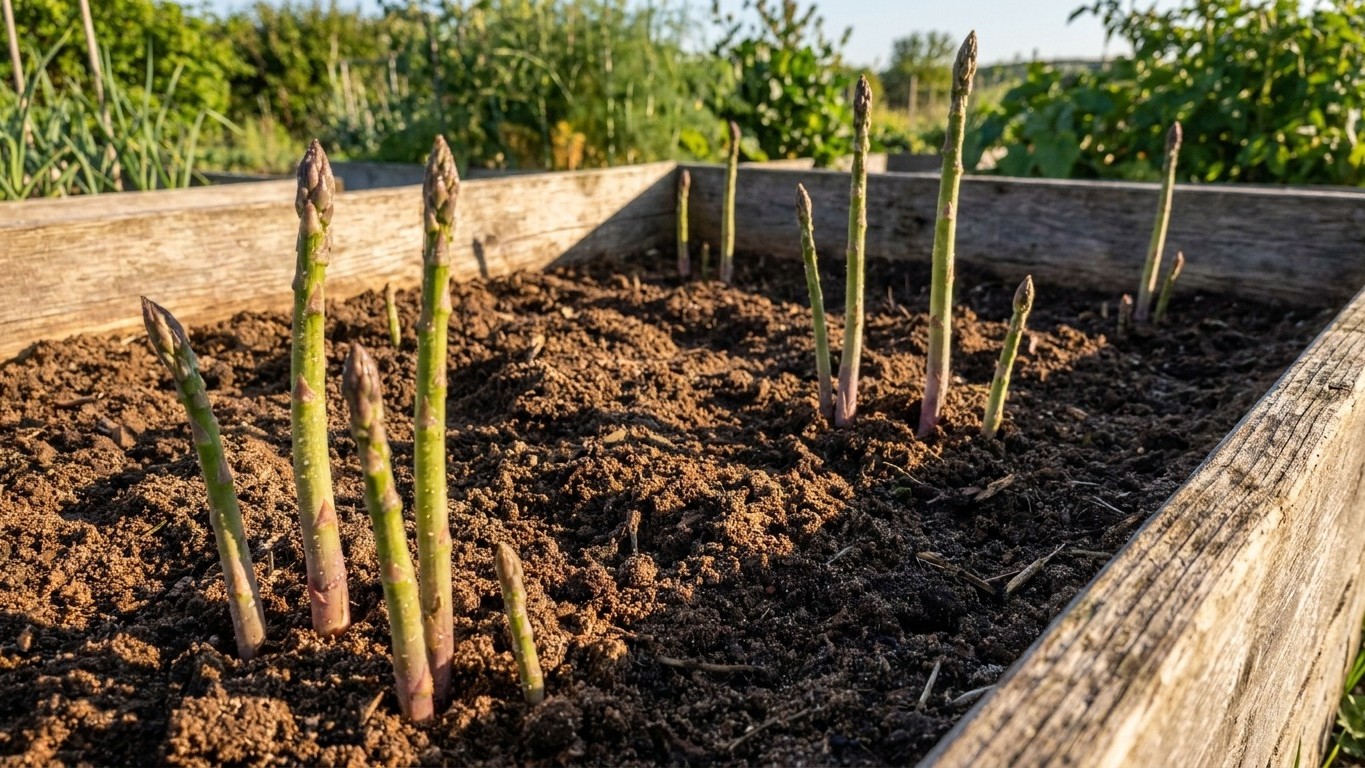

Prince Edward Island’s dominant soil is a sandy, acid Podzol that drains adequately for most garden crops, but its official rating is “imperfectly drained,” a word that matters when the crop in question sits in the same spot for ten to fifteen years. Asparagus tolerates almost any soil except one that stays wet. So the honest answer is: probably yes, with a drainage check before you commit a single crown.
The short answer
Start with what the soil actually is. Across the mapped agricultural surface of Prince Edward Island, the most common profile is a Podzol, the acid, leached soil type that forms under conifer forest, where centuries of rain have washed the base minerals out of the topsoil. The median surface reading runs about pH 4.8, strongly acid, and the texture leans heavily sandy: 66 percent sand, 27 percent silt, 7 percent clay, with organic matter around 2.2 percent. That sand content is good news for drainage in principle, since sandy particles leave large pore spaces that water moves through quickly. Yet the same survey classifies this soil as imperfectly drained overall, which tells you something is slowing that water down somewhere in the profile, whether a denser layer beneath the surface, flat terrain that stalls runoff, or a naturally high water table in low-lying fields.
What that means for a fifteen-year bed
Utah State University Extension’s guidance on asparagus is blunt on this point: most soils will grow the crop, provided they are well drained. There is no pH range published in that guidance and no chilling requirement either, so neither belongs in this answer. Drainage is the one condition named, and it is also the one condition where this territory’s rating gives a mixed signal: sandy in texture, which favors drainage, but imperfectly drained in classification, which does not.
This is exactly why a provincial soil profile is a starting point rather than a verdict on any one yard. The median describes hundreds of mapped components rolled into a single number; a garden on a gentle slope with sandy loam may drain perfectly well, while a low spot fifty feet away, on the same farm, may pool water every spring. Before digging the furrows for a bed meant to outlast a decade of seasons, dig a test hole instead. Fill it with water, let it drain, then fill it again and time how long the second fill takes to disappear. If it clears within a few hours, the ground passes. If water is still sitting there the next day, the fix is not to abandon asparagus, it is to build the bed up: a raised mound or raised bed frame filled with amended, sandier soil solves the imperfect-drainage problem without needing to relocate the whole planting.
Will the summer here water it for you?
Asparagus has a two-stage thirst. In the first two years after planting, while roots are establishing, it wants 1 to 2 inches of water every other week. Once the bed matures, that eases to roughly the same amount every three weeks. Set against Charlottetown’s climate normals, average summer rainfall across June, July and August comes to about 10.8 inches, broken down as June 3.89 inches, July 3.15 inches, and August 3.77 inches.
- Weekly average, spread evenly: divided across roughly thirteen summer weeks, 10.8 inches works out to well under an inch a week on paper, below the every-other-week target a new bed needs during its first two seasons.
- But rain doesn’t arrive evenly: normals are monthly totals built from scattered storms and dry stretches, not a steady drip, so a young bed can sit through a two-week gap even in a month that averages close to 4 inches.
- July is the tightest month: at 3.15 inches it’s the driest of the three, and it lands squarely in the establishment window for any bed planted the same spring, or in year two for one planted a year earlier.
- Sandy soil accelerates the shortfall: given the texture already described, sand lets water through fast and holds little in reserve, so a dry week here drains a young asparagus root zone faster than the same week would on a heavier clay soil.
- The practical fix: a rain gauge staked next to the bed is the only way to know whether a given week met the 1-to-2-inch target; when it falls short, supplemental watering closes the gap rather than trusting the sky to average out over the season.
None of this is a forecast. These are 1981-2010 normals for the Charlottetown A station, and a garden on the other side of the Island, closer to the coast or set back in higher ground, will see a different pattern of the same averages. The number to trust in the end is whatever a gauge on that particular plot records.
When to put the crowns in
Crowns go into the ground in early spring, set into furrows about 8 inches deep. On Prince Edward Island, early spring means working around a mean last frost date of about May 16 at the Charlottetown station. That date is an average, not a guarantee: in roughly half of all years, frost arrives after it, so treat mid-May as the middle of a window rather than a safe green light, and lean later rather than earlier if a cold snap is forecast.
How the furrow gets filled
Once the crowns are set at the bottom of that 8-inch trench, the furrow isn’t backfilled all at once. Soil goes in gradually, about 2 inches every other month across the year, letting the emerging spears grow up through the loose soil rather than pushing through a solid cap. This staged fill is part of why asparagus takes patience even before the first real harvest: there is no shortcut to the crown settling in.
And that first harvest is further out than most new gardeners expect. There is no cutting at all in year one or year two. Year three brings the first harvest, limited to about 4 weeks. The following year stretches to 6 weeks, and the year after that to 8. Beyond that, the rule for when to stop cutting each season isn’t a date on the calendar, it’s a visual cue: stop once most of the spears coming up are thinner than a pencil, since that’s the plant signaling it needs to put energy into foliage rather than more spears.
Crowns versus seed, and the varieties on offer
Utah State University Extension’s guidance describes planting crowns rather than seed as the standard route, since crowns are already a year or more along and shorten the wait to that year-three harvest. Starting from seed is the alternative some gardeners choose instead, usually because crowns of a particular variety aren’t available locally, but it adds a further season of growing the plant to transplant size before the crown-planting clock even starts.
On variety, the source names four without ranking them on flavor, yield or hardiness:
- Jersey Giant, all-male
- Jersey Knight, all-male
- UC 157 F1, male and female
- Purple Passion, male and female
All-male varieties tend to be favored commercially because they don’t spend energy producing seed, but no comparative performance data appears in this guidance, so nothing more specific than sex should be claimed for any of the four.
Common questions
Does asparagus need acidic soil to grow well on Prince Edward Island?
The source used for this article’s asparagus guidance, Utah State University Extension, doesn’t publish a pH requirement at all, so no acidic or neutral target can be attributed to it. The Island’s dominant soil does run acid, at a median pH near 4.8, but whether that helps or hinders a bed isn’t something this guidance addresses. A local soil test remains the only way to know what’s actually in the ground being planted.
Can an asparagus bed handle Prince Edward Island’s sandy topsoil long-term?
Sandy texture, at roughly two-thirds sand in the province’s dominant profile, generally favors the drainage asparagus needs. The complication is that the same soil is officially rated imperfectly drained overall, so texture alone doesn’t settle the question. A simple drainage test on the actual planting site is worth more than the provincial average.
What happens if the chosen spot doesn’t drain well enough?
Rather than giving up on the crop, gardeners facing standing water typically raise the bed, building a mounded row or a framed raised bed filled with amended, sandier soil so the crowns sit above the saturated layer rather than in it. Given a fifteen-year commitment, that upfront correction costs far less than relocating an established planting later.
How soon after planting can spears actually be harvested?
Not for two full years. Year three brings the first harvest, capped at about 4 weeks, followed by 6 weeks in year four and 8 weeks from year five onward. Harvest each season stops once most spears emerging are thinner than a pencil, a sign the plant needs its energy for foliage rather than more cutting.