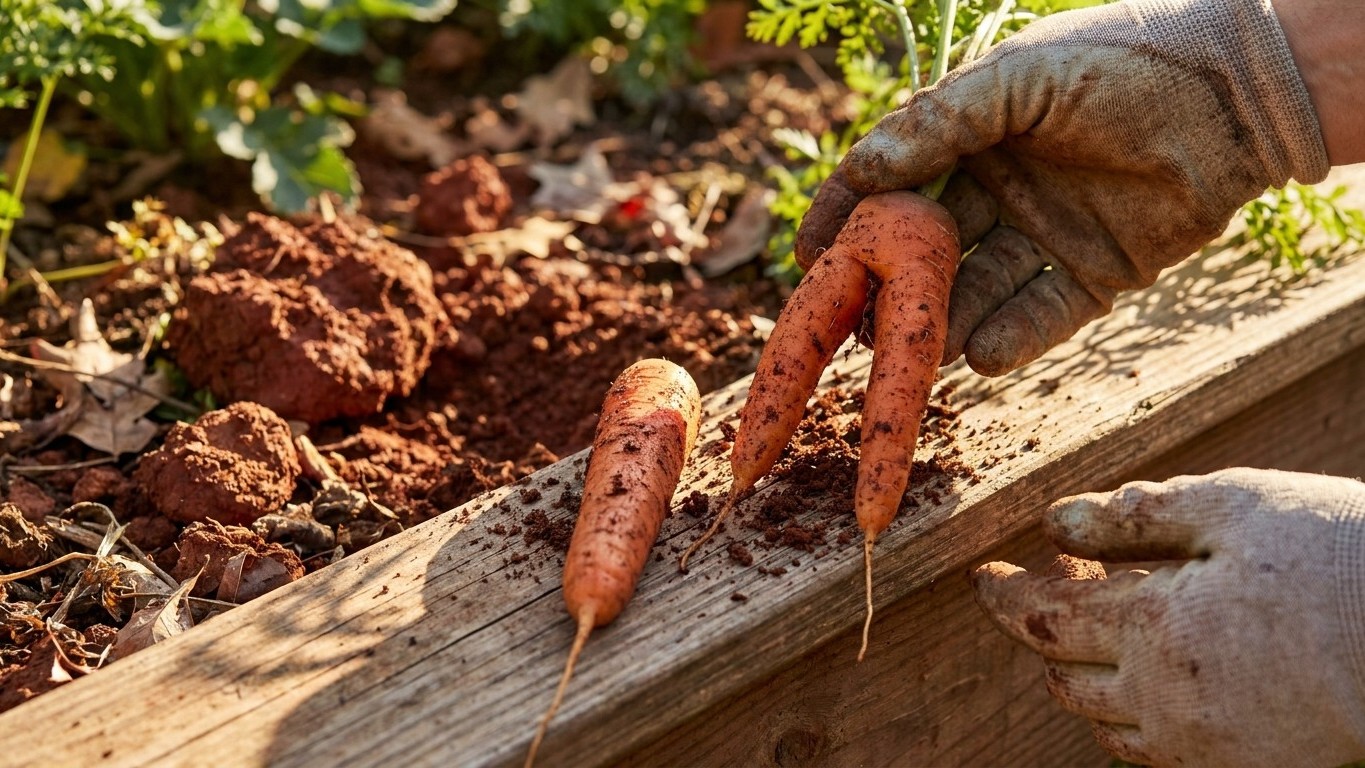

Most garden soil across Prince Edward Island is sandy, not heavy clay, so carrots planted there have decent odds of growing straight. The province’s dominant profile runs 66 percent sand and only 7 percent clay, the kind of loose ground carrots actually like. But that same soil is imperfectly drained and strongly acid, and it varies field to field enough that the only real answer for your own garden comes from digging into your own dirt.
The short answer
The soil most commonly mapped across Prince Edward Island’s agricultural land is a Podzol, the acid, leached soil type that forms under conifers once rain has washed the bases out of the topsoil. It makes up about 33 percent of the mapped surface, with Gleysolic soils close behind. The median surface reading on that Podzol runs strongly acid, around pH 4.8, and the texture leans sandy: 66 percent sand, 27 percent silt, 7 percent clay, with organic matter around 2.2 percent. Drainage is rated imperfect, meaning water moves through but not freely, and it can sit longer than a carrot root would like after a heavy rain.
Set that against what a carrot actually wants. Utah State University Extension describes the ideal carrot bed as deep, sandy, and well drained, with plenty of organic matter worked in. Heavy or rocky ground is what makes a taproot split into two or three legs instead of growing down as one clean spike. On paper, Prince Edward Island’s dominant profile checks two of those boxes already: it is sandy, and the clay content is low enough that compaction and forking from sheer density shouldn’t be the main worry. That is good news for anyone gardening on ground that matches this profile.
The catch is the other two numbers. Imperfect drainage means water can linger around the root in a wet spring, and a soil running around pH 4.8 sits well below the range most vegetable crops, carrots included, grow best in. Neither of those problems shows up as forking the way heavy clay does. They show up as stunted growth, pale color, or roots that stop early because the plant just isn’t thriving in acid, slow-draining ground. Compost worked into the top foot of soil helps on both fronts: it lightens the structure so water moves through faster, and it buffers some of that acidity over a season or two. Double digging, loosening the soil a spade’s depth deeper than you normally would, gives the root more open ground to push into before it hits anything that would deflect it sideways.
None of this is a diagnosis for your yard specifically. Prince Edward Island spans hundreds of individual soil series across its agricultural regions, and the survey behind these numbers doesn’t cover the province’s far north. A Podzol profile is a starting point, the kind of thing that tells you what the ground tends to do across a wide area, not what is sitting under your raised bed or back corner. If your garden sits on filled ground, near a riverbank, or in a low spot that used to be wet meadow, it can behave nothing like the median. That is exactly why the next step matters more than any provincial average.
The test that settles it in your own garden
- Dig a hole at least a foot deep. Use a spade in the spot you actually plan to seed carrots, not just anywhere in the yard. Set the soil aside in a pile as you go so you can look at it layer by layer.
- Check the depth before you hit something solid. Carrots need open ground to grow straight down. If you hit a hardpan, a rock layer, or dense clay within that first foot, that’s the ceiling your roots will run into and likely fork against.
- Look for stones and debris as you sift through the pile. Small pebbles are usually fine. A soil full of fist-sized rocks or construction fill is a soil where forking is close to guaranteed unless you build up rather than dig down.
- Rub a handful between your fingers. Sandy soil feels loose and falls apart almost immediately. Clay-heavy soil holds together, feels sticky when wet, and can be rolled into a ribbon without cracking. The stickier and more cohesive it feels, the more it will resist a straight root.
- Fill the hole with water and time how fast it disappears. Water that’s gone within a few hours points to free drainage. Water still sitting there the next day is a sign the soil holds moisture the way an imperfectly drained soil does, and that’s worth knowing before you sow a single seed.
None of these steps require a lab, and none of them replace one either. A basic soil test through your local extension service or a private lab will give you the one figure this page can’t: your actual pH, measured in your actual bed, not a provincial median from a mapped agricultural region.
What goes wrong here
- Forking in heavier pockets of ground. Even where the provincial average leans sandy, low spots and older garden beds can pack in more clay than the surrounding field. Roots meeting that denser ground split rather than push through. The fix is the same one Utah State University Extension gives for heavy soil anywhere: work in generous compost and double dig the bed before seeding, loosening it well beyond the depth a mature carrot will reach.
- Slow or patchy germination during a hot, dry stretch. Carrot seed is small and sits close to the surface, so it dries out fast once temperatures climb and rain skips a week. A crust can form on sandy soil that’s been left to dry between waterings, and seedlings underneath simply don’t push through it. Keeping the top inch of the seedbed consistently damp until seedlings appear solves most of this; a light mulch or row cover over the seed line helps hold that moisture in.
- Splitting from uneven watering later in the season. A soil rated imperfectly drained can swing between soggy after rain and dry a week later, and that swing is what splits a carrot root that’s already sized up. The remedy isn’t more water overall, it’s steadier water: a consistent watering schedule rather than a heavy soak followed by days of nothing keeps the root growing at an even rate instead of expanding and cracking.
- Acidic ground slowing growth without any visible forking at all. A median pH around 4.8 is well below where most vegetable roots grow their best. The plant can look thin and pale rather than forked, which is easy to mistake for a watering or fertility problem. Compost and, where a soil test confirms it’s needed, lime worked into the bed ahead of the season address this directly rather than guessing at feed or water fixes that won’t touch the real cause.
Common questions
Does sandy soil guarantee straight carrots?
It helps a lot, but it isn’t a guarantee. Sandy soil removes the density problem that causes most forking, but a carrot can still split if it hits a rock, a root, or a compacted layer underneath, or if watering swings between soaked and dry once the root has started to size up.
Should I add lime to bring the pH up before planting?
That decision should follow a soil test on your own bed rather than the provincial median. The dominant profile here runs strongly acid around pH 4.8, but individual gardens vary enough that guessing at a lime rate without testing first can just as easily overcorrect as undercorrect.
How long until carrots are ready to harvest?
Carrots are sown directly in the ground rather than transplanted, so the 70 to 100 days growers commonly count on run from the seeding date itself, not from any later transplant.
Is a raised bed worth building instead of amending the ground I have?
If your test hole turns up heavy clay, a shallow hardpan, or standing water that doesn’t drain within a day, a raised bed filled with a loose, sandy, compost-rich mix sidesteps the problem entirely rather than fighting the existing ground season after season.