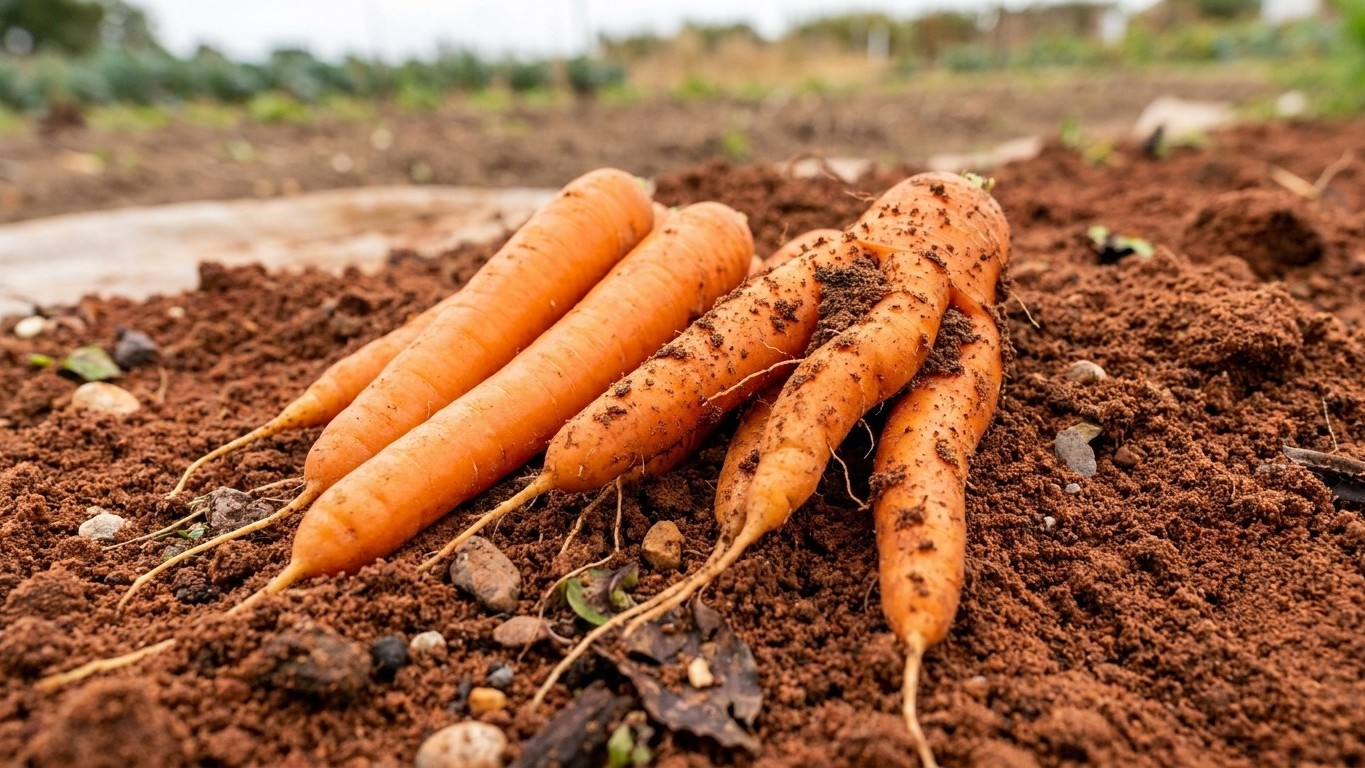

Prince Edward Island’s red soil has a reputation for being sandy, and the numbers back it up: 66 percent sand across the province’s mapped agricultural ground. That texture works in a carrot’s favor. But the province’s soil also runs strongly acid and drains imperfectly, and those two traits matter as much as sand content when you’re deciding whether to plant carrots straight into the ground or build up a bed first.
The short answer
The most common soil order across Prince Edward Island’s mapped agricultural land is Podzol, covering 33 percent of the mapped surface, with Gleysolic soils close behind. Podzols form under conifer cover, where rainfall leaches the bases out of the topsoil and leaves it acid. The median surface pH across the province’s mapped soils sits at about 4.8, which counts as strongly acid. Texture-wise, the median mix is 66 percent sand, 7 percent clay and 27 percent silt, with organic matter around 2.2 percent. Drainage is classed as imperfect. That data comes from Agriculture and Agri-Food Canada’s Canadian Soil Information Service, pulled from the Soil Name Table and Soil Layer Table covering 542 mapped soil components across the province.
For a carrot root, sand is the friend and clay is the enemy. Utah State University Extension is blunt about it: carrots want deep, sandy, well-drained soil rich in organic matter, and heavy or rocky ground makes the root fork. With clay sitting at only 7 percent of the median PEI profile, straight roots are more likely here than they would be in a heavier clay province. The catch is that “imperfectly drained” doesn’t mean well-drained. Water sitting around the root, even in a sandy matrix, can still push a taproot to split or branch, and the acidity of a Podzol is a separate issue from its texture — a question worth exploring further in Will Carrots Fork in Prince Edward Island Soil?
None of this tells you what’s under your own feet. Prince Edward Island spans hundreds of individual soil series, from well-drained sandy loams on higher ground to the Gleysolic pockets that form in low, wet spots where water sits for weeks at a stretch. The 542-component dataset behind these numbers covers the province’s agricultural regions; it says nothing about the far edges of the province or about any lot that’s been graded, filled, or built on. Treat the Podzol profile as a starting point, not a verdict on your garden, and pair it with guidance on When to Sow Carrots in Prince Edward Island so timing works with, rather than against, your soil’s conditions.
If your ground turns out to be on the heavier or wetter side of that range, the fix Utah State’s guidance points to is straightforward: work in plenty of compost and double dig the bed to loosen and aerate the root zone below where a spade normally reaches. Where drainage is the real problem rather than texture, a raised bed solves it faster than any amount of digging, because it lifts the root zone above the water table instead of trying to out-compost it.
The test that settles it in your own garden
The provincial numbers describe an average across hundreds of soil types. Your carrot bed is one patch of ground, and the only way to know what it’s actually made of is to look at it directly.
- Dig a hole about a foot and a half deep in the spot you plan to seed. Note how easy or hard the digging is, and whether you hit a hardpan layer, a band of clay, or a shelf of rock before you reach that depth.
- Check for stones as you dig. Carrots forced around a stone will split or fork exactly where they meet it, so a rocky profile in the top foot is worth knowing about before you sow rather than after.
- Grab a handful of moist soil from the hole and rub it between your fingers. Soil that feels gritty and falls apart easily leans sandy. Soil that smears, holds its shape, and feels slick leans toward clay. Something in between, silky but not gritty, points to silt.
- Squeeze a handful into a ball and press it flat. Sandy soil won’t hold together at all. Clay-heavy soil will form a ribbon that holds its shape when you push it out between your thumb and finger.
- Fill the hole with water and time how long it takes to drain. Water that disappears within a few hours suggests decent drainage. Water that’s still sitting there the next day points to the kind of imperfect or poor drainage that causes forking and splitting regardless of what the texture test showed.
When to sow here
Carrots are sown directly into the ground, never started indoors and transplanted, so every date here counts from the seeding day itself, not from any later step.
- Start with the local frost record. Environment and Climate Change Canada’s Canadian Climate Normals, drawn from the Charlottetown A station, put the average last spring frost at May 16. That’s a mean date, not a safe cutoff. In roughly half of all years, frost arrives after May 16, so treat it as the middle of a window rather than a line you can plant right up against.
- Work backward from that date by two to three weeks, which lands sowing somewhere around the last days of April into the first days of May for most of the province.
- Before you put seed in the ground, check that the soil itself has warmed to at least 40°F. Carrot seed sown into colder ground simply sits there, and in an imperfectly drained Podzol soil that’s still holding spring moisture, the ground can lag behind the air temperature for days after a warm stretch begins.
- Know that germination speeds up considerably once soil temperature reaches the 55 to 65°F range. Seed sown at the cold end of the window will still sprout, just more slowly and less evenly, so a patient gardener gets straighter rows by waiting for that warmer band rather than rushing the earliest possible date.
- Remember that upland and northern parts of the province typically run behind the Charlottetown A record, since that station reflects one location, not the whole island’s varied terrain.
What goes wrong here
- Forking in the heavier, wetter pockets. Gleysolic soil sits alongside Podzol as one of the province’s common profiles, and it forms in low ground where water lingers. A taproot pushing into a soggy, compacted patch splits around the resistance instead of going straight down. The remedy is the same one Utah State’s guidance gives for any heavy ground: work in compost and double dig, or skip the fight entirely and grow in a raised bed filled with looser soil.
- Poor, patchy germination during a warm dry stretch. Carrot seed needs consistent moisture at the surface to sprout, and a sandy soil, the kind that dominates PEI’s texture profile, dries out at the surface faster than a clay-heavy one even while staying damp a few inches down. A light daily watering to keep the top inch damp until seedlings appear solves most of this.
- Splitting roots from uneven watering later in the season. An imperfectly drained soil swings between too wet after rain and dry in between, and that swing is exactly what causes an established carrot root to crack open. Mulching to hold moisture steady and watering on a regular schedule rather than only after the soil visibly dries out keeps that swing smaller.
- Stunted, misshapen roots in strongly acid ground. A median surface pH of 4.8 is on the acid end, and while the sourced guidance here doesn’t spell out a carrot-specific pH fix, it’s worth knowing that your own soil could sit well above or below that provincial median. A soil test is the only way to know where you actually stand.
Checking this against your own county
Every number on this page describes the province as a whole, not the particular patch of ground behind your house. Prince Edward Island’s agriculture office maintains soil and growing information specific to island conditions, and it’s the right next stop for anything more precise than a provincial median. You can find it through the Government of Prince Edward Island’s agriculture page. A local soil test through that office, or through a private lab they can point you toward, will give you an actual pH and texture reading for your bed instead of a province-wide estimate.
Common questions
Does Prince Edward Island’s sandy soil mean carrots won’t fork here?
Sand lowers the odds of forking compared to a heavy clay soil, since carrots push through loose sandy ground more easily than through compacted clay. But the province’s soil is also classed as imperfectly drained, and a wet, low-lying pocket can still cause forking even where the texture itself is sandy.
Should I add lime to bring the pH up before planting carrots?
The sourced carrot guidance used on this page addresses texture and drainage, not pH correction, so no specific lime recommendation is given here. A soil test through the province’s agriculture office will tell you your actual pH and whether it needs correcting.
How many days from seeding to harvest should I expect?
Carrots are sown directly into the garden rather than transplanted, so the days-to-maturity figure on any seed packet runs from the sowing date itself, not from a later transplant step. This page doesn’t carry a specific maturity figure; check the packet for the variety you’re growing.
Is May 16 a safe date to plant without frost risk?
No. May 16 is the average last spring frost date recorded at the Charlottetown A station, which means frost arrives after that date in roughly half of all years. Sowing two to three weeks before that average, rather than treating it as a guaranteed cutoff, gives carrot seed time to germinate before the soil dries out in early summer while still respecting the real frost risk.