
Collards can be grown across New Brunswick as an autumn crop, sown once the danger of frost has genuinely passed rather than on a fixed calendar date. The province’s short, cool growing season and its firmly cold winters mean this is a one-shot crop here, harvested hard before the ground freezes, not a leaf-by-leaf winter standing crop the way it can be further south.
When the soil is warm enough in New Brunswick

A frost date tells you about the air. It says nothing about the ground six inches down, and that’s the part collard roots and germinating seed actually care about. Environment and Climate Change Canada’s 1981-2010 normals put the average last spring frost at the Moncton station at May 23. That figure is a mean, not a guarantee: in roughly half of all years, frost arrives after that date, sometimes by a week or more. Treat May 23 as the midpoint of a window, not a green light.
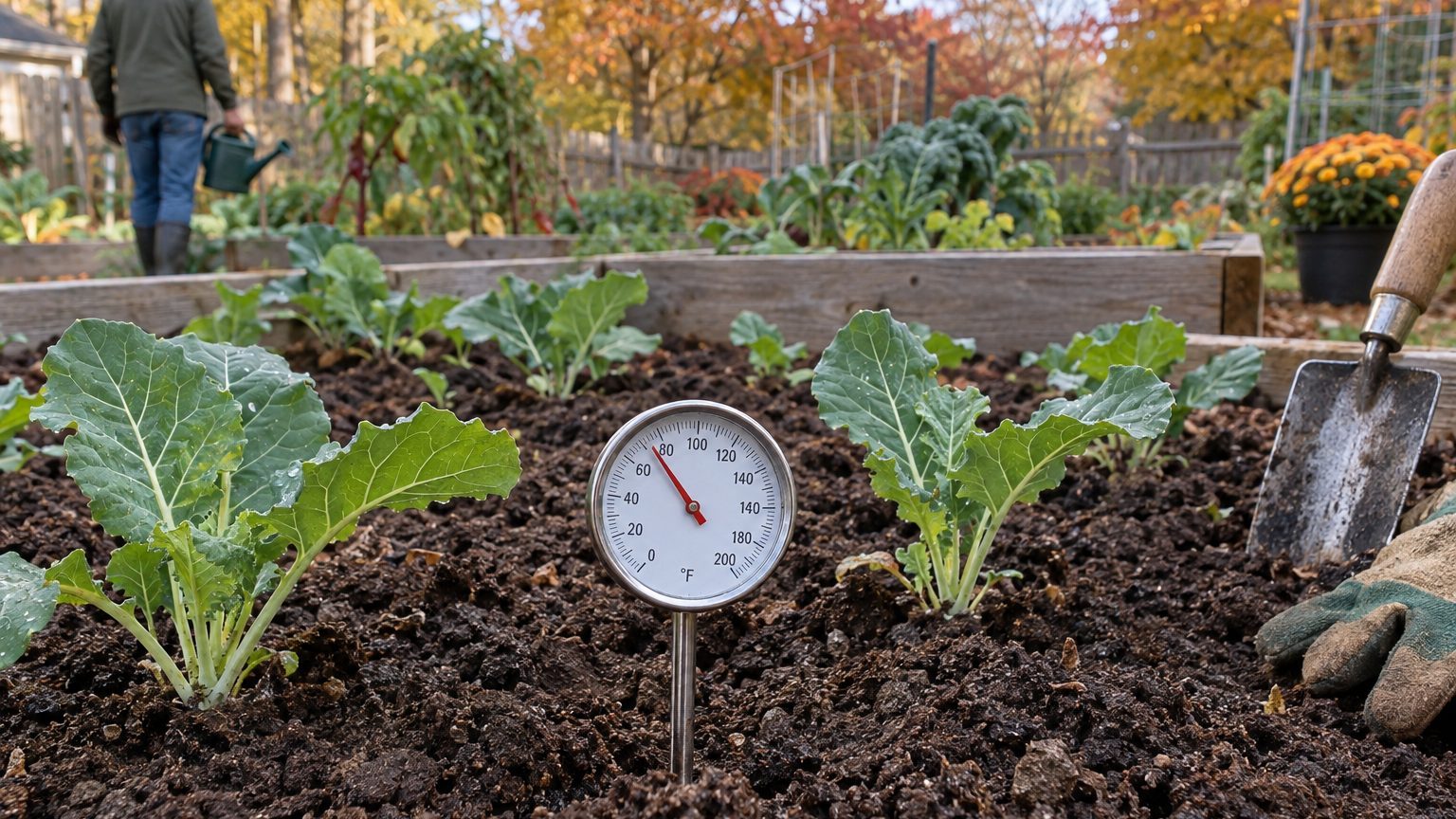
Soil warms slower than air, and it warms slower still under New Brunswick’s maritime spring, when fog and cool onshore air can keep a bed chilly well after the thermometer says frost risk has passed. Most growers here wait a further stretch past the average frost date before direct-seeding or setting out transplants, giving the topsoil time to climb into a range where collard seed actually germinates promptly instead of sitting and rotting. If you’ve got a soil thermometer, use it. If not, watch for weeds germinating freely and for the soil crumbling rather than clumping when squeezed, both rough signs that the ground has turned the corner.
Keep in mind that Moncton is one station, and New Brunswick is not one climate. The Saint John River valley, the upper Miramichi, and the Fundy coast each run their own version of spring, and inland or northern districts typically lag the Moncton normal rather than lead it. If you’re gardening away from the coast, push your working date later rather than earlier.
Collards belong to the brassica family, alongside cabbage, kale, mustard, turnip, and rutabaga, and they share that family’s pest and disease pressure, including cabbage root maggot and clubroot. A bed that grew any of those crops last year has not been rested, whatever it looks like on the surface, so plan rotation across the whole brassica group rather than just this one crop.
How long the season lasts here
Subtract the average last spring frost from the average first fall frost and New Brunswick’s frost-free window runs about 132 days, from May 23 to October 2, both figures drawn from the same Moncton normals. That’s a modest window by North American standards, and it shapes almost every decision that follows.
A 130-plus day window is enough to grow collards to a full harvestable size, but it is not generous enough to treat the way a gardener in a six-month growing zone would. There, a first sowing gets harvested young and a second goes in behind it for a longer autumn cutting. Here, that second sowing is a real gamble: sow too late in July and the plants are still juvenile when the first hard frost arrives in early October, with too little of the season left to size up properly.
That changes the calculus on transplants versus direct seeding, too. Starting seedlings indoors a few weeks before the soil is ready to receive them buys back some of the season the frost dates take away, letting a gardener effectively begin the clock before the ground itself is warm. It also means a stand that gets set back by a cutworm or a cold snap has less runway to recover than one growing in a longer season further south.
If you do want to try layering a second sowing into the same bed, whether of collards or a faster-maturing green behind them, the succession sowing guide on this site walks through how to time overlapping crops without running out of days before the first fall frost closes the window.
Heat and water in New Brunswick

This is where New Brunswick genuinely diverges from most of the collard-growing territory covered on this site. There’s no meaningful count of 90°F days in the local record worth reporting, because there essentially isn’t one: New Brunswick’s summers are short and mild by continental standards, and the heat stress that shapes collard growing further south (bolting, bitter leaves, plants struggling through a string of scorching afternoons) is rarely the problem here. The problem, if there is one, runs the other way: a cool, damp maritime summer is exactly the kind of weather that favors downy mildew and other fungal disease on brassica leaves, and slows ripening rather than speeding it.
Good airflow between plants, wider spacing than a seed packet’s minimum, and picking outer leaves promptly rather than letting a dense canopy sit wet after rain or fog all do more useful work in this climate than any of the heat-mitigation advice written for hotter states.
The number that matters far more here is the winter one. The mean daily minimum of New Brunswick’s coldest month sits at -13.9°C (roughly 6.9°F), reflecting the Moncton normals. That is a firmly cold winter minimum, nowhere near the mild range that lets collards stand in the garden and be picked leaf by leaf from November into March. In territory where the coldest month stays close to freezing, collards behave as a standing winter crop. In New Brunswick, they don’t get that chance: the plants are an autumn crop, grown to size across the frost-free window and harvested out before or right at the first hard freeze, not left in the ground through the cold months.
That single figure, more than any summer statistic, is what should shape how a New Brunswick gardener plans this bed: as a crop with a firm closing date, not an open-ended one.
Which collards suit New Brunswick
None of this page’s advice should include a variety name, and that’s a deliberate choice rather than an oversight. Cultivar performance depends on trial data specific to a region’s soils, day length, and disease pressure, and this page has no access to New Brunswick trial results. Naming a cultivar here would mean guessing, and a gardener who plants it and gets an unexpected result deserves better than a guess dressed up as a recommendation.
What the facts on this page do support is reasoning by type. New Brunswick’s short frost-free window favors the earliest-maturing types available, since a slower-growing type risks running out of season before the first hard freeze. The mild-summer, damp-air conditions typical here make disease resistance, particularly against downy mildew and other leaf fungi, a more useful selection criterion than heat tolerance, which matters far less in this territory than it does further south. And because collards share their pest and disease load with cabbage, kale, mustard, turnip, and rutabaga, whatever type you choose should go into a bed that hasn’t carried any of those crops in the recent past, not just one that hasn’t carried collards specifically.
For the actual names, check with your provincial extension service or the federal agriculture department (agriculture.canada.ca) for the varieties trialled under conditions close to your own. Local trial data accounts for things this page can’t: how a given type handles the particular combination of a short, cool summer and a harsh, early-arriving winter, which is exactly the combination that defines Growing Collards in New Brunswick.