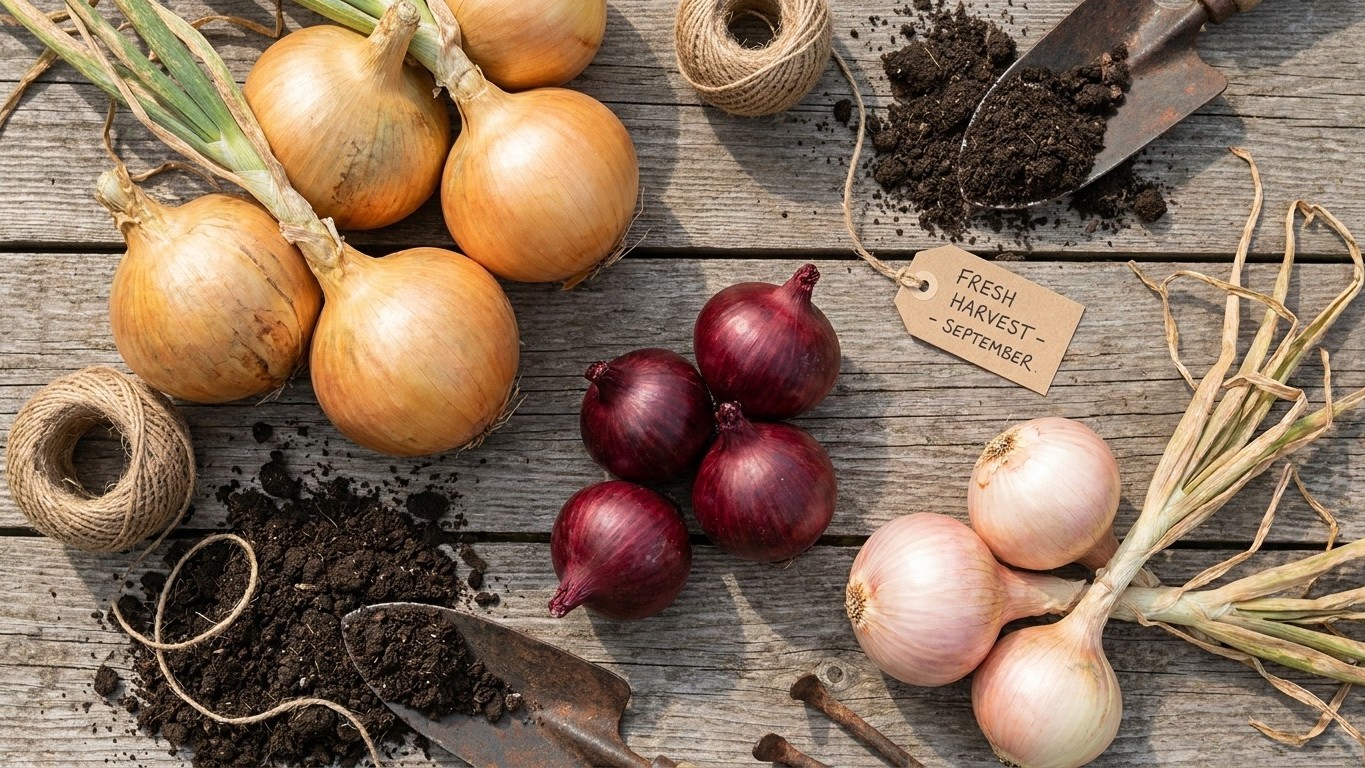

Prince Edward Island sits at 46.29 degrees north, measured at the Charlottetown weather station, and on the longest day of the year the sun there delivers 15 hours and 36 minutes of daylight. That’s the number an onion bulb actually answers to, not the thermometer. At this latitude, long-day onions are the group built for PEI gardens, with a handful of intermediate-day varieties also working. Short-day types, bred for latitudes far to the south, are not an option here no matter how well you feed them.
The short answer for Prince Edward Island

Onions read day length to decide when to stop building leaves and start building a bulb. At 46.29 degrees north, Charlottetown’s 15 hours and 36 minutes of solstice daylight lands comfortably inside the 14-to-16-hour window that long-day varieties wait for. That single fact settles the selection for the whole island: Prince Edward Island is long-day territory, with a short list of intermediate-day varieties reaching far enough north on their published ranges to also make sense here.
The long-day and intermediate-day varieties documented for this latitude
Fifteen of the 31 onion varieties tracked on this site list a published range that covers 46.29 degrees north, meaning Charlottetown’s day length falls inside their known bulbing window:
- Ailsa Craig (long-day, 38-60N)
- Barolo (long-day, 38-55N)
- Blush (long-day, 38-55N)
- Bridger (long-day, 35-50N)
- Frontier (long-day, 40-50N)
- New York Early (long-day, 38-50N)
- Patterson (long-day, 38-55N)
- Powell (long-day, 43-47N)
- Red Long of Florence (intermediate-day, 38-50N)
- Red Long of Tropea (intermediate-day, 35-48N)
- Redwing (long-day, 43-65N)
- Rossa di Milano (long-day, 38-50N)
- Safrane (long-day, 42-50N)
- Talon (long-day, 42-50N)
- Walla Walla Sweet (long-day, 35-55N)
Notice that most of these ranges stretch well past 46.29N in both directions. Redwing, for instance, is rated all the way to 65N, which tells you PEI’s daylight is nowhere near the northern edge of what a long-day onion can handle.
Varieties at the edge, worth trying with caution
Eight more varieties fall within 1.5 degrees of a published boundary, which puts them in a blurred zone rather than a clear yes. A catalogue range is a continuum, not a fence, so these may bulb well in a PEI garden or may fall short depending on the season and the exact site. They are not a safe bet for a gardener’s whole onion patch, but they are worth a trial row: Cabernet (intermediate-day, 35-45N), Calibra (intermediate-day, 35-45N), Elsye (intermediate-day, 32-45N), Expression (intermediate-day, 32-45N), Monastrell (intermediate-day, 35-46N), Red Carpet (long-day, 40-45N), Scout (intermediate-day, 32-46N), and Sierra Blanca (intermediate-day, 32-45N).
What will not work here
Short-day onions are triggered into bulbing once day length reaches about 12 hours, a threshold published by Clemson Cooperative Extension’s Home & Garden Information Center. In Charlottetown, day length climbs past 12 hours in mid-spring and keeps rising through the solstice, so a short-day plant gets its bulbing signal while it is still a small seedling. It obeys anyway, sets a bulb the size the plant happens to be at that moment, and stops. That is a variety mistake, not a feeding mistake: no amount of fertilizer or watering changes what day length tells the plant to do.
The eight varieties to skip
- Candy (intermediate-day, 33-40N): the range tops out roughly six degrees south of Charlottetown, so it never reaches the daylight window it needs.
- Gabriella (short-day, 20-35N, no page of its own on this site): a Deep South short-day type that bulbs almost as soon as it sprouts this far north, leaving tiny onions.
- Madalyn (short-day, 20-35N, no page of its own on this site): same short-day trigger, same result: small bulbs formed before the plant has grown.
- Red Rock (short-day, 30-36N, no page of its own on this site): rated for latitudes 10 to 16 degrees south of PEI, well outside the long summer daylight here.
- Red Sensation (short-day, 25-35N): bulbs at the 12-hour mark, long before PEI’s summer daylight peaks near 15 hours and 36 minutes.
- Texas Grano 1015Y (short-day, 25-35N): built for southern winters and springs, not a Maritime Canadian summer.
- Vidora (short-day, 25-35N): another short-day type that will size up as small onions, not full-grown bulbs.
- White Castle (short-day, 30-38N, no page of its own on this site): the upper edge of its range still sits eight degrees south of Charlottetown.
Plant any of these in a PEI garden and the outcome is consistent: undersized bulbs, not a failed crop exactly, but a disappointing one for the bed space and season it takes up.
What changes across Prince Edward Island
Charlottetown sits fairly centrally on the island, in Queens County, which is useful because Prince Edward Island runs mostly east to west rather than north to south. The province stretches from North Cape at the western tip to East Point in the east, a shape that spreads gardens out across longitude far more than across latitude. That matters for this topic specifically: day length depends on latitude, not longitude, so a garden near Summerside or Souris sits close enough to Charlottetown’s 46.29 degrees north that the same daylight figures apply without meaningful adjustment.
Where the guidance holds without adjustment
A mainland state stretching the same distance east to west could easily cross several degrees of latitude if it also ran north to south, changing the daylight math from one end to the other. PEI’s compact, narrow shape avoids most of that problem. Gardeners in Kings County to the east or Prince County to the west are working with a summer solstice day length close enough to Charlottetown’s 15 hours and 36 minutes that the long-day recommendation in the first section, and the short-day exclusions in the second, hold across the province.
The one place to be more careful is the far northern coast versus the sheltered south shore, where local microclimate (wind exposure, proximity to water, frost pockets) affects planting dates and soil warm-up more than it affects the underlying day-length math. Two gardens at the same latitude can still have very different frost calendars.
Checking this against your own garden
Everything above comes from Charlottetown’s climate station and a solar daylight calculation for that one point on the map. A garden elsewhere on the island, or a reader visiting this page from a different province, should not assume the numbers transfer exactly. A few checks take less than an afternoon:
- Look up your own garden’s latitude if you’re not near Charlottetown, using any online coordinate lookup tied to your street address.
- Compare that latitude against the variety ranges listed above rather than assuming the island-wide answer applies unchanged.
- Confirm your local average last spring frost and first fall frost dates, since day length decides bulb size but frost dates decide when it’s safe to plant or transplant.
- Contact your local agricultural extension office or the provincial Department of Agriculture and Land for soil test results and planting-date guidance specific to your county.
- If you’re trying one of the eight blurred-zone varieties, plant it alongside a known long-day variety as a comparison, rather than betting a full row on an untested edge case.
Charlottetown’s figures are a solid starting point for the island as a whole, but they describe one weather station, not every backyard on Prince Edward Island.