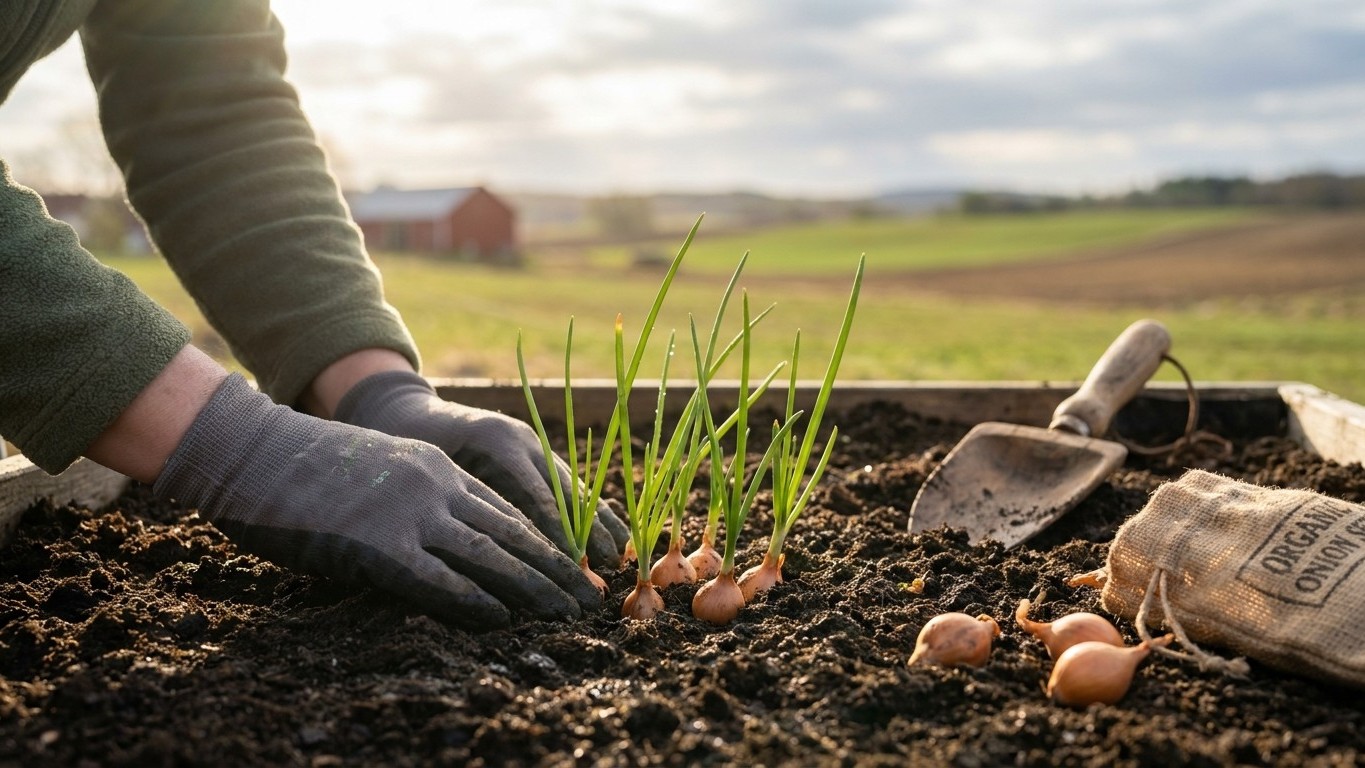

Plant onion transplants or sets in Prince Edward Island in early spring, once the soil can be worked, and choose long-day varieties. At 46.29 degrees north (the latitude of Charlottetown), the island gets 15 hours and 36 minutes of daylight on the longest day of the year, which is exactly the trigger long-day onions need to start forming bulbs instead of just growing leaves.
The short answer for Prince Edward Island

Onions don’t bulb because of warmth. They bulb because of day length, and that single fact decides almost everything about a planting calendar here. Once daylight reaches a certain number of hours, the plant switches from making leaves to making a bulb, no matter what the calendar says or how warm the soil is. Clemson Cooperative Extension’s Home & Garden Information Center puts the threshold for short-day types at roughly 12 hours of daylight. Long-day types wait much longer, needing 14 to 16 hours before they’ll bulb at all.
At 46.29 degrees north, Charlottetown reaches 15 hours 36 minutes on the summer solstice. That’s inside the window long-day onions need, and it’s also why the calendar here looks nothing like the one used in the American South. In mild-winter states, gardeners plant short-day onions in the fall, let them overwinter as small plants, and harvest in late spring before the days get long enough to force premature bulbing. That approach doesn’t apply on Prince Edward Island. Winters are too cold to overwinter young onion plants in the open ground, and the short-day varieties suited to fall planting would bulb absurdly early and small here anyway.
Instead, the season runs the other direction. Onions go in as soon as the ground thaws and can be worked, typically as transplants or sets rather than direct-seeded, because the growing season is too short to start from seed outdoors and still reach a decent size before the long days of June and July trigger bulbing. The goal is to get as much leaf growth as possible before that trigger hits, since leaf size at the moment of bulbing determines how big the finished onion will be.
Long-day varieties documented for this latitude include Ailsa Craig, Patterson, Redwing, Powell, and Walla Walla Sweet, among others whose published ranges cover 46.29 degrees north. A handful of intermediate-day types, such as Red Long of Tropea and Red Long of Florence, also fall within range and can work here, though they sit closer to the middle of the day-length spectrum than a true long-day onion.
What will not work here
Short-day onions are the mistake gardeners make most often on Prince Edward Island, usually because a catalog photo looked appealing or a variety was popular somewhere else. Short-day types are built for latitudes far to the south, where the growing season’s daylight barely reaches 12 hours even at its peak. Planted here, they hit their bulbing trigger almost immediately, while the plant is still small. The result isn’t a delayed onion. It’s a finished one, just tiny, because the plant had no time to build leaf mass before day length told it to stop.
Timing doesn’t fix this. Planting a short-day variety earlier or later on Prince Edward Island doesn’t change when the days get long enough to trigger bulbing. It only changes how small the plant is when that trigger arrives. The same logic applies to long-day onions planted too late in spring: a late start doesn’t push the harvest date back, it shrinks the bulb, because whatever size the plant has reached by the time daylight crosses its threshold is the size the bulb will be. There’s no catching up once bulbing starts.
Eight documented varieties fall outside what this latitude can support, based on published growing ranges:
- Candy (intermediate-day, 33-40N), rated for latitudes well south of 46.29N, will bulb too early and too small here
- Gabriella (short-day, 20-35N), a far-southern short-day type, bulbs almost immediately at this latitude
- Madalyn (short-day, 20-35N), same short-day limitation, no leaf growth window before bulbing
- Red Rock (short-day, 30-36N), triggers bulbing far too soon for the plant to size up
- Red Sensation (short-day, 25-35N), bulbs prematurely at this daylight range
- Texas Grano 1015Y (short-day, 25-35N), a classic Southern short-day onion, unsuited to a 15h36 summer
- Vidora (short-day, 25-35N), same problem, small bulbs guaranteed
- White Castle (short-day, 30-38N), still too far south-adapted for this island
Plant any of these on Prince Edward Island and the outcome is predictable: leaves grow, the plant bulbs on schedule for its own genetics rather than for the island’s daylight, and the harvest is a fraction of what a long-day variety would produce in the same bed.
What changes across Prince Edward Island
Prince Edward Island is small as Canadian provinces go, and that matters for how much this advice shifts from one end of it to the other. Unlike a sprawling state that might stretch across four or five degrees of latitude, PEI is a compact island roughly 140 miles from tip to tip, and its latitude range stays narrow. There isn’t a corner of the province sitting far enough north or south to change the day-length math in any meaningful way.
That’s different from what a gardener in a large western or southern U.S. state would face, where the northern and southern counties can belong to entirely different day-length groups and need varieties suited to each. On Prince Edward Island, the 15 hours 36 minutes of summer daylight measured at Charlottetown is a fair stand-in for the whole province. A gardener near North Cape or one near East Point isn’t dealing with a fundamentally different bulbing trigger than one gardening just outside Charlottetown itself.
What does shift, even on a small island, is frost timing and how early the soil can be worked in spring. Coastal areas and low-lying fields often stay wetter and colder longer into spring than higher, better-drained ground further inland, and that can push the practical planting date by a week or so even though the daylight trigger stays constant. The daylight number decides which varieties can bulb at all; local soil and frost conditions decide the exact week those varieties should go in the ground.
Checking this against your own garden
The numbers here come from Charlottetown’s climate station, and they’re a solid baseline for the province as a whole given how little PEI’s latitude actually varies. Still, no calendar written for a whole territory replaces what’s happening in one specific garden bed. A few things are worth confirming locally before committing a season’s worth of onion sets to the ground.
- Check your average last spring frost date through your local agricultural extension service or the provincial Department of Agriculture, since that date, not the calendar month, is what should set your planting window
- Look at how quickly your own soil drains and warms in spring; low, heavy ground often needs another week or two compared to raised beds or sandy loam
- Confirm you’re working with a long-day or intermediate-day variety before ordering, since day-length group matters more than any other factor on this list
- Ask your extension office whether any local frost pockets or coastal exposure in your specific area run later than the regional average
- If you’re gardening near the edges of the province, note that the daylight figure barely shifts here, so soil and drainage differences matter more than latitude does
None of this changes the core rule. Day length decides when an onion bulbs and how big it gets, and on Prince Edward Island that means long-day varieties, planted early enough in spring to put on real leaf growth before the solstice does its work.