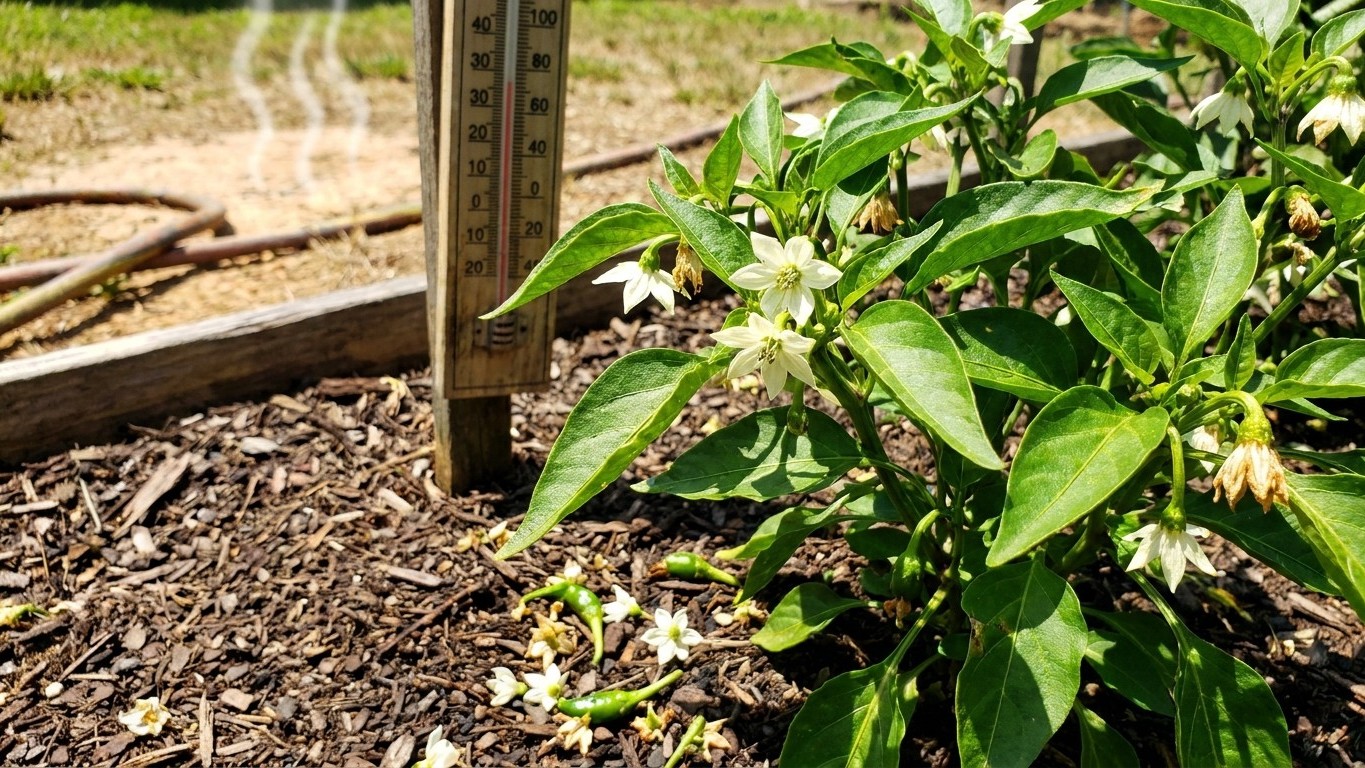

Peppers in Prince Edward Island rarely struggle because of excess heat. The Island’s summers stay mild enough that heat-driven blossom drop is almost a non-issue. The bigger risk runs the other direction: nights that dip below the pepper’s comfort zone, especially in a short growing season bookended by a frost date that arrives later here than in most of the Maritimes.
The short answer
Charlottetown, the reference station for the Island, averages 0.0 days a year at or above 90 F, according to Environment and Climate Change Canada’s Canadian Climate Normals for 1981-2010. That number is not a rounding error. It means a typical Prince Edward Island summer never crosses the heat threshold that causes pepper blossoms to abort and drop before they set fruit. Growers here can mostly cross the hot-end failure off their worry list. If a heat wave does push past 90 F for a day or two, it would be an outlier against three decades of local data, not the pattern.
That’s the easy half of the story. Pepper fruit set fails at both ends of the thermometer, not just the top. Utah State University Extension’s guidance on peppers is direct about it: flowers drop and fruit fails to form when nights fall below 55 F, just as they do when days climb above 90 F. Prince Edward Island’s near-zero count of hot days doesn’t cancel out the cold-end risk. If anything, a maritime climate like this one tends to produce cool, damp nights well into what other regions would call full summer, and those nights are exactly what stalls pollen viability and blossom retention in peppers.
Here’s where this site has to be honest about its limits. The climate data available for Prince Edward Island covers daytime heat load, that count of 90 F-plus days, but it does not carry summer night minimum temperatures. There’s no verified figure here for how many nights in a typical Island July or August dip under 55 F. Guessing at that number from the province’s northern latitude or from its winter cold would be a mistake; night minimums in summer depend on local factors like proximity to water, wind exposure and even which side of a valley a garden sits on, and none of that is captured by a single average. The practical move is to watch your own thermometer through the growing season, particularly overnight lows in June and again in early September when the season starts to turn. A cheap min-max thermometer left in the garden bed tells you more about your peppers’ odds than any regional average can.
When to start seed here
Working out a seed-starting date for peppers on Prince Edward Island means working backward from two conditions that both have to be met before a transplant goes outside, then subtracting the weeks a pepper seedling needs indoors before it’s ready.
- Start with the frost date, but treat it as a midpoint, not a guarantee. The Charlottetown A station’s Canadian Climate Normals put the average last spring frost at May 16. That’s a mean drawn from three decades of records, which means in roughly one year out of every two, frost actually arrives after that date. Treating May 16 as a safe planting day is a coin flip you don’t need to take with a heat-loving crop like peppers.
- Wait for the second gate: soil at 60 F. Frost passing isn’t enough on its own. Utah State University Extension is clear that pepper transplants should go into the ground only once soil temperature reaches 60 F, and only after the frost risk has passed. Air can feel warm well before soil catches up, especially in a maritime climate where the ground holds winter’s chill longer than the air does. The only reliable way to know is a soil thermometer pushed a few inches into the bed, not a date circled on a calendar.
- Take whichever gate closes last. On the Island, that’s usually the soil, not the frost date, since soil often needs extra weeks past mid-May to warm through in cooler, wetter ground. So the real transplant window tends to sit somewhere in the back half of May into early June, depending on the specific plot, not just the regional average.
- Count back 8 to 10 weeks from that transplant window to find your seed-starting date. If a gardener expects to transplant near the end of May once soil has caught up, counting back 8 weeks lands seed-starting around the start of April; counting back the full 10 weeks pushes it to roughly mid-March. A gardener planning for an early-June transplant, more typical on cooler parts of the Island, would shift both of those starting points about a week later.
- Adjust for your own county, not the provincial average. Coastal plots, low-lying frost pockets and upland districts away from the moderating effect of the water can all run behind the Charlottetown normal. The arithmetic above is a starting point to redo with your own frost history and your own soil thermometer readings, not a fixed date to copy.
What goes wrong here
- Blossom drop from a cool night rather than a hot spell. Given the Island’s essentially nonexistent count of 90 F days, heat-driven blossom drop is unlikely. The more probable cause here is a night that slips below 55 F, particularly right after transplant in late spring or again as nights start cooling in early fall. The remedy is to delay transplanting until nights have stabilized, and to keep floating row cover on hand to throw over plants when an unexpected cool night is forecast.
- Sunscald on exposed fruit. Even without extreme heat, a pepper that loses its leaf cover to wind damage, disease or aggressive pruning can end up with fruit sitting in direct, unfiltered sun for hours. The skin bleaches, softens and eventually rots at that spot. The fix is to keep the plant’s canopy full enough to shade its own fruit, and to avoid stripping foliage late in the season when Island winds are already testing the plant’s structure.
- Blossom-end rot from uneven watering. This shows up as a sunken, leathery patch at the blossom end of the fruit, and it traces back to inconsistent soil moisture interrupting the plant’s calcium uptake rather than a soil calcium shortage itself. Mulching to hold moisture steady and watering on a regular schedule, rather than letting the bed dry out between heavy soakings, keeps this from developing.
Common questions
Do Prince Edward Island summers ever get hot enough to hurt pepper fruit set?
Rarely. The Charlottetown normal of 0.0 days a year at or above 90 F means a typical Island summer doesn’t reach the heat threshold that causes blossom drop. Cold nights are the more realistic risk here, not heat.
Is May 16 a safe date to transplant peppers on the Island?
No. That’s the average last spring frost date from Environment and Climate Change Canada’s Charlottetown A records, which means frost arrives later than that in about half of all years. Peppers also need soil at 60 F, which often takes longer to arrive than the frost date itself.
Why does this site not give a night temperature threshold for Prince Edward Island?
Because that data isn’t part of what’s tracked here. Summer night minimums vary too much by local terrain and water proximity to responsibly average across a whole province, so gardeners need to track their own overnight lows with a thermometer in the garden rather than rely on a regional figure.
How many weeks before transplant should pepper seed go in on the Island?
Utah State University Extension recommends starting pepper seed 8 to 10 weeks before transplanting. On the Island, where transplant timing often lands in the back half of May or into early June once soil has warmed past 60 F, that puts seed-starting somewhere between mid-March and early April, adjusted for your own soil readings.