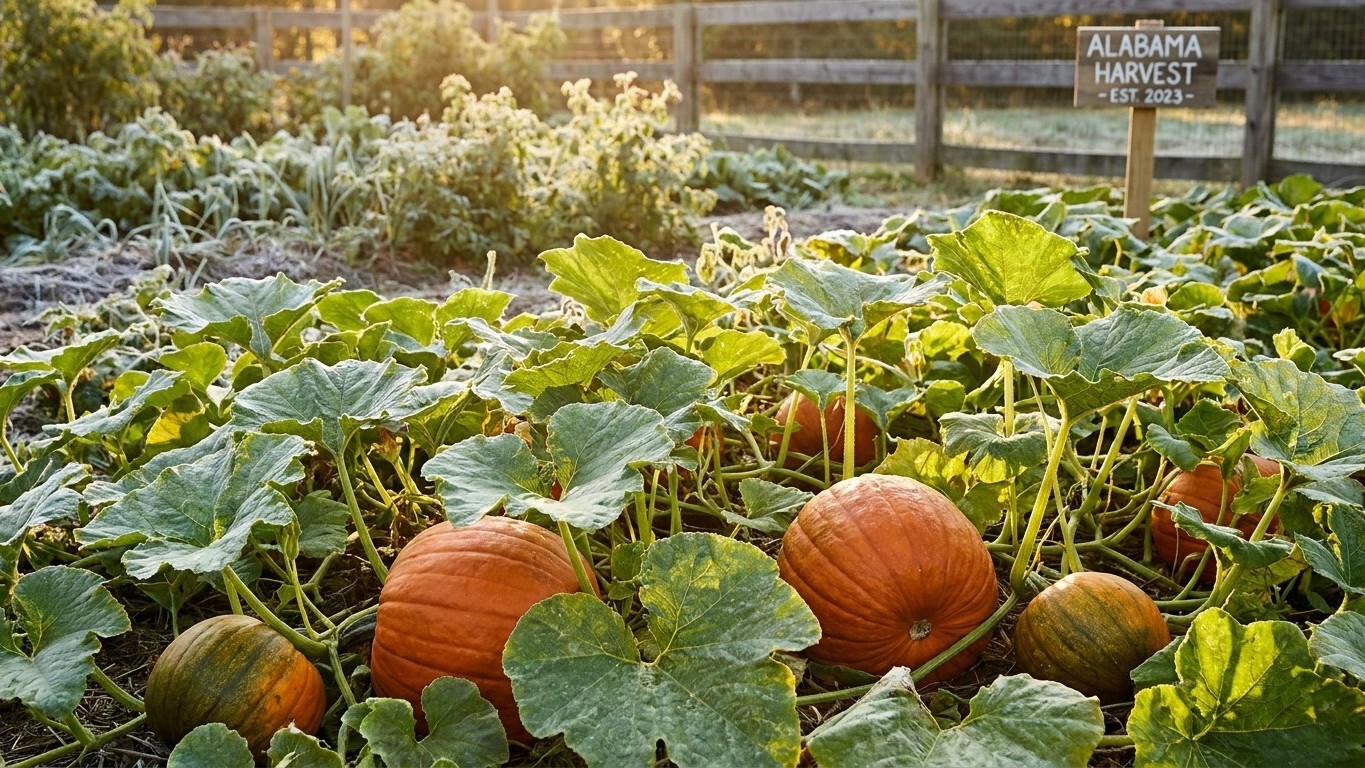

On Prince Edward Island, a pumpkin generally has enough season to turn from green to orange, but only if its flowers open before the first days of September. Charlottetown’s average first fall frost lands October 17, and a pumpkin needs 45 to 55 days of warmth after that bloom to finish coloring. Push flowering later than early September and the fruit risks sitting green when the cold arrives.
The short answer
Environment and Climate Change Canada’s Canadian Climate Normals, drawn from the Charlottetown A station, put the average first fall frost at October 17. That figure comes from the 1981-2010 normals period, and it’s worth treating with some caution before you build a planting plan around it: an average date means frost arrives later than October 17 in roughly half the years on record, not that October 17 itself is a safe cutoff. Some seasons push well past it; others fall short. The Charlottetown A station also sits on the coast, and inland or upland parts of the province, along with the north shore, commonly lag behind it by a week or more in fall cooling.
Work backward from that October 17 midpoint using the 45-to-55-day maturation window that Utah State University Extension gives for pumpkins after flowering, and the arithmetic lands in a narrow band. Counting 45 days back from October 17 puts the latest safe bloom date at roughly September 2. Counting the full 55 days back moves that same cutoff to around August 23. So the practical flowering window for this island runs from late August through the very start of September, and blossoms opening later than that carry real risk of never finishing before frost.
That 45-to-55-day clock starts at flowering, not at seeding and not at transplanting. This distinction trips up a lot of gardeners who count from the day seed goes in the ground rather than the day the female flower opens and sets fruit. A vine seeded early but slow to flower gains nothing from that head start once the countdown to frost actually begins. The only date that matters for the ripening math is the one when pollination happens, because that’s the day the fruit itself starts its own private race against the calendar.
None of this changes if a gardener plants in Charlottetown, Summerside, or a rural lot near Souris. The underlying frost normal comes from one station, and the safest approach is to treat late August into early September as the deadline for flowering everywhere on the island, then add a buffer for anyone farming ground that historically runs cooler than the coast.
When to sow here
Getting a flower to open by late August means working backward again, this time from soil temperature rather than frost dates. Utah State University Extension’s guidance is direct: pumpkins go into the ground once soil reaches 65°F, and that threshold has nothing to do with when the last spring frost occurs. Air crossing the frost line and soil actually warming to seed-friendly temperatures are two separate clocks, and conflating them is one of the more common planting mistakes on this island.
- Start counting from the average last spring frost, May 16, but hold that date loosely. Like the fall frost figure, it’s a midpoint from the Charlottetown A station’s 1981-2010 normals, meaning frost arrives after May 16 in about half of all years.
- Expect soil to lag well behind the air. Prince Edward Island’s sandy loam and red clay soils typically need several more weeks past the last spring frost before they hold a steady 65°F at seeding depth, since soil warms far slower than the surrounding air.
- Use row cover to close some of that gap. Covering the bed can bank roughly two weeks of extra warmth, letting a gardener set seed or transplants earlier while the uncovered soil around it is still catching up.
- Confirm the number rather than guessing from the calendar. A simple soil thermometer pushed to about an inch deep, checked in the morning before the sun heats the surface, gives a real reading instead of an assumption based on air temperature alone.
- Once that thermometer holds steady at 65°F, seed or transplant. From there, the vine still has to grow, flower, and then run its 45-to-55-day maturation clock, all before that late-August-to-early-September flowering deadline established above.
Stacked together, these steps show why pumpkin timing on Prince Edward Island runs tighter than it might on a page written for a warmer province. The gap between a mid-May frost average and a soil that’s genuinely ready weeks later, followed by a flowering deadline that arrives before Labor Day, leaves a narrower runway than most gardeners assume when they first look at a seed packet’s days-to-maturity number.
What goes wrong here
- A late flower that never colors. Vines that keep setting new blossoms into mid-September are racing a clock they can’t win, since even 45 days from a September 10 flower lands past October 17’s average frost. The fix is to pinch off new flowers and small, clearly-late fruit once the calendar passes the first days of September, so the plant channels its remaining energy into the pumpkins that already have a fair shot at finishing.
- A fruit caught by frost. Fruit that’s colored but still on the vine when a hard frost moves through can be damaged even if it looks ripe. Utah State University Extension recommends harvesting with the stem attached and doing it before frost arrives rather than after, since a frost-touched stem shortens how the fruit holds afterward.
- A vine that dies back before the skin hardens. A collapsed vine leaves the fruit exposed and its rind soft, which matters because a hardened rind is part of what lets a pumpkin be stored at all. If frost is closing in and the skin hasn’t fully set, cut the fruit with stem attached and move it somewhere it will not freeze, which is the storage guidance Utah State University Extension actually publishes; the source gives no specific storage temperature, humidity level, or keeping time beyond that basic protection from freezing.
Insect pressure can shorten the season indirectly by weakening vines before fruit ever sets, and squash bugs and cucumber beetles are both common culprits worth checking for separately rather than treating as an afterthought here.
Common questions
What’s the latest a pumpkin flower can open on Prince Edward Island and still Ripen Before Frost?
Roughly between August 23 and September 2, working back 45 to 55 days from the October 17 average first fall frost recorded at the Charlottetown A station. Flowers opening after that window run a real risk of leaving green fruit when frost arrives.
Is May 16 a safe date to plant pumpkins outdoors?
Not by itself. May 16 is the average last spring frost from the Charlottetown A station’s 1981-2010 normals, meaning frost still occurs after that date in about half of all years. It also has nothing to do with whether the soil itself is warm enough; soil temperature is a separate measurement that lags behind the air.
Why does soil temperature matter more than the last frost date?
Because pumpkin seed germination depends on the soil holding 65°F, a threshold that arrives weeks after the air itself stops frosting. Planting by calendar date alone, based only on the last frost, often means seeding into soil that’s still too cold for reliable germination.
What should I do if frost is forecast and my pumpkins haven’t finished ripening?
Harvest what’s colored with the stem attached before the frost hits, since Utah State University Extension’s guidance centers on getting fruit off the vine ahead of frost rather than after. Fruit that’s still green or soft-skinned when frost is imminent is unlikely to finish properly regardless of what’s done at that point.