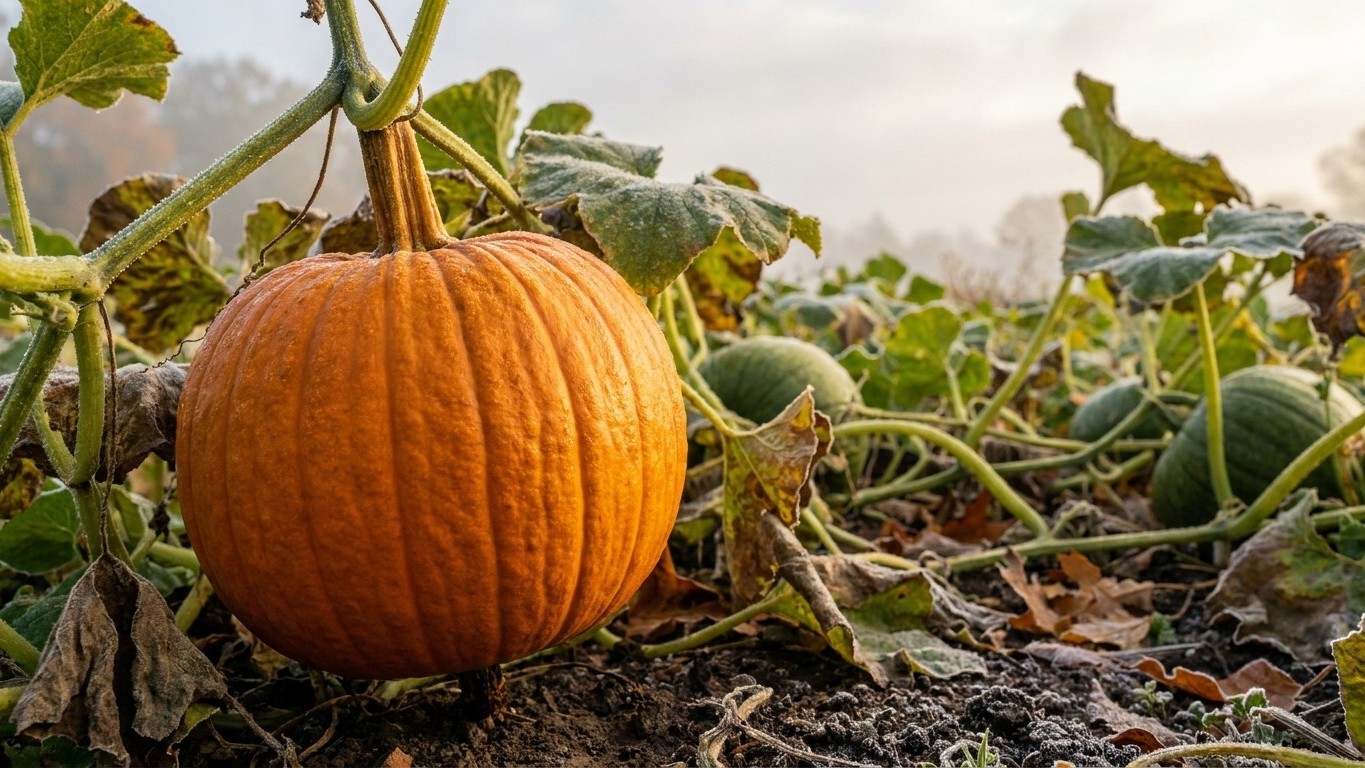

Will Pumpkins Ripen Before Frost in Prince Edward Island? They can, but only if the flower opens by early September. The mean first fall frost lands October 17 at the Charlottetown A station, and Utah State University Extension puts pumpkin maturity at 45 to 55 days after flowering, not from seeding. Count back from that frost date and the flowering deadline falls in late August. Miss it, and the fruit stays green on the vine.
The short answer
The math starts with a single station record. Environment and Climate Change Canada’s Canadian Climate Normals, drawn from the Charlottetown A site (climate ID 8300300) over 1981 to 2010, put the average first fall frost at October 17. Utah State University Extension’s guidance on pumpkins in the garden supplies the other half of the equation: a pumpkin needs 45 to 55 days from the moment a female flower opens to reach full color and a hardened rind. Not from the day the seed goes into the ground, not from transplant. From flowering.
Run the subtraction and the deadline appears. Forty-five days back from October 17 lands on September 2. Fifty-five days back lands on August 23. That gives a working flowering window of roughly August 23 to September 2. Any flower that opens after that risks staying green, or worse, freezing before the vine finishes its work.
Here’s the catch nobody puts in bold letters: October 17 is a mean, not a guarantee. Climate normals average three decades of frost dates into a single figure, which means in roughly half those years the first frost actually arrived later than October 17, and in the other half it arrived earlier. Treat it as the middle of a spread, not a line to plant against. A gardener working right up to September 2 is betting on the average holding, and averages fail half the time by definition.
Location inside the province matters too. The Charlottetown A station sits in one of the milder pockets of PEI. Coastal ground warmed by the Northumberland Strait or the Gulf of St. Lawrence often sees a later frost than inland or elevated land, where cold air settles fast on clear autumn nights. A gardener in Kings County’s interior, or toward the island’s western tip, should treat the August 23 end of the window as the safer target, not September 2.
None of this changes the basic shape of the answer. Pumpkins with flowers opening by late August generally have enough runway to color up before the average frost. Pumpkins flowering into September are running the calendar close, and a cool, wet spring that delays planting can push flowering later without anyone noticing until the vines are already sprawled across the garden.
When to sow here
Getting flowers to open by that August window starts weeks earlier, with a decision most gardeners get wrong: they plant on the frost date instead of the soil temperature.
- Start from the mean last spring frost, not the calendar. The Charlottetown A normals put the average last spring frost at May 16. That figure only tells you when air temperatures typically clear freezing, not when the soil is warm enough for pumpkin seed.
- Wait for the soil, not the air. Utah State University Extension calls for a soil temperature of 65°F before sowing pumpkin seed directly in the ground. Soil holds onto cold long after the air has warmed, because raising ground temperature takes weeks of steady sun, not a single mild afternoon. In practice, ground that clears frost in mid-May often doesn’t reach 65°F until well into the following weeks.
- Don’t treat May 16 as sowing day. Sowing on the frost date and hoping is the most common mistake behind a late-flowering crop. Seed will germinate in cold soil, but slowly and unevenly, which pushes the whole flowering schedule closer to, or past, the late-August deadline covered above.
- Use row covers to move the date up. Clear or spun-fabric row covers trap solar heat against bare soil and can effectively buy about two weeks on the calendar. That means soil under cover can read 65°F roughly two weeks earlier than the same patch left uncovered.
- Pull the covers once flowers need pollinators. Covers warm soil and shield young seedlings, but they also keep bees out. Once vines start setting flowers, the cover has to come off so pollination, the actual starting gun on the 45-to-55-day clock, can happen.
Bank those two weeks and the arithmetic from the short answer gets friendlier. A crop sown two weeks earlier than bare-soil timing has that much more room to flower comfortably inside the August 23 to September 2 window, rather than scraping against its edge.
What goes wrong here
- A late flower that never colors up. This happens when sowing waits for the calendar instead of the soil, or when a cool spring delays germination. The remedy is the two-week head start row covers provide, paired with choosing a variety known for a shorter maturity window, so even a flower opening in early September still has some cushion.
- A fruit caught by frost before the rind hardens. A pumpkin that’s colored but still soft-shelled can be knocked out by a single hard night. Track nightly forecasts closely once flowering begins, and cover exposed fruit with a blanket or a thick layer of straw on any night frost is forecast. If a hard freeze is coming regardless, cut the pumpkin with the stem attached rather than leave it to split or rot on the vine.
- A vine that dies back before the skin hardens. Foliage loss from disease or insect feeding can shut down a vine weeks before the fruit is finished, leaving a pumpkin that’s colored on the outside but thin-walled underneath. Keep vines watered through dry stretches, and watch foliage-feeding pests early rather than late. Squash bugs and cucumber beetles are covered in detail on this site’s dedicated pages for identification, timing, and pressure by state; check squash bug activity and cucumber beetle activity rather than guessing at what’s on the leaves.
Checking this against your own county
Everything above rests on one weather station, Charlottetown A, and a single provincial average. A backyard in Alberton or a farm plot near Souris can run a week or two behind that figure, especially on low ground where cold air pools on clear nights. Before locking in a sowing date, check current-year guidance and local frost patterns through the Prince Edward Island Department of Agriculture, which tracks conditions across the province rather than a single station.
That’s the difference between a provincial average and a plan for the actual patch of soil the pumpkin will sit in.
Common questions
Does the 45-to-55-day figure start at planting or at flowering?
Flowering. Utah State University Extension is specific on this point: the 45 to 55 days run from the opening of the flower to a ripe, hardened fruit. Counting from the seeding date instead will give a harvest estimate that’s off by weeks.
Is October 17 a safe date to count on for the first frost?
No. It’s a mean drawn from three decades of records at the Charlottetown A station. In roughly half of those years, frost arrived later than October 17, and in the other half, earlier. Treat it as a midpoint, not a promise.
Can row covers replace the need for early sowing?
Not entirely. Row covers can buy roughly two weeks by warming soil faster, but they still need soil that’s on its way to 65°F to work with. They shift the timeline; they don’t remove the need to sow with the soil temperature in mind rather than the frost date alone.
What should I do if my pumpkin hasn’t colored by the first hard frost?
Cut it with the stem attached and move it somewhere it won’t freeze. The source guidance available on storage is limited to that single instruction, keeping the fruit out of freezing conditions, without a specific temperature or timeline attached.