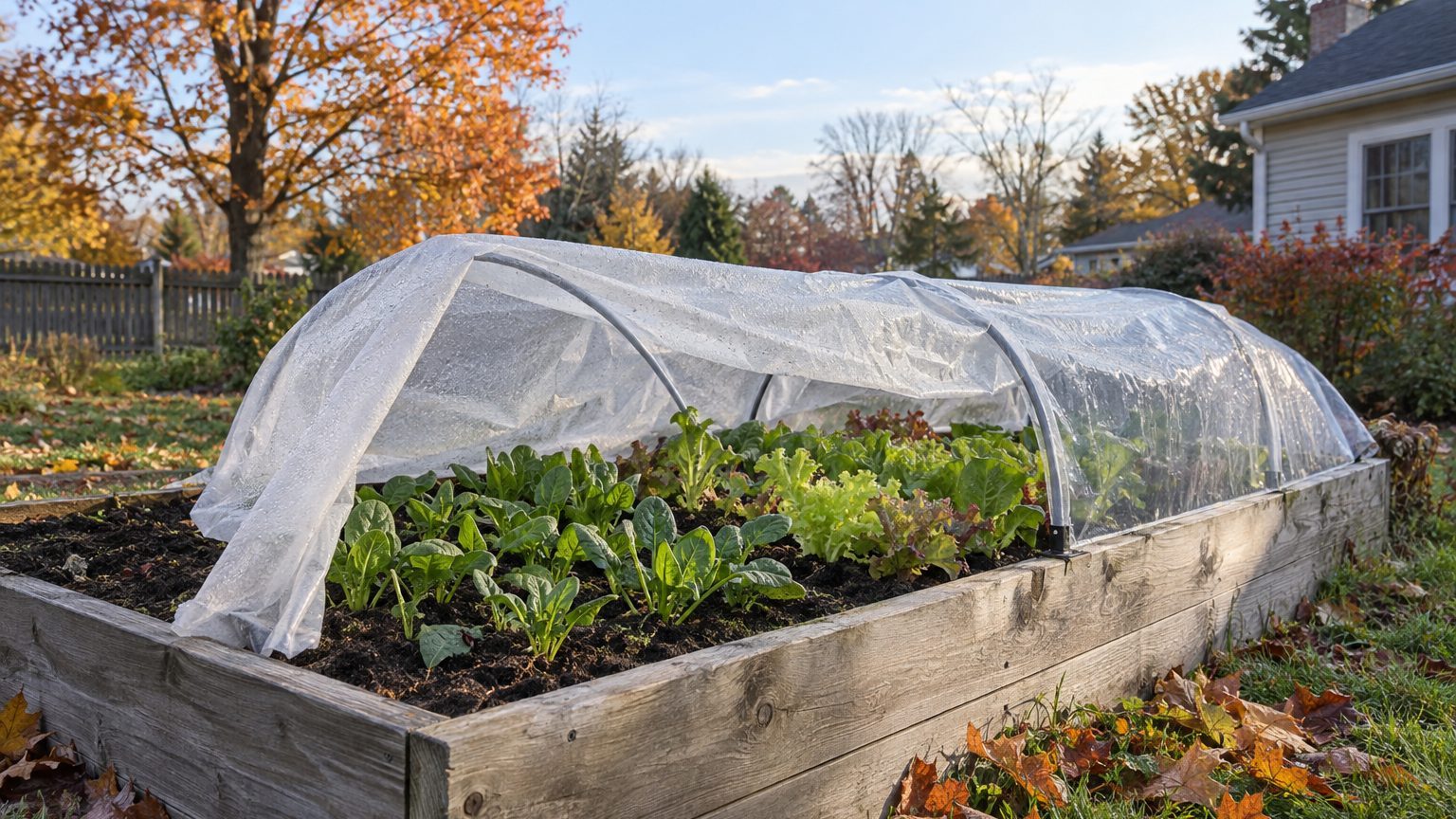

At the Charlottetown A station, the last spring frost falls on average on May 16 and the first fall frost on October 17, which leaves about 154 days between them. Covers can stretch both ends of that window. They cannot change two limits that no fabric touches: how fast the soil warms in spring, and how little daylight is left in late fall.
When the soil is warm enough in Prince Edward Island
Everyone asks for the date, so here it is. According to Environment and Climate Change Canada’s Canadian Climate Normals 1981-2010, the last spring frost at CHARLOTTETOWN A (climate ID 8300300) comes on average on May 16. That is a mean, the midpoint of a window. In one year out of two, the last frost lands later than May 16, and a frost date is a probability, never a promise.
Why the frost date is only a proxy
Frost tells you when air temperature stops dropping below freezing. Season extension is waiting on something slower: warm soil. Soil is a big, wet heat sink that gains warmth gradually, so it reaches a useful temperature after the frost risk ends, not on the same day. A tender seedling set out on May 17 can be safe from frost and still sit in cold ground, with roots that barely function.
On an island surrounded by cold water, that lag is easy to believe. The practical test costs nothing: push a thermometer into the bed at planting depth in the morning, when the reading is at its lowest, and compare it with the minimum soil temperature printed on the seed packet for that crop.
Two cautions about the figure itself. It comes from one station, and a province is not one climate. Northern and upland districts can run weeks behind Charlottetown, so a gardener far from the airport should treat May 16 as a starting guess and watch local conditions. Canadian normals also cover 1981-2010, while the US figures elsewhere on this site cover 1991-2020, so the two sets are not strictly comparable.
What a cover does with that soil
During the day, soil absorbs heat. At night, it gives some back. A cover (fabric, a low tunnel, a frame with glazing) traps part of that radiated warmth and keeps the air around the plants still, so it cannot drain away on the breeze. A second layer inside the first adds another pocket of still air. The gain is real but variable: it depends on the material, the night, the wind, and whether the ground was warm to begin with. After a week of cold rain, the soil has little to give back.
A cover shifts the limit. It does not remove it. A clear, calm night after a cold day is exactly when one covered bed can freeze solid while the forecast looked mild. Everything described here is passive, with no added heat of any kind.
Ventilation is not optional once a structure is closed. A sealed cold frame in spring sun can cook its contents within an hour, even when the air outside is cool. Prop it open on any bright morning, and close it again before the afternoon cools.
How long the season lasts here
Count from May 16 to October 17, both mean dates from the same Charlottetown A normals, and you get 154 days, a little over 22 weeks. The number looks generous, but it is the gap between two midpoints. In a late spring or an early fall, the frost-free stretch shrinks from both ends, and the cold, slow soil of April and the short light of late October make the edges less productive than the middle. The dates are averages, not a guaranteed run of 154 good days.
What 154 days allows
For quick, cool-tolerant crops, it allows a second sowing. Lettuce, radishes, spinach and similar greens mature fast enough that a bed cleared in midsummer can be sown again and still finish before the first fall frost, with a light fabric over the later sowing to smooth the cold nights. The Extending the Season: What a Cover Buys, and What It Cannot page explains how far that stretch goes, and this site’s succession sowing guide covers the spacing of those repeat sowings.
Long-season, heat-hungry crops get one shot. A fruiting vegetable sown directly in May has little time to ripen before October, so a transplant started indoors is usually worth the small setback of root disturbance, because those weeks indoors are weeks the outdoor window does not have to provide. Root crops are the opposite case, since a disturbed taproot forks, so they go in the ground as seed and stay there.
The neighboring province sits in a similar position, and the Extending the Growing Season in New Brunswick page shows how the same logic plays out there, with its own frost dates and its own inland variation.
Heat and water in Prince Edward Island
What can be said is that heat is not the governing problem for gardeners here, and a hot-climate page, with advice on shade cloth and root-zone cooling, would be written for a different place. Those numbers are small for a maritime island at this latitude, and the reader whose peppers stall in a cool August knows it. The Extending the Growing Season in Indiana page deals with the opposite problem, where summer heat is the stress that needs managing.
Light and cold set the real limits
Charlottetown sits at 46.29 degrees north. A gardener near the edge of the province should check their own latitude, though the spread across the island is small. The latitude fixes the date in fall after which daylight falls below what most crops need to grow. Past that date, a cover no longer extends growth. It holds a mature crop alive in the ground, and the plants wait for spring. At this latitude that date arrives well ahead of the coldest weather, which surprises people who assume cold is the only brake.
The coldest month then decides how much structure you need. At Charlottetown, the mean daily minimum of the coldest month is -12.1 °C (10.3 °F), from the 1981-2010 normals. That is an average of the night lows, not the record, and individual nights go lower. A light fabric can carry hardy crops through the shoulder seasons, when the cold is shallow. For the deep part of winter, only a framed structure, with its own air space and a second layer, has a chance of keeping hardy greens alive, and even that holds them rather than growing them.
For perennials, the relevant figure is Charlottetown’s hardiness zone of 5b in the Canadian system, from Natural Resources Canada’s 1991-2020 data. It is not a USDA zone and does not convert to one, because the Canadian method uses seven climate variables and the USDA method uses one.
Cool, damp summers bring their own trouble
Where summer heat is modest and humidity is high, the problems are mildew, slow ripening and fungal and bacterial disease, not scorched leaves. Covers make this worse if they are shut. Still, humid air under fabric or glazing turns condensation into a steady invitation to rot, so airflow matters here for the same reason it matters in a hot climate, only the danger is moisture instead of heat. Water also deserves attention: rain does not reach the soil under a cover, so beds can dry out while the lawn outside stays green.
Which season extension suit Prince Edward Island
The choice here comes down to type, and the territory’s facts point in a clear direction. A season of about 154 days between mean frosts favors the earliest-maturing types of any crop, the ones that finish before the window closes. Humidity makes disease resistance the first criterion when choosing among varieties of the same crop. Heat tolerance, the question that dominates in a hot state, comes last.
Matching the structure to the job
- Floating fabric over the bed: the lightest option, suited to the weeks around the last and first frost, when the cold is shallow.
- Low tunnels: a hoop frame under fabric or film, giving a larger pocket of still air for early transplants. Open the ends on warm, sunny days.
- Cold frames: a small, low box with a lid, handy for hardening seedlings and for hardy greens in late fall. The lid needs propping open on every sunny day.
- Framed, unheated structures: the only type with a realistic chance in the coldest weeks, because of the extra layer and air space. They still hold a crop, not grow it, once daylight has dropped.
Each of those, once closed, has the same weakness: trapped sun can overheat a spring bed far faster than a cold night can harm it, and trapped moisture breeds disease. Ventilation is part of the structure, not an accessory.
Why no variety is named
The varieties that perform on Prince Edward Island are the ones trialled on Prince Edward Island, in its soils and its damp summers. A name pulled from a general list would be a guess presented as a recommendation. The Government of Prince Edward Island’s agriculture pages are the place to start for locally tested advice, and a local grower with a few seasons behind them will tell you which types have survived the weather.
Common questions
When can I plant outside in Prince Edward Island?
The average last spring frost at Charlottetown A is May 16, but half of all years run later, and soil warmth matters more than the frost date. Check the soil temperature at planting depth against what each crop needs, and harden transplants off before they go out.
Does a cover make a crop frost-proof?
No. A cover traps heat from the soil and holds still air around the plants, which moves the limit by an amount that depends on the material, the wind and the night. A clear, calm night can still freeze a covered bed, especially if the soil was cold to start with.
Can I grow vegetables through winter here?
Only hardy crops, and only under a framed structure. With a coldest-month mean daily minimum of -12.1 °C at Charlottetown, and daylight too short for real growth, a structure keeps a mature crop alive for harvest, but nothing grows much until spring.
Is the Charlottetown frost date my frost date?
Maybe not. It comes from a single station, and northern or upland districts can run weeks behind it. Keep your own notes on the first and last frosts in your garden for a few seasons, and trust them over any average.