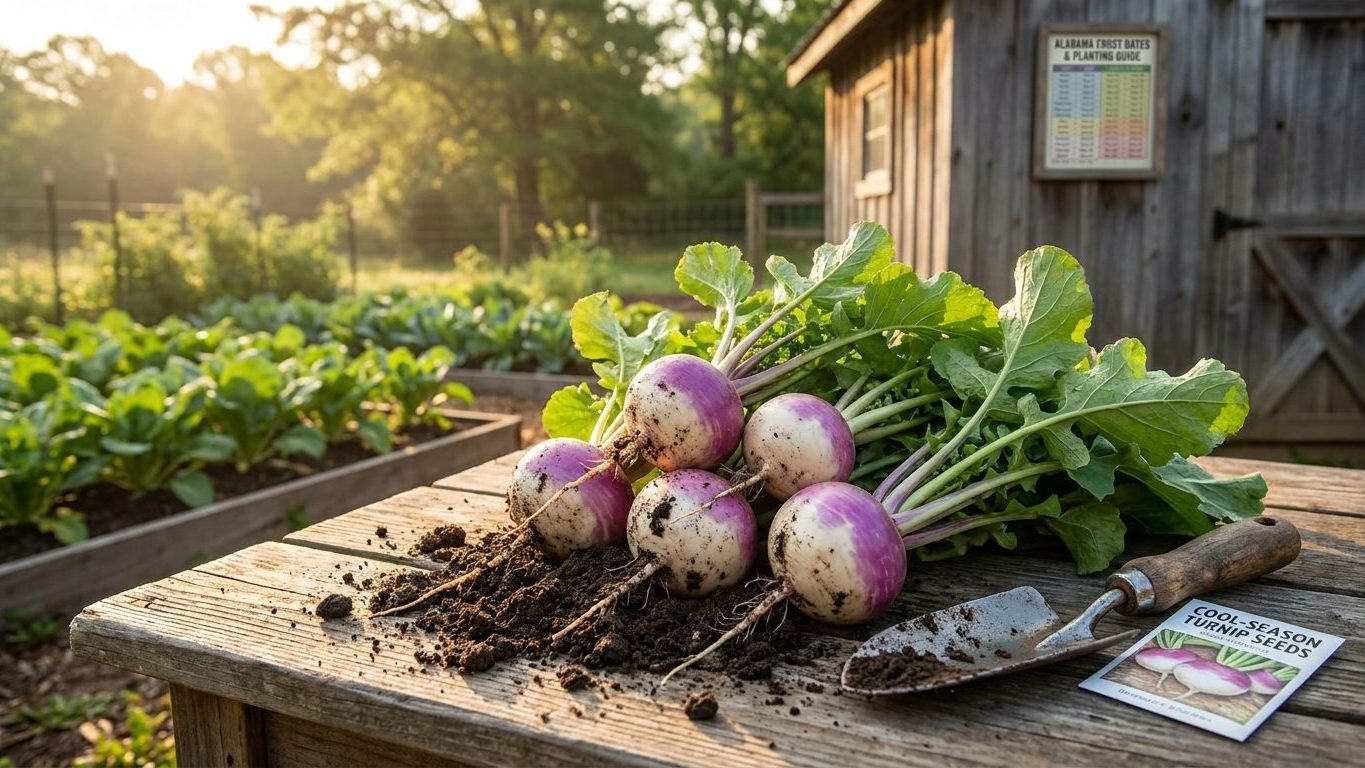

Sow turnips in Prince Edward Island from about mid-May, when the average last spring frost arrives (May 16 at Charlottetown). Sow again in summer for a fall crop that has to finish before the average first fall frost on October 17. Both dates are averages, not guarantees, and rutabaga belongs in the earlier slot. What follows turns those two dates into a working window.
The short answer for Prince Edward Island
The window runs from mid-May to mid-October, and both ends come from one weather station. Environment and Climate Change Canada’s 1981-2010 normals for CHARLOTTETOWN A put the last spring frost on average on May 16 and the first fall frost on average on October 17. Those are mean dates. They describe the probability of frost on a given day, and they say nothing about your soil or your seed.
A mean date is a coin flip. In about one spring out of two, the last frost lands after May 16. In about one fall out of two, the first frost arrives before October 17. Treat each date as the midpoint of a window, never as a safe date. Between the two means sit roughly five months, and a bad year shrinks that at both ends.
Spring sowing
Turnips are a cool-season root and tolerate light frost, so the first sowing can go in around mid-May without waiting for a frost-free guarantee that PEI never offers. Rutabaga is the crop that cannot wait. Its long run to a full-size root is exactly what a short island season squeezes, so it goes in at the front of the window. Varieties differ a lot in speed, and The Best Turnips and Rutabaga for Prince Edward Island sorts them by how well they fit this season.
Summer sowing for a fall crop
For the second sowing, work backward from October 17. Take the days to maturity printed on your seed packet, count back from that date, and add a buffer, because in half of all years frost comes sooner.
| Sowing | Anchor date | What the date is | How to use it |
|---|---|---|---|
| Spring turnips | May 16 | Mean last spring frost, Charlottetown A | Start around it; light frost is tolerable |
| Rutabaga | May 16 | Same mean date | Sow at the front of the window, not later |
| Fall turnips | October 17 | Mean first fall frost, Charlottetown A | Count back from it, then add a buffer |
For the full picture of the crop on the island, see Growing Turnips and Rutabaga in Prince Edward Island.
What will not work here
Treating May 16 as a green light fails first. Half of all years bring a frost after that date, so a gardener who sows tender crops on the 16th and calls it safe is gambling at even odds. Turnips can take that gamble because they handle light frost. A bed of anything frost-tender beside them cannot.
A rutabaga sown late fails next. The roots keep swelling into fall, and a crop started well past the front of the window runs out of season before it fills out. With only about five months between the two mean frost dates, there is little slack to lose. Gardeners from warmer regions often sow rutabaga in midsummer as a matter of habit, and on this island that habit leaves you with leafy plants and thin roots when the frost arrives.
A fall turnip sowing counted forward instead of backward fails too. If you sow on a date because it feels like summer and then discover the variety needs more days than remain before October 17, the crop is already lost. And since October 17 is itself a midpoint, the sowing has to finish ahead of an earlier frost in half of all years. Frost on a maturing turnip is survivable, but a season that ends early with roots still small is not fixable.
Leaving roots in the ground to overwinter is a poor plan as well. The coldest month here averages a daily minimum of -12.1 °C (10.3 °F), measured at the Charlottetown reference station. That is the average low, and individual nights run colder.
One more failure is quieter. American sowing calendars, and many online ones, use the 1991-2020 climate period and USDA zones. The Canadian frost dates here come from the 1981-2010 normals, a different thirty years. Copying a calendar written for Maine or Massachusetts imports another station’s frost dates and another period’s averages. They may land within a week or two of the island’s, but that is luck, not a method.
Finally, a calendar built on a single station fails the districts that run behind it. Northern and upland parts of the province run weeks behind Charlottetown. A gardener there who sows on Charlottetown’s dates is sowing into colder soil and facing an earlier fall.
What changes across Prince Edward Island
A province is not one garden. The frost dates above come from a single station, CHARLOTTETOWN A, and Natural Resources Canada’s Canada’s Plant Hardiness Site lists Canadian zone 5b for the reference city, using 1991-2020 normals. That is the zone of the reference city, not of the whole province. Zone figures vary by district, so there is no single answer for every plot.
The Canadian hardiness system is also not the USDA system. It is built on seven climate variables where USDA uses one, and Natural Resources Canada states that there is no simple conversion between the two. A Canadian zone can overlap several USDA zones. Read “5b” here as a Canadian zone, and never match it to a number on an American map.
The practical shift is straightforward. If you garden in a northern or upland district, your last spring frost falls later than May 16 and your first fall frost earlier than October 17, by weeks according to the station notes. Move the spring start later, move the fall deadline earlier, and give the rutabaga even more priority, because its window narrows from both ends. A reader near the Charlottetown reference station can use the dates as written, bearing in mind that they are midpoints.
To find your own zone, look it up on the Canada’s Plant Hardiness Site map and search for your municipality.
Where to check this for your own county
The provincial agriculture department is the next stop. Prince Edward Island’s Department of Agriculture is the official source for island growing guidance. Look there for a local planting calendar and for the varieties that have been trialled near you. A trial result from your part of the island is worth more than any rule of thumb in this article.
The dates above are a provincial summary. It is a provincial summary built on one weather station and the dates from it. A recommendation for your own county or district beats a provincial one, because it reflects the soil and frost pattern you actually garden in. When the two disagree, follow the local one.
When you check, look for three things in particular:
- A sowing calendar that names turnips or rutabaga, not just “vegetables” in general.
- Varieties tested in your district, with notes on maturity and disease.
- Any local frost-date information that differs from the Charlottetown figures.
If the department’s site has nothing for turnips, ask the local office what it recommends for similar cool-season roots.
Checking this against your own garden
Your own observation outranks every date above, because the dates are averages and your garden is one plot. Three things are worth watching, and none needs equipment.
First, the feel of the soil. Squeeze a handful in early spring. If it stays cold, soggy and clumped, wait. If it crumbles and no longer chills your hand, the seed will germinate. A bed that reaches that state earlier than your neighbor’s tells you it drains well and warms fast, and you can sow there first.
Second, the first true leaves on your first sowing. The first pair of leaves are seed leaves, and the true leaves that follow look different, usually rougher and shaped like the mature plant. How many days that takes, from one spring to the next, shows you how warm the bed really is. Slow seedlings point to a cold microclimate, so push later sowings back.
Third, where frost shows up. On a clear cool morning, look at which parts of the yard are white and which are not. Low spots, where cold air pools, frost earlier in fall and later in spring. Keep a note of the last frosty morning you see and the first one in fall. After two or three seasons you will have a calendar for your own garden that no regional page can supply, and it will tell you how far your plot sits from Charlottetown’s May 16 and October 17.
The Moon calendar is a separate, older custom: see when to plant turnips by the moon, written as tradition rather than fact.
Common questions
Is May 16 a safe date to sow?
No. It is the average last spring frost at Charlottetown A, so in about one year out of two frost falls after it. Turnips tolerate light frost, which makes the date workable for them, but it is a midpoint and not a guarantee.
Can I sow rutabaga at the same time as turnips?
In spring, yes, and rutabaga should go in at the front of the window. Its long season is the reason. For a fall crop, turnips are the safer choice, since they are quicker to finish before October 17.
Is Canadian zone 5b the same as a USDA zone?
No. Canadian zone 5b for the reference city comes from a seven-variable system, and Natural Resources Canada says there are no simple conversions to USDA zones. Check your own location on Canada’s Plant Hardiness Site map.
Can I leave turnips in the ground over winter?
The coldest month averages a daily minimum of -12.1 °C, and individual nights run colder, so plan to harvest and store roots rather than counting on the ground to hold them.