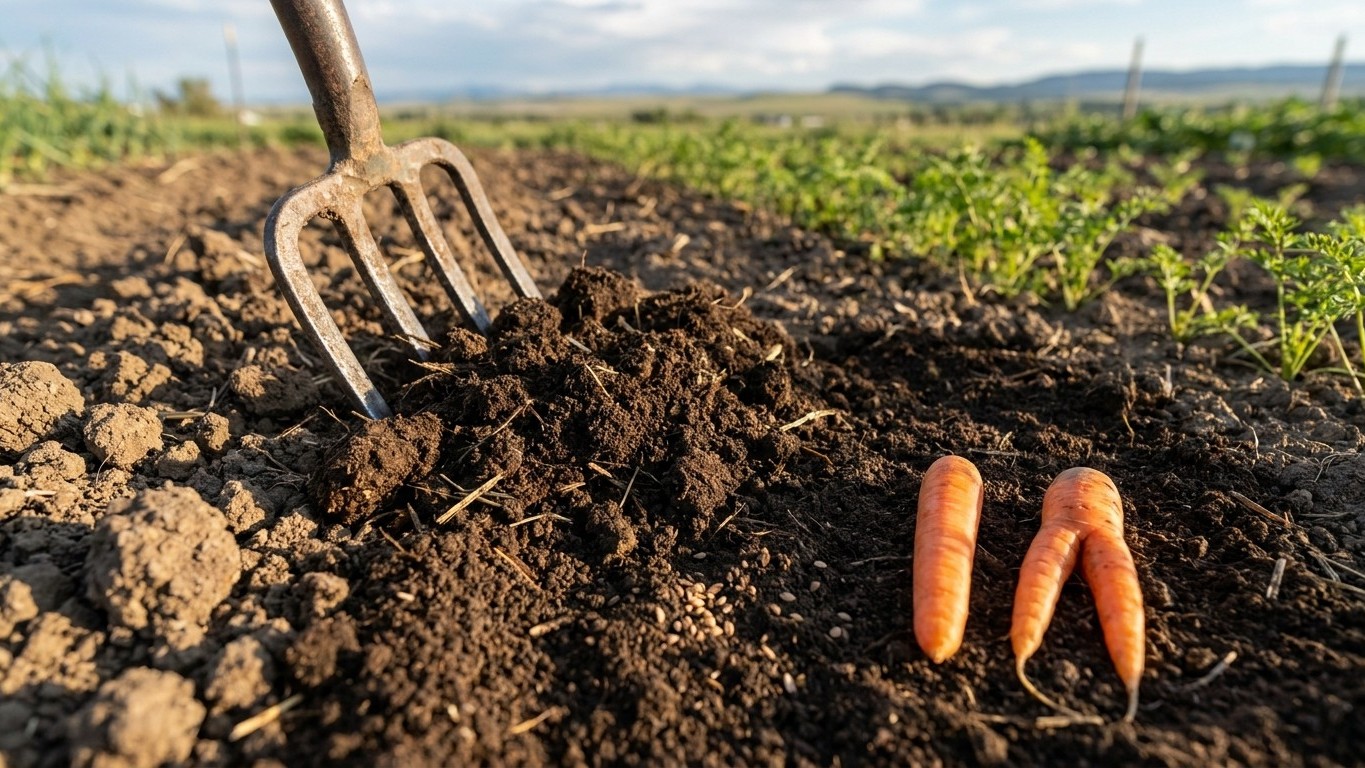

Carrots are ready to pull about 65 to 75 days after planting, according to Clemson Cooperative Extension. Carrots are sown in place, so that clock starts at seeding. Once they are out of the ground, the job changes to keeping them cold and moist. Clemson says to store them at 33 °F and high humidity, and to cut the tops off first. Carrots left bunched with their leaves keep only 10 to 14 days.
Keeping them, and for how long
The Home & Garden Information Center at Clemson Cooperative Extension gives the storage temperature as 33 °F, with high humidity to prevent wilting. Water freezes at 32 °F, so that target sits one degree above ice. It is a refrigerator number. It is not a cellar number, and it is not a garage number either. A root is mostly water, and dry air pulls that water out through the skin. The carrot goes limp and rubbery long before it spoils.
Warmth does its own damage. A carrot stored at 50 °F will sprout and soften in a fraction of the time it would last at 33 °F. The root is alive and uses itself up faster the warmer it sits. That is why a pantry shelf or a kitchen counter, which feels cool in October, is a poor place for a harvest you want to keep.
Why do you cut the carrot tops before storing?
Because the leaves keep working after the carrot is pulled. They draw moisture out of the root and let it escape into the air, so a carrot with its greens on is drying out the whole time. Clemson says bunched carrots, meaning plants with the tops still attached, keep for about 10 to 14 days. Trimmed carrots keep for months.
Cut the tops off the same day you pull. Take them off close to the crown, where the greens meet the orange. Brush off loose dirt with your hand. A carrot that goes into storage soaking wet and caked in mud is more likely to turn slimy than one that goes in lightly cleaned. Pull on a cool morning if you can. Roots left lying in the sun at the end of a row start to wilt before they ever reach the house.
How long will carrots really keep?
Treat every storage duration as a ceiling. The 10 to 14 days for bunched carrots is what you get when the temperature and the humidity are both right. A fridge that runs a few degrees warm, or a drawer that dries the roots out, will cut that short. The “months” for trimmed carrots works the same way. A carrot that was split, nicked by a fork tine, or chewed on in the ground will go bad first and can spoil its neighbors, so sort those out and use them first.
Harvest timing matters too. The 65 to 75 days gets you to a pullable carrot, and slower kinds take longer. Check the shoulder, the top of the root showing at the soil line. If it has color and looks about as wide as the packet describes, pull one and taste it. Roots pulled well before that stage store fine but give you less to eat, and roots left far past it tend to get woody or split after a heavy rain.
Where in the house that actually is
For most households, the refrigerator is the closest match to 33 °F, and the crisper drawer is the best spot in it. A household fridge runs colder than many garden crops can stand. Carrots are one of the crops that like it. The drawer also holds moisture better than an open shelf. Put the trimmed roots in a perforated plastic bag, or in a container lined with a damp paper towel, so the humidity stays high without water pooling in the bottom.
Every other room misses the target in its own way. A heated kitchen or pantry is too warm, and the carrots soften and sprout. A garage swings with the weather. In the humid South and Mid-South it can sit near 60 °F on a warm autumn afternoon. A basement or root cellar sounds right on paper, but plenty of them hold closer to 50 °F than 33 °F through much of the fall, which is exactly the temperature that loses carrots to sprouting.
The refrigerator is not perfect either. The dial on the front shows a setting, not a temperature. The door shelves run the warmest, and the back of a shelf near the cooling vent can freeze what sits against it. Leave an inexpensive appliance thermometer in the drawer for a full day before you commit the harvest to it. If it reads well above 33 °F, the carrots will lose days. If it dips to 32 °F or below, they will freeze.
A full harvest may not fit in one drawer. A spare refrigerator in the garage or basement can hold the overflow, but the same thermometer check applies, since garage fridges can run cold in winter and warm in summer. Check the bag every week or so. Pull out anything slimy, and use what has gone limp before it turns.
Common questions
How do I know when carrots are ready to pull?
Count from the day you seeded. Clemson Extension puts harvest at about 65 to 75 days after planting. Then check the shoulders at the soil line for color and width. Pull one and taste it. If you are still sorting out sowing dates for your own beds, Growing Carrots in Tennessee covers the whole season.
Can I leave carrots in the ground instead of storing them?
Where winters are mild, many gardeners leave carrots in the bed under a thick layer of mulch and pull them as needed. The tradeoff is that the roots stay exposed to whatever lives in the soil, and rain can split them. A hard freeze can lock the bed solid and make digging a chore. What Eats Carrot in Tennessee, and When explains what to watch for if the crop stays in the ground longer.
Why do my carrots fork or snap when I pull them?
Soil is the usual cause. Utah State University Extension says carrots want deep, sandy, well-drained soil rich in organic matter, and that heavy or rocky soil makes the root fork. Tennessee’s state soil, the Dickson series, is a good example of why this matters. It is an old, heavily leached, naturally acid soil that USDA records as about 11 percent sand, 20 percent clay and 68 percent silt, with about 1.5 percent organic matter and moderately well drained. A silty soil like that can pack down and hold water, which works against a straight root.
That soil represents the state, not your back garden. A state spans hundreds of soil series, and river bottoms, hill country and ground a builder has scraped or filled can differ completely. To find out what you have, send a sample to your county extension office for a soil test. For a quick check at home, squeeze a moist handful. If it forms a tight ball that holds its shape when poked, it is heavy. Heavy ground calls for plenty of compost and double digging, or a raised bed, rather than a different seed. The full soil story is in Will Carrots Fork in Tennessee Soil?
How can I tell stored carrots have gone bad?
Slime, a sour smell, or dark soft spots mean the carrot is finished, so throw it out. A carrot that is only limp has lost water but not quality. White fuzz or fine sprouts on the crown mean the storage spot is too warm, so check it with a thermometer.