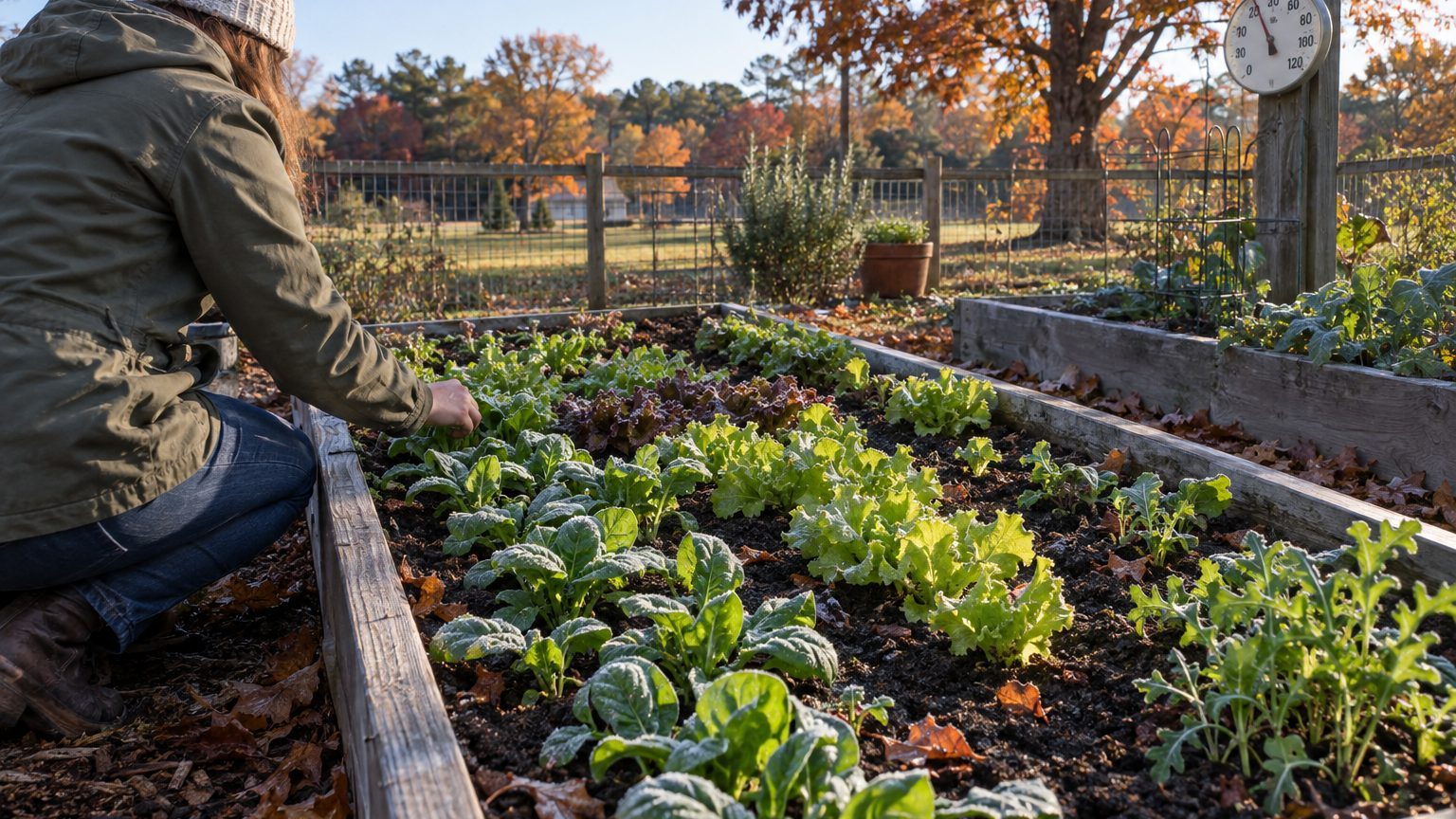

Sow winter salads in late summer, not fall. Plants need to be close to full size before daylight shrinks in early November, because after that they mostly hold rather than grow. Frost sets the covering schedule, but light sets the real deadline. The slowest crops go in first.
The short answer for Prince Edward Island
Sow winter salads between early August and the second week of September, starting with spinach, mâche and claytonia and finishing with arugula, mizuna and tatsoi. Count back from October 17, the average first fall frost at the Charlottetown A weather station, and aim for plants near harvest size by then.
Both frost dates come from Environment and Climate Change Canada’s 1981-2010 normals for that station. The average last spring frost is May 16 and the average first fall frost is October 17. Each is a midpoint. In one year out of two the last spring frost falls after May 16, and in one year out of two the first fall frost arrives before October 17. The reference station has about 154 frost-free days between the two dates. Canadian normals cover 1981-2010, while US gardening figures use 1991-2020, so compare across the border with care.
How does fall daylight limit sowing dates?
At Charlottetown’s latitude, daylight shortens noticeably from roughly early November to early February. Hardy salad crops shrug off frost, but they barely add leaf in that stretch. A bed that is half-grown on November 1 will stay half-grown until February.
That is why the windows below start earlier than most gardeners expect. Treat them as starting points and adjust to your own site.
| Type of salad crop | Sowing window | What to expect |
|---|---|---|
| Spinach, mâche, claytonia | Early to late August | Slow to size up, but the hardiest through the cold months |
| Cold-hardy leaf lettuce | Mid-August to early September | Needs a tunnel or cold frame to carry through winter |
| Arugula, mizuna, tatsoi, mustard greens | Late August to about September 10 | Ready in weeks, so a late sowing still reaches harvest size |
Can you sow winter salads in spring too?
Yes, but those are spring salads, a separate project. Hardy greens will sprout in cool April soil once the ground can be worked. May 16 is only the midpoint for the last frost, so half of all years bring a frost after it. Keep row cover on hand through late May.
Specific varieties matter for the slow crops, and the guide to the best winter salads for Prince Edward Island sorts them by hardiness.
What will not work here

An October sowing in open ground fails. With short days and soil cooling fast, seeds may sprout, but the seedlings stall at a few tiny leaves. They go into winter too small to survive it. Sowing even in the last days of September is a gamble for anything but the quickest greens.
A short season also rules out the slowest crops on a late schedule. About 154 frost-free days sounds generous until the time is divided. Spring is cold and the usable light is gone by November. Mâche sown in mid-September rarely gets big enough to harvest before it goes dormant, and heading radicchio or Belgian endive want a longer run than a late-summer sowing gives them.
Can winter salads survive without any cover?
Mostly not. The mean daily minimum of the coldest month is -12.1 °C (10.3 °F), and that is an average night, so the worst nights run well below it. Lettuce and arugula left in an open bed are usually finished by midwinter. Spinach, mâche and claytonia are tougher and may hold under snow, but they suffer from repeated freezing and thawing in exposed beds.
A single layer of row cover buys only a little warmth. A cold frame, or a low tunnel with a second cover laid directly over the plants, is a much better match for a -12.1 °C average night. Exposed coastal sites need hoops anchored well, since wind on an island can strip a loose cover in one storm.
Does a damp maritime climate cause problems?
It does. Autumn on an island ringed by water brings fog, dew and slow-drying foliage. Crowded seedlings stay wet, and wet leaves rot and invite slugs. Thin salad greens to their proper spacing rather than leaving the dense stand a seed packet tempts you to keep. On mild days, open the ends of tunnels and lift the covers so air moves through.
The opposite problem shows up in early August. A warm, dry spell can leave seed-row soil hot enough that lettuce refuses to sprout. Shade the row with a board or a light cloth, water it daily until it emerges, and sow in the evening.
What changes across Prince Edward Island
The island is small, but it is not one garden. Charlottetown’s climate is the reference, and Natural Resources Canada rates that city at zone 5b in the Canadian plant hardiness system. That is the zone of one city, not of the whole province. The Canadian system uses seven climate variables and does not convert to USDA zones, so a 5b here should never be read as any US zone.
Because the zone belongs to a reference city, there is no single answer for the province. Northern and upland districts run weeks behind the Charlottetown frost dates, so the average first fall frost of October 17 arrives earlier there and spring comes later. Shoreline gardens often stay milder through fall but take harder wind. To see where your own municipality falls, check the municipality listing on Natural Resources Canada’s plant hardiness site rather than guessing from the nearest town.
How should northern or upland gardeners shift their sowing dates?
Start earlier, and lean on the fast crops. A garden where frost comes early needs its slow crops sown in the first days of August. Move the fast greens up as well, because the light deadline holds everywhere, while a frost that arrives weeks sooner shortens the weeks for growth.
Plan on a cold frame or tunnel from the start in those districts. Cold nights that Charlottetown sees in December can arrive in November further out. For the full picture of what suits the province, Winter Salads for Prince Edward Island Gardens covers the wider approach.
Where to check this for your own county
Your provincial agriculture office is the next stop. Prince Edward Island Agriculture is the place to start for local growing information, and its staff can point you to regional specialists.
Look for two things in particular. The first is a local planting calendar for cool-season vegetables, ideally one that gives sowing dates for fall crops in your part of the island rather than for the province as a whole. The second is a list of varieties tried in your county. A variety that did well in a trial a few miles away is a better bet than one with a good name.
Why does a county recommendation beat a provincial one?
A county recommendation is built from conditions close to your garden: its frost pockets, its soil, its wind. The dates in this article are provincial, and they rest on one weather station’s averages. Treat them as a sound starting point and defer to the county office when the two disagree.
Market growers and long-time neighbors are another source. Ask when their first fall frost usually lands, and which beds they cover first. One year’s notes from a nearby grower often tell you more than a table of normals.
Checking this against your own garden
Your own observations outrank every date above. Three are worth watching, and none needs a gadget.
Soil warmth by feel. In early August, push your hand into the seed bed at the depth you will sow. Soil that feels hot and dry is too warm for lettuce seed, so shade it or wait for a cooler evening. Soil that feels cool and damp is ready. Gardens with sandy soil heat up faster than clay, and the difference shows up in your fingers.
First true leaves. Note how many days pass between sowing and the first true leaves, the ones that look like the mature plant after the rounded seed leaves. If seedlings are still on seed leaves by early September, the bed is running cool or shaded, and next year’s sowings there belong earlier.
Where frost shows first. After the first frost, walk the garden and see which plants are blackened. Low corners collect cold air and burn first, while beds against a south-facing wall hold out longest. Put the most tender crops in the warm spots and the hardiest in the cold ones.
Write the sowing date and first frost date in a notebook each year. After two or three seasons, your own record is a better calendar for your yard than any averaged normal.
Common questions
Is it too late to sow winter salads in October in Prince Edward Island?
For harvest through winter, yes. With short days arriving in early November, seedlings sown in October do not reach harvest size. A tunnel can carry tiny plants until spring, but the crop will not come on until days lengthen.
When should spinach be sown for winter harvest?
Early to late August is the usual window, since spinach is slow to size up and hardy once established. Sow it before the faster greens and protect it with a cold frame or low tunnel once nights drop toward freezing.
Do winter salads need a tunnel or cold frame here?
Most do. The mean daily minimum of the coldest month is -12.1 °C (10.3 °F), which ruins unprotected lettuce and arugula. Spinach, mâche and claytonia are the hardiest and sometimes pull through under snow, but cover gives better results.
Is May 16 a safe date to put out tender plants?
No. May 16 is the average last spring frost at the Charlottetown A station, so in one year out of two the last frost comes later. Keep row cover handy through the end of May, and later in northern or upland districts.