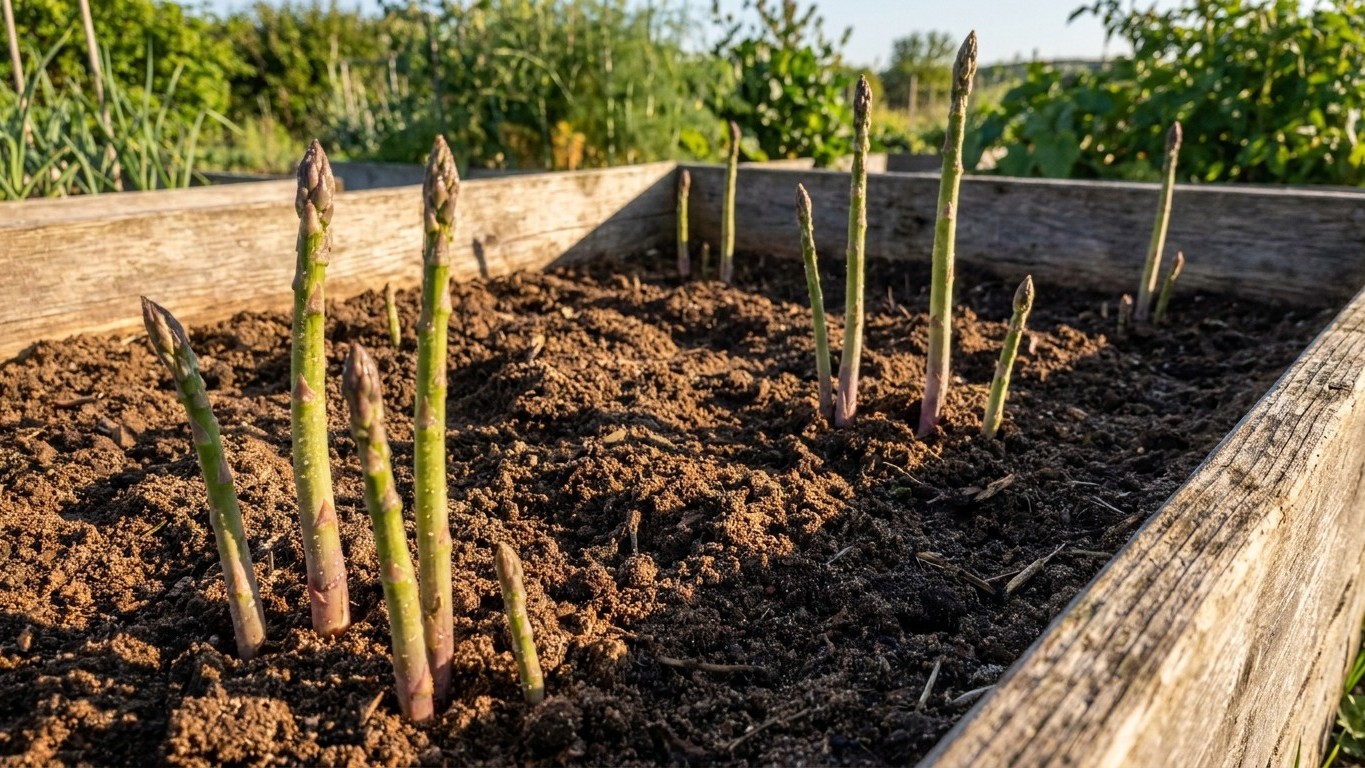

Three kinds of trouble go after asparagus in Quebec: chewing insects on the spears in spring, insects feeding on the ferns through summer, and rot at the crown where the soil stays wet. The first two follow the frost-free season closely. At the Montreal/St-Hubert A station, the mean last spring frost falls on May 6, and spears and the insects that feed on them show up around that date. A bed lives 10-15 years, so a pest that settles in has a long time to build.
Which pests attack asparagus in Quebec
The attackers that matter in an asparagus bed fall into three groups. A local agronomist can put a species name on each one once there is a specimen in hand.
- Chewing insects that feed on spears as they emerge, nibbling tips and scarring the sides.
- Insects that feed on the ferns after harvest, or from the first spring in a new bed, stripping the fine foliage.
- Soil-borne problems at the crown and roots, which rot the plant from below when water sits.
The ferns deserve more attention than most growers give them. Crowns go in as crowns planted in 8-inch furrows in early spring, and nothing is harvested until year 3. For two full seasons the ferns are the only way the plant feeds its roots. Heavy fern damage in those years slows the bed that will produce for 10-15 years, and it cannot be made up later.
The ground matters too. The dominant soil across Quebec’s mapped farmland is a Podzol (36 percent of the surface, followed by Gleysolic soils). Its typical surface is a well-drained loam to silt, with 51 percent sand, 15 percent clay and 34 percent silt. That profile suits asparagus, since most soils will do provided they drain well. The second most common group, the Gleysolic soils, tends to be wet, and a wet crown invites rot long before any insect finds it. A river bottom, a low corner or a patch of graded fill can behave nothing like the typical profile. The article on whether Quebec soil will hold an asparagus bed for fifteen years covers how to judge a spot before planting.
When each one shows up, and what it does first
The calendar hangs on the last spring frost. At the St-Hubert station, Environment and Climate Change Canada’s climate normals put the mean last spring frost on May 6. That is a midpoint. In one year out of two the last frost falls later, and northern or upland districts run weeks behind that station. Count from your own last frost, and plant crowns on a schedule that fits it (see when to plant asparagus crowns in Quebec).
Spears: the weeks around the last frost
Spear chewers arrive as the spears do, once the soil has warmed enough to push them up. The first thing you see is damage at the tip. It may be nibbled, ragged or bent over, or the spear may carry brown scars along one side. A bed that is being harvested is exposed for the whole cutting window. Harvest stops when most spears come up thinner than a pencil, and the rest are left to become ferns.
Ferns: from the first spring in a new bed, then after harvest ends
In years 1 and 2 the ferns stand from the first spring, so fern feeders can be active from the first warm weeks. In an established bed they get going once cutting stops. The first sign is thinning foliage: bare patches, stripped stems, or a fern that looks see-through against the sky. Summer rainfall at the Montreal/Pierre Elliott Trudeau station averages 269 mm (10.6 inches) from June to August, and June is the driest month at 87 mm (3.42 inches). A dry spell in June on a sandy patch can stress ferns enough that they look insect-damaged when they are not.
Crown and roots: any time the ground is wet
Soil problems announce themselves by absence. Spears fail to appear in spring, come up thin and weak, or ferns yellow and flop in a wet stretch of summer. Nothing is chewed, and nothing is visible above ground.
Telling the damage apart from everything else
Plenty of things that look like insect damage are weather, water or ground conditions. The reliable test is to look for the cause itself. Ragged edges, droppings or the insect itself on the plant point toward a pest. A damaged plant with none of the three needs another explanation. The table sets out common look-alikes and what separates them.
| What you see | Other causes to rule out | What tells them apart |
|---|---|---|
| Limp, dark, water-soaked spear tips | Frost on spears that came up before the last frost | Several spears are hit on the same cold night, and the damage is on the exposed tips |
| Spears clipped or snapped at one height | Hoe or foot damage, wind, or browsing by a larger animal | Insect feeding leaves small bites and scars, while mechanical or browsing damage leaves a clean break or a torn stem |
| Yellow ferns in midsummer | Drought stress, waterlogged crowns, or a disease | Dig a small hole near the crown. Soggy, smelly soil points to water, and dust-dry soil points to drought |
| Orange or brown powder on ferns | A fungal disease rather than a chewing insect | The powder rubs off on a finger, and nothing is eating the foliage |
| Thin, spindly spears | A young crown, a crowded bed, or an overharvested one | Crown age and the harvest history usually explain it, with no chewed tissue |
| Ferns yellowing in fall | Normal dieback at the end of the season | The whole bed yellows at once and evenly as the season closes |
Causes can overlap, so a table only narrows the field. Before you decide what is wrong, take a photo, collect a few damaged stems, and bring them to your regional agricultural office or a local agronomist, who can confirm a diagnosis.
What actually works here, and what is a waste of time
A physical barrier set at the right moment beats a treatment on a short season. A light row cover laid over the bed just before spears emerge keeps flying and crawling insects off the tips. It has to come off for cutting, and it should go back on the same day. In a bed with no harvest yet (years 1 and 2), cover the young ferns and pick off what you find by hand.
Cleanup counts as much. Cut the dead ferns once they have browned and cleared the bed, because old stalks give insects a place to sit out the winter. Backfill the furrow gradually through the first year, and never all at once. Full backfill on day one buries the crown under soil it cannot push through.
Drainage is the cheapest protection against crown rot. A low spot or a heavy patch of fill is a decision made for fifteen years, so choose the site with that in mind. Weed control helps for a plain reason: less cover means fewer places for insects to hide near the spears.
Several common habits waste time. Spraying on a calendar before you know what you are fighting treats a guess, and spraying during the cutting window means you eat what you spray. Tearing out thin ferns in a young bed removes the only food supply the crowns have. Cutting spears beyond the pencil-thickness rule weakens the bed. Which products are registered for use in Quebec is a question for an agronomist or the provincial agricultural advisory service, because registrations change and labels govern use.
Where to check this for your own county
Quebec is not organized into American-style counties, and there is no county extension office to walk into. The equivalent is the regional agricultural office for your area, or an independent agronomist who works in your region. Ask them what is active in your district this season, since pest presence can differ widely inside one province.
The frost date alone shows the spread. A garden in a northern or upland district can run weeks behind the St-Hubert station, so its spears and the insects that follow them arrive later. The soil varies just as widely, and the typical well-drained Podzol surface says little about a river bottom, a clay pocket or ground a builder has scraped.
For the crop itself, Utah State University Extension is the reference for the bed: crowns in 8-inch furrows in early spring, no harvest until year 3, then 10-15 years of production on well-drained ground. The broader guide to growing asparagus in Quebec ties those steps to the local season.
Your next step is small. Bring an agronomist the damaged stems, a photo of the whole fern, and your dated notes from the weekly walk. A soil test on the bed will show whether the ground itself is part of the problem.
Common questions
When do asparagus pests become active in Quebec?
Spear feeders appear when spears do, in the weeks around the last spring frost. The mean date at the Montreal/St-Hubert A station is May 6, and in one year out of two it falls later. Fern feeders take over as the foliage opens, and crown problems follow wet weather.
Can I still eat spears that insects nibbled?
Spears with a small chewed tip can usually be trimmed. Skip any that are slimy or rotting. Store cut spears at 0°C to 2°C (32°F to 35.6°F) with the butts standing in water to hold humidity near saturation. Above 10°C (50°F) the spears toughen quickly, and at -0.6°C (30.9°F) or lower they freeze and go soft.
Should I treat a new bed in its first year?
Protect the ferns first, with row cover and hand-picking. In years 1 and 2 nothing is harvested, and the ferns feed the crowns. If damage keeps climbing, bring a specimen to an agronomist before any product goes on.
Does Quebec’s soil make pest trouble worse?
The typical farmland surface is well drained loam to silt, which suits asparagus. Wet pockets, where Gleysolic soils tend to occur, raise the risk of crown rot. Test your own ground, and see the article on soil and drainage for a fifteen-year bed.
Sources : wcax.com