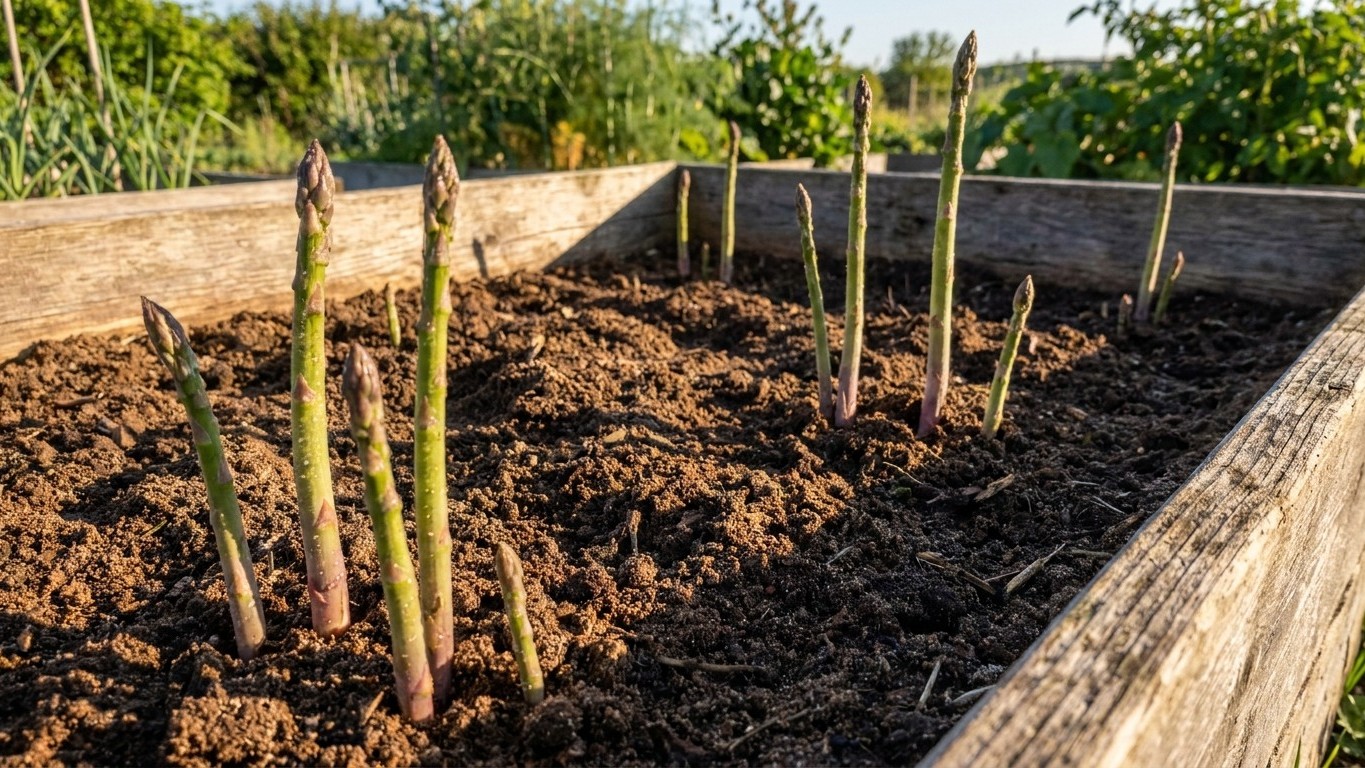

Quebec’s ground can carry an asparagus bed through its full ten-to-fifteen-year run, but only where the plot drains. The province’s most common soil, a Podzol, is rated well drained and runs slightly acid to loam-silt, which covers the plant’s one real requirement. Where a garden sits on heavier, wetter ground instead, the fix is a raised bed or a mounded row, not a change of crop.
The short answer
Fifteen years is the outer edge of the commitment Utah State University Extension describes for an asparagus planting, and the source is almost casual about the soil: “most soils will do provided they are well drained.” That single condition matters more here than it would for a crop pulled after one season, because a bed that sits wrong for even three or four years is a bed the gardener has to dig out, roots and all, and start over somewhere else.
Quebec’s dominant mapped soil is a Podzol, the acid, leached profile that forms under conifer cover once rain has carried the bases out of the topsoil. It covers 36 percent of the province’s mapped surface, more than any other order, with Gleysolic soils next. The median surface reading across 248 mapped components puts the texture at 51 percent sand, 15 percent clay and 34 percent silt, a loam-to-silt mix, with a median pH near 5.5 and organic matter around 6.2 percent. Agriculture and Agri-Food Canada’s Canadian Soil Information Service rates this profile well drained under the Canadian System of Soil Classification.
That combination, a sandy-leaning loam with decent organic matter and an official well-drained rating, is close to what the asparagus source asks for. It is not a demand for a particular pH or a particular fertility level; the source is silent on both. It is a demand that water move through the root zone instead of sitting in it, and on this province’s most common profile, it generally does.
What a Podzol rating does not tell a gardener
The state-level figure is a starting point, not a diagnosis of one backyard. It describes the median of agricultural-region soils across the province; it says nothing about a specific lot, and it says nothing about ground near a river, a low corner of a yard, or fill brought in during construction. Any of those can behave nothing like the median, holding water for days after a storm even where the regional profile drains cleanly.
The only way to know a given plot’s answer is a shovel test after a hard rain: dig a hole about a foot deep, fill it with water, and see whether it drains within a few hours or still holds water the next morning. Where it holds water, the workaround is not amending soil chemistry, it is changing the bed’s shape. A raised bed, or a mounded row built up eight to ten inches above grade, moves the crowns out of standing water without asking the gardener to fight the native soil for fifteen years.
Will the summer here water it for you?
The asparagus source sets a two-stage watering rule: 1 to 2 inches every other week through the first two growing seasons, then a lighter 1 to 2 inches every three weeks once the planting is established. Quebec’s summer, by the 1981-2010 normals for the Montreal/Pierre Elliott Trudeau Intl A station, delivers about 10.6 inches across June, July and August combined, with June the driest month at 3.42 inches, July at 3.52 and August at 3.71.
- Convert the target to a monthly figure. Every-other-week watering at 1 to 2 inches works out to roughly 2 to 4 inches a month during the first two seasons, the period when crowns are building the root system that will feed the bed for the next decade.
- Compare it to what falls. At 3.4 to 3.7 inches a month, June through August rainfall sits inside that 2-to-4-inch band on paper, sometimes near the top of it, sometimes below.
- Read the fine print on how rain arrives. A normal is a monthly total, not a schedule; a month’s worth can fall in two heavy thunderstorms with two dry weeks between them, and young crowns don’t hold moisture through a two-week gap the way an established bed does.
- Plan to supplement in the first two years regardless. Because the source’s every-other-week rule assumes a fairly even 1-to-2-inch interval, a gardener should treat the summer normal as a rough offset, not a guarantee, and keep a hose or drip line ready for any stretch longer than ten days without rain.
- Ease off once the bed is established. After year two, the target drops to every three weeks, a pace Quebec’s summer normal covers comfortably on its own in most years, leaving supplemental watering as an occasional response to an unusually dry stretch rather than a routine task.
- Keep a rain gauge on the actual plot. A station normal describes the region; a slope, a tree canopy or a city microclimate changes what lands on one particular bed, and a five-dollar gauge answers that question better than any average can.
When to put the crowns in
Utah State University Extension’s planting method is straightforward: crowns go into furrows about 8 inches deep, set in early spring, with the furrow backfilled gradually across the year, roughly 2 inches of soil added back every other month rather than filled in all at once. That gradual backfill lets new growth push through progressively shallower soil instead of fighting a full 8 inches of cover from the start.
“Early spring” in Quebec has to be read against the region’s own frost pattern. The Montreal/St-Hubert A station’s 1981-2010 normals put the last spring frost at around May 6, and that figure is a mean, not a promise: in roughly half of all years, frost arrives later than that date. A gardener working from this normal should treat May 6 as the midpoint of a window that can run later, not as a green light on its own, and should watch local forecasts as the date approaches rather than planting strictly by the calendar.
Crowns are typically set once the soil has thawed and can be worked, which for most of the province’s agricultural regions lines up somewhere around that early-May window, sometimes a little before it if the ground is workable, sometimes after it where a cold spring pushes the date back. Seed is the alternative route: rather than buying dormant one-year crowns, a gardener can start asparagus from seed, though the source gives no schedule for germination time or transplant size, and no comparison of how a seed-grown bed performs against a crown-grown one. Anyone choosing that route is working with less published detail on timing than the crown method offers.
Varieties named, without a recommendation
Utah State University Extension names four varieties in its asparagus guidance, distinguished only by sex, with no note on flavor, yield or regional suitability for any of them.
| Variety | Type |
|---|---|
| Jersey Giant | All-male |
| Jersey Knight | All-male |
| UC 157 F1 | Male/female |
| Purple Passion | Male/female |
All-male varieties skip seed production, which some gardeners prefer because energy that would go into berries goes into spear growth instead, but that preference isn’t something the source states outright, and no yield or taste comparison is published to back a choice between the four.
Common questions
Can I harvest asparagus the first year after planting crowns?
No. The bed is not harvested at all in year one or year two; the first cutting comes in year three, and even then the harvest window starts short, around four weeks, before extending to six weeks and then eight weeks in the years that follow.
How do I know when to stop cutting for the season?
Stop when most of the spears coming up are thinner than a pencil. That’s a visual signal tied to the plant’s stored energy, not a fixed date or week count, so the cutoff shifts a little from year to year and from bed to bed.
Does Quebec’s soil pH need adjusting before planting asparagus?
The source for asparagus care doesn’t publish a pH requirement, and no chilling-hour figure is published either. The province’s median surface pH runs slightly acid, around 5.5, but that’s a regional median, not a target the crop is known to need, so there’s nothing here to compare it against.
What if my yard has heavy, slow-draining soil instead of the province’s typical loam?
Build up rather than dig in. A raised bed or a mounded row lifts the crowns above the water table without requiring years of soil amendment, and it’s the more reliable fix for a fifteen-year planting than hoping drainage improves on its own.