
Peonies, daylilies, and hostas shrug off Quebec winters that finish off tropical hibiscus and bougainvillea within a single season. The difference comes down to whether a plant’s roots can sit through a winter that stays well below freezing for months and still push up new growth in spring. Build your border around perennials and cold-hardy bulbs bred to survive northern winters, and treat true tropicals as annuals you replace every year instead of plants you expect to overwinter.
Putting a border together
A Quebec border works the same way any border works, but the plant list narrows fast once winter enters the picture. Start with height: tall plants at the back or center, medium plants filling the middle, low edging plants at the front or along the path. Then think about when each plant blooms, because a border that peaks in July and goes bare by August looks unfinished for two-thirds of the season. Repeat two or three colors through the whole bed instead of scattering one of everything, and leave real gaps at planting time so perennials have room to reach their mature spread in two or three years rather than fighting each other in year one.
Layering by height and cold tolerance
For the back layer, peonies (such as ‘Sarah Bernhardt’) and tall garden phlox like ‘David’ come back reliably from the same crown year after year because their roots sit below the frost line and tolerate deep winter cold. Delphinium and tall bearded iris fill a similar role, though delphinium often needs staking once it tops five feet. These are the plants worth anchoring a Quebec border around, because they are the ones that don’t need replacing every spring.
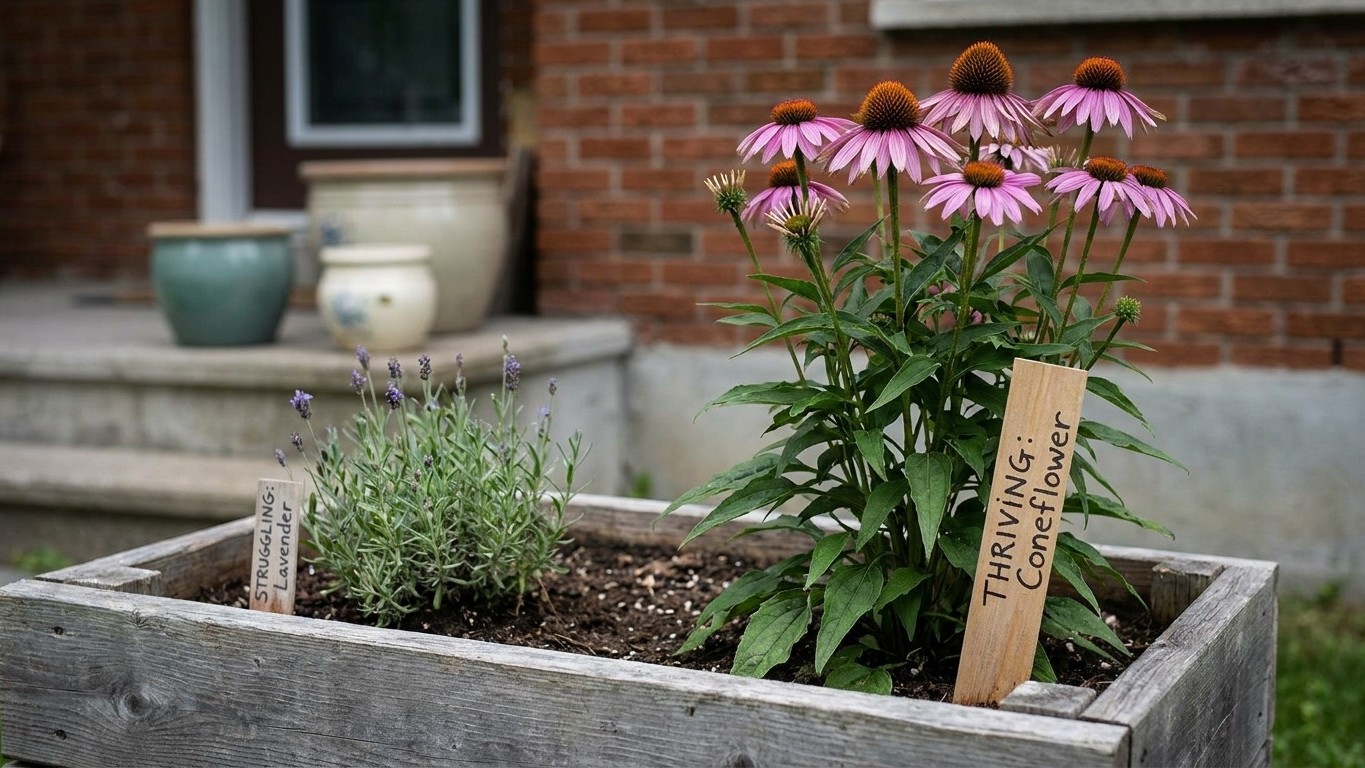
For the middle layer, coneflower (Echinacea purpurea), black-eyed Susan (‘Goldsturm’), and daylilies such as ‘Stella de Oro’ carry the bulk of summer color and ask very little in return. Nepeta ‘Walker’s Low’ and Sedum ‘Autumn Joy’ both hold their shape through the season and into a light frost, which matters when the border needs to look presentable well past the first cool nights. For the low front edge, hostas handle shade at this height while low sedums and creeping phlox handle sun.
Natural Resources Canada’s Plant Hardiness zone map, using 1991-2020 normals, places Montreal at zone 5b under the Canadian system, which is built on seven climate variables and does not translate directly onto the single-variable USDA scale used in American nursery tags. All the perennials named above are commonly grown through winters this cold. What actually kills plants in a Quebec winter is less the occasional deep cold snap than the sustained cold of the coldest month: Environment and Climate Change Canada’s 1981-2010 normals put Montreal’s mean daily minimum for that month at -14.1°C. A perennial that dies back to bare ground every fall and re-sprouts from a hardy crown shrugs this off. A woody plant with tender stems above ground, like a hybrid tea rose, does not, unless it’s mounded with soil or mulch before the ground locks up.
Succession of bloom through a short season
Plan the calendar in layers too. Tulips and daffodils open the season before most perennials have even broken ground, since spring bulbs are planted the previous fall and bloom on stored energy. Peonies and iris carry early summer, coneflower and daylilies take over for the middle of the season, and asters and sedum close things out into fall. The table below shows a rough succession for a Quebec border, with height and winter behavior included since that second column is what decides whether a plant belongs in this climate at all.
| Plant | Bloom season | Height | Winter behavior |
|---|---|---|---|
| Tulip / daffodil | Early spring | 10-18 in | Bulb overwinters in ground |
| Peony ‘Sarah Bernhardt’ | Late spring | 30-36 in | Dies back, hardy crown |
| Bearded iris | Late spring to early summer | 24-36 in | Dies back, hardy rhizome |
| Coneflower (Echinacea purpurea) | Midsummer | 24-36 in | Dies back, hardy crown |
| Daylily ‘Stella de Oro’ | Midsummer, repeats | 12-18 in | Dies back, hardy crown |
| Garden phlox ‘David’ | Mid to late summer | 30-40 in | Dies back, hardy crown |
| New England aster | Fall | 36-48 in | Dies back, hardy crown |
| Sedum ‘Autumn Joy’ | Fall | 18-24 in | Dies back, hardy crown |
Timing planting around the frost dates matters more here than in milder climates. Environment and Climate Change Canada’s 1981-2010 normals put Montreal’s average last spring frost at May 6 and its average first fall frost at October 5, both measured at the Montreal/St-Hubert A station. These are means, not guarantees. In one year out of two, the frost falls later than May 6 in spring or earlier than October 5 in fall, so treat the window between them as roughly five months rather than a fixed date to circle on the calendar. Bulb planting for spring bloom happens in the weeks before the ground freezes in fall, well after that October frost date, once the soil has cooled but is still workable.
What struggles here
Tropical and subtropical flowers are the clearest failures. Bougainvillea, tropical hibiscus, mandevilla, and true gardenias need a long stretch of sustained heat that Quebec’s climate doesn’t provide as an outdoor perennial, and none of them tolerate any frost at all. That’s a different problem from summer heat itself: Environment and Climate Change Canada’s 1981-2010 normals show Montréal/Pierre Elliott Trudeau Intl A airport averaging only 2.8 days a year above 32°C, with a more representative 9.3 days above 30°C in a typical summer. Those numbers describe extreme-heat days, not the length of the growing season, and they aren’t the reason tropicals fail here. The real limit is the frost-free window bounded by that May and October pair of dates, which is simply too short and too cool for plants that evolved with no winter dormancy at all.
- Tropical hibiscus and bougainvillea: killed outright by the first hard frost, no dormancy to fall back on
- Tuberous begonias and gladiolus: survive only if the tubers or corms are lifted and stored indoors each fall
- Hybrid tea roses: often die back to the graft or below without a mound of soil or mulch over the crown before the ground freezes
- Lavender: tolerates the cold reasonably well but often rots over winter in heavy, poorly drained Quebec clay
Roses illustrate the split well. Hybrid teas grafted onto a rootstock frequently lose everything above the graft union in a winter with a coldest-month mean minimum like Montreal’s -14.1°C, unless they’re mounded. Shrub roses bred for northern climates, including the Explorer series such as ‘John Cabot’ and ‘William Baffin’, grow on their own roots and come through the same winters with far less fuss, which is why they show up so often in Quebec gardens instead of the florist-style hybrid teas. Gardeners further west face an even harder version of this problem: our guide to flowers that actually thrive in Saskatchewan, and the ones that struggle covers a growing season with a shorter frost-free window than Montreal’s. By contrast, a state like Indiana runs a longer, hotter summer that lets gardeners succeed with heat-loving annuals that never fully perform in Quebec, a difference our Indiana flower guide lays out in more detail.
Repetition, color, and leaving room
Repeating a plant three or more times through a bed reads as intentional, while one of everything reads as cluttered. Pick a color pair, like the purple-and-gold combination of Echinacea and Rudbeckia, and echo it in at least two spots along the border rather than confining it to a single clump. When you plant, resist the urge to fill every visible gap in year one. A peony given its full mature spread of three feet looks sparse in its first spring and crowded, root-bound, and reluctant to bloom five years later if it was planted eighteen inches from its neighbor. Space for the plant’s fifth year, not its first. Fill the temporary gaps with an annual like zinnia or cosmos, both of which grow, bloom, and die within one season here and won’t compete with the perennials establishing underneath them.
Local help
MAPAQ, Quebec’s agriculture ministry, runs an extension service with horticulture bulletins and regional contacts, and it’s a better source for plant advice specific to your county than any provincewide figure, since conditions on the North Shore or in the Eastern Townships run noticeably colder or wetter than around Montreal. Local horticultural societies and Master Gardener volunteer programs are worth seeking out too, since their members have usually tested a given plant’s hardiness in your exact microclimate rather than the reference station’s. For more Quebec-specific growing guides, start with our Quebec guides portal.
Common questions
Can I grow hydrangeas in Quebec?
Panicle hydrangeas (Hydrangea paniculata varieties like ‘Limelight’) generally do well because they bloom on new wood grown fresh each spring, so even if the previous year’s stems die back, the plant still flowers. Bigleaf hydrangeas that bloom on old wood are far less reliable, since a hard winter can kill the buds that would have opened that summer, leaving the plant leafy but flowerless.
Do I need to dig up dahlias and gladiolus every fall?
Yes, if you want them back next year. Their tubers and corms won’t survive a Quebec winter in the ground, so growers lift them after the foliage is killed by frost, let them cure, and store them indoors somewhere cool and dry until spring replanting.
When is it actually safe to plant flowers outside after winter?
There’s no single safe date, since Environment and Climate Change Canada’s average last spring frost of May 6 for the Montreal area is a midpoint, not a guarantee, and frost arrives later than that in roughly half of all years. Tender annuals go out only once the risk has clearly passed in your specific area, and gardeners further from Montreal or at higher elevation should wait longer still.
Will lavender survive a Quebec winter?
It can, but it fails more often from wet feet than from cold. Lavender needs sharp drainage, and heavy clay that stays saturated through a Quebec winter tends to rot the roots long before the cold itself becomes the problem, so raised beds or generous grit worked into the soil make a bigger difference than picking a hardier-sounding variety.
Related guides
- Flowers That Actually Thrive in Ontario, and the Ones That Struggle
- Flowers That Actually Thrive in New Brunswick, and the Ones That Struggle
- Flowers That Actually Thrive in Saskatchewan, and the Ones That Struggle