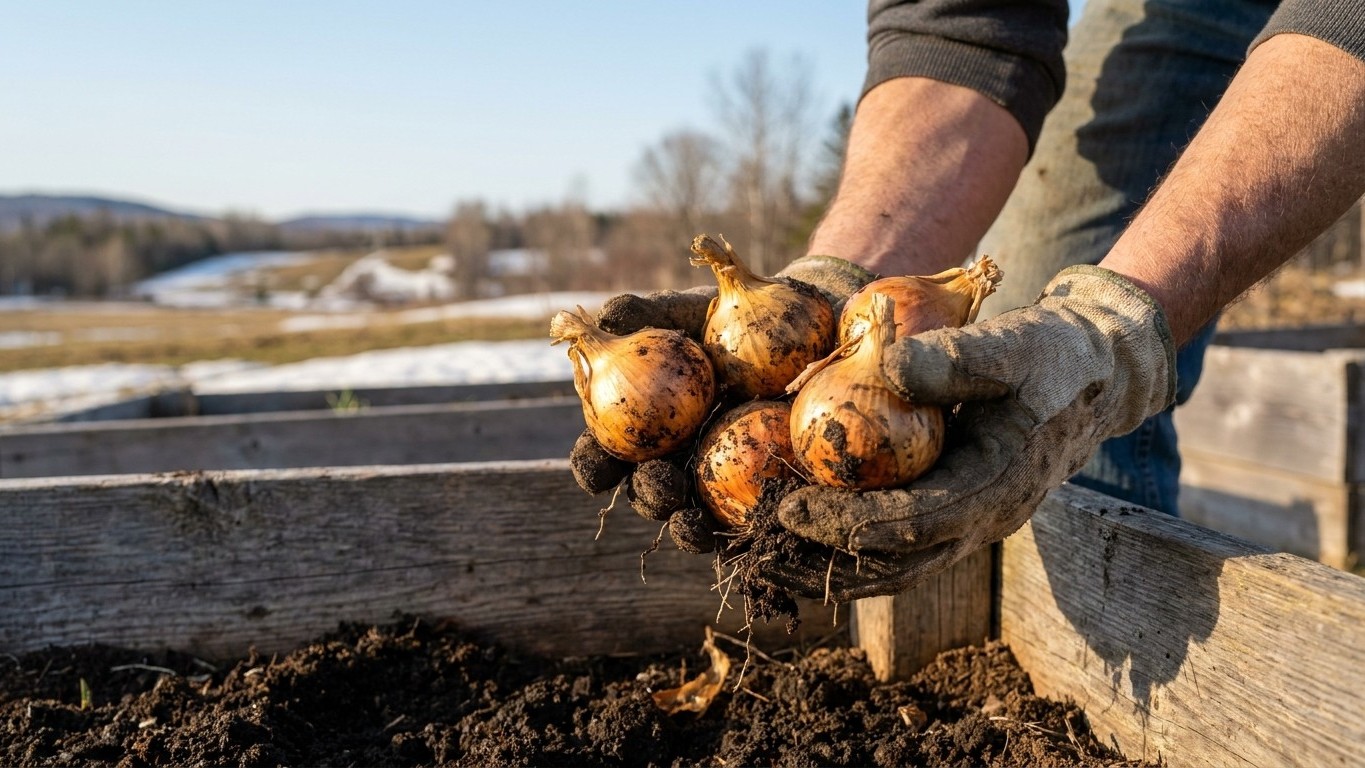

Onions in Quebec go into the ground in early spring, not fall. At 45.47 degrees north, the latitude of Montreal, drawn from Environment and Climate Change Canada’s climate station at Pierre Elliott Trudeau airport, the longest day of the year brings 15 hours and 29 minutes of daylight. That single number decides almost everything: it is long enough to trigger bulbing in long-day and intermediate-day onions, but the province’s winters are too harsh to let bulbs sit in the ground over winter the way milder states do. The whole growing plan has to fit between the spring thaw and the June solstice.
The short answer for Quebec

Onions do not respond to warmth the way tomatoes or peppers do. They respond to day length. Once the number of daylight hours crosses a variety’s threshold, the plant stops building leaves and starts building a bulb, whatever size it happens to be at that moment. At Montreal’s latitude, the longest day tops out at 15 hours and 29 minutes. That is well past the 12-hour mark that trips short-day onions, and it sits comfortably inside the 14-to-16-hour window that long-day types need. It also clears the 12-to-14-hour range that intermediate-day varieties look for. In practice, that means Quebec gardens are long-day and intermediate-day territory, full stop.
Seventeen of the varieties documented on this site have a published latitude range that covers 45.47N, which is another way of saying they are built for exactly this kind of daylight: Ailsa Craig, Barolo, Blush, Bridger, Frontier, Monastrell, New York Early, Patterson, Powell, Red Long of Florence, Red Long of Tropea, Redwing, Rossa di Milano, Safrane, Scout, Talon, and Walla Walla Sweet. Most are long-day; a handful, like Monastrell, Red Long of Florence, Red Long of Tropea, and Scout, are intermediate-day types that also tolerate this far north.
Why timing, not just variety, matters
Because the trigger is a calendar date, not a temperature, the planting window has to give the plant as much leaf growth as possible before that date arrives. In a state with mild winters, gardeners plant onion sets or transplants in October or November, let the roots establish through a gentle winter, and the plant is already sizable by the time day length starts climbing in spring. Quebec cannot do that. A young onion left outside in a Quebec winter freezes solid and dies. So the season shifts entirely to the other end of the calendar: seed started indoors in late winter, or sets and transplants moved outside in early spring as soon as the soil can be worked, usually sometime in April depending on the region. Every week gained in that spring window is a week of leaf growth banked before the solstice throws the switch.
What will not work here
Two mistakes ruin an onion crop in Quebec, and neither one is about soil or fertilizer. The first is planting late. The second is planting the wrong day-length group. Both produce the same disappointing result: small onions, harvested on schedule, that never had the chance to size up.
Planting late does not push the harvest back the way it would with a slower-growing lettuce. The solstice arrives on the same date whether the onion went in the ground in April or in late May. Whatever leaf mass the plant has built by the time daylight crosses its bulbing threshold is locked in. A late-planted onion does not catch up later in the season; it simply bulbs early relative to its own growth, and the bulb stays small. This is the single most common reason gardeners in short-season climates end up with a harvest of onions the size of golf balls.
The variety mistake is just as unforgiving, and it runs the opposite direction from what a lot of catalog browsing might suggest. Short-day onions are bred for latitudes far south of Quebec, where summer days barely reach 12 hours. Planted this far north, where days run past that threshold within weeks of the plants going outside, they start bulbing almost immediately, long before the plant has any size to speak of. Eight varieties documented on this site fall into that trap here:
- Candy (intermediate-day, published range 33-40N): bulbs early at this latitude, giving small onions rather than none at all.
- Gabriella (short-day, published range 20-35N): triggers into bulbing while the plant is still tiny.
- Madalyn (short-day, published range 20-35N): same early-trigger problem, undersized bulbs.
- Red Rock (short-day, published range 30-36N): built for far shorter summer days than Quebec provides.
- Red Sensation (short-day, published range 25-35N): bulbs before real growth has happened.
- Texas Grano 1015Y (short-day, published range 25-35N): a southern variety, poor fit for this latitude.
- Vidora (short-day, published range 25-35N): same mismatch, tiny harvest.
- White Castle (short-day, published range 30-38N): threshold reached far too early in the Quebec season.
None of these are a feeding problem or a watering problem. They are a variety chosen for the wrong latitude, and no amount of compost fixes that.
What changes across Quebec
Every figure above comes from one station: Montreal, at 45.47 degrees north. Quebec is not one latitude, though. The settled, gardening part of the province runs from roughly the U.S. border near the Eastern Townships, close to Montreal’s own latitude, up through the Saguenay and North Shore regions, and the province technically extends well past 60 degrees north toward Ungava Bay, though almost no vegetable gardening happens that far north.
| Region | Approximate latitude | What it changes |
|---|---|---|
| Montreal / Monteregie / Eastern Townships | ~45N (reference point) | Figures on this page apply directly; plant in early spring for long-day and intermediate-day varieties. |
| Quebec City / Saguenay–Lac-Saint-Jean | ~47-49N | Summer days run longer than 15h29, which favors long-day varieties even more, but frost dates arrive later in spring and earlier in fall, tightening the growing window. |
| North Shore / far northern communities | above ~55N | Daylight is generous, but the frost-free season is often too short for onions to bulb before fall frost, regardless of variety chosen. |
A gardener in the Eastern Townships, close to the U.S. border, is planting under conditions nearly identical to Montreal’s. Someone gardening near Saguenay or the North Shore is working with a longer summer day but a shorter frost-free season, which means the planting date matters even more than the variety choice. The six varieties that sit within 1.5 degrees of their published boundary, Cabernet, Calibra, Elsye, Expression, Red Carpet, and Sierra Blanca, are the ones most affected by exactly where in Quebec a garden sits. None of them are a clear yes or a clear no at 45.47N; they may bulb here, and a gardener slightly north or south of Montreal is genuinely at the edge of what these varieties were bred to do.
Checking this against your own garden
Everything on this page describes conditions at one specific point in Quebec. A backyard fifty miles away, at a different elevation or a different distance from the St. Lawrence River, can behave differently enough to matter. Before committing to a planting date, it is worth confirming a few things locally.
- Look up your own latitude if you garden well north or south of Montreal; a difference of even one or two degrees shifts the day length your onions actually experience.
- Confirm your last spring frost date and first fall frost date with local records rather than assuming the provincial average applies.
- Check with your local agricultural extension or provincial agronomy office for microclimate notes specific to your county or municipality.
- Watch your soil, not the calendar: onion sets and transplants go in once the ground can be worked, which varies year to year even at the same address.
- If you are near the edge of a variety’s published range, treat the first season as a test rather than a guarantee, and note the bulb size you get for next year’s decision.
The 12-hour threshold that Clemson Cooperative Extension publishes for short-day onions is a useful benchmark for understanding why the varieties above fail here, but it does not replace a look at your own thermometer and your own frost dates before deciding when the first onions go into the ground.