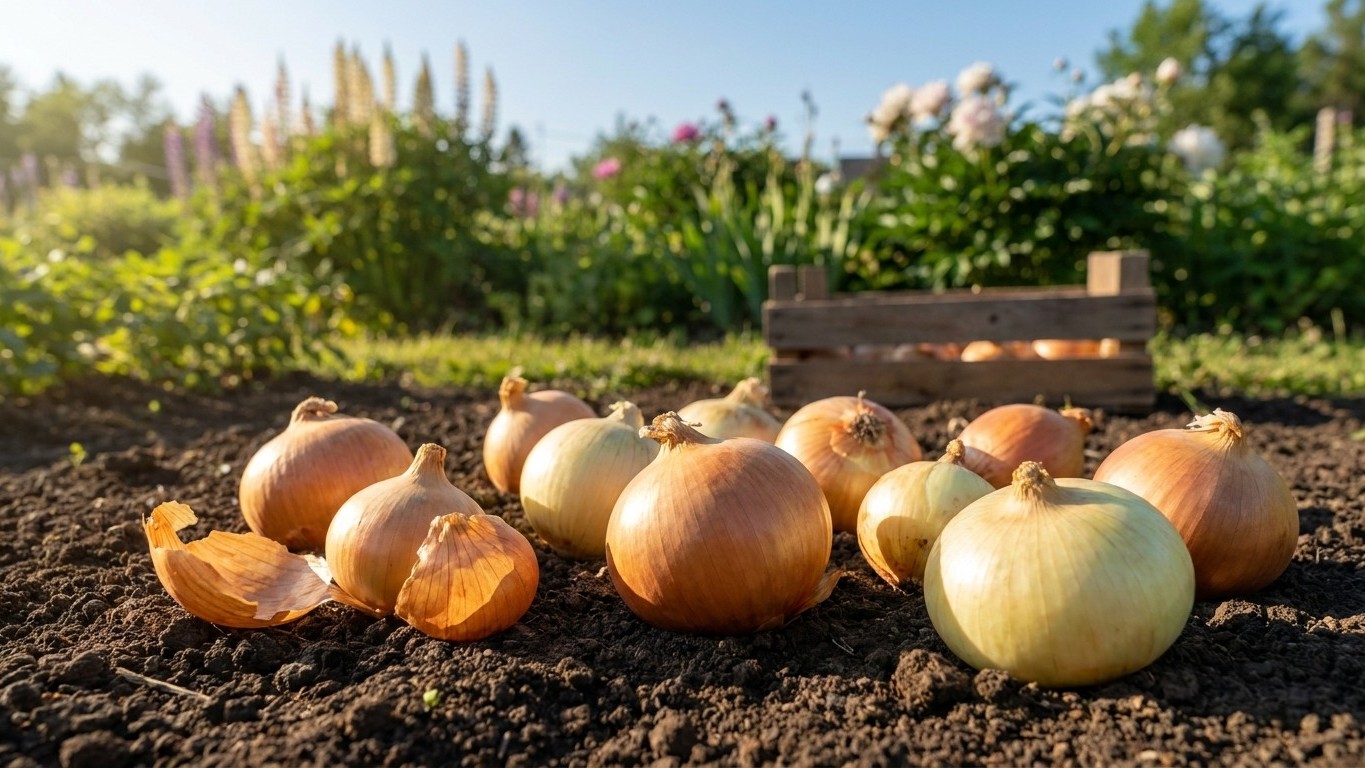

Montreal sits at 45.47 degrees north, and on the summer solstice the city gets 15 hours and 29 minutes of daylight, well inside the 14-to-16-hour window that triggers bulbing in long-day onions. That single detail decides which onion varieties will actually form bulbs in a Quebec garden and which ones will spend the whole season making leaves instead. Of the 31 varieties documented on this site, 17 fit this latitude, several more sit right at the edge, and eight are simply the wrong tool for this climate.
The short answer for Quebec

Onions don’t bulb because the weather warms up. They bulb because the days get long enough, and the length that flips the switch is written into the variety itself. Clemson Cooperative Extension’s Home & Garden Information Center puts the trigger for short-day onions at roughly 12 hours of daylight. Long-day varieties wait much longer, typically 14 to 16 hours, before they stop pushing out leaves and start swelling a bulb. At 45.47N, Montreal’s 15 hours 29 minutes on the longest day of the year lands squarely inside that long-day window, with room to spare for most intermediate-day types too.
That makes Quebec long-day and intermediate-day territory. A short-day onion planted here will see the trigger hour arrive while the plant is still small, so it bulbs anyway, just at a fraction of the size it could reach. A long-day onion, by contrast, gets to spend most of the frost-free season building leaf mass before the solstice tells it to switch gears, which is exactly why long-day varieties end up so much bigger in northern gardens.
Long-day and intermediate-day varieties built for this latitude
Seventeen of the varieties tracked on this site have a published range that covers 45.47N outright:
- Ailsa Craig (long-day, 38-60N)
- Barolo (long-day, 38-55N)
- Blush (long-day, 38-55N)
- Bridger (long-day, 35-50N)
- Frontier (long-day, 40-50N)
- Monastrell (intermediate-day, 35-46N)
- New York Early (long-day, 38-50N)
- Patterson (long-day, 38-55N)
- Powell (long-day, 43-47N)
- Red Long of Florence (intermediate-day, 38-50N)
- Red Long of Tropea (intermediate-day, 35-48N)
- Redwing (long-day, 43-65N)
- Rossa di Milano (long-day, 38-50N)
- Safrane (long-day, 42-50N)
- Scout (intermediate-day, 32-46N)
- Talon (long-day, 42-50N)
- Walla Walla Sweet (long-day, 35-55N)
| Day-length group | Bulbing trigger | Fits Quebec’s 15h29? |
|---|---|---|
| Short-day | ~12 hours | No, triggers far too early |
| Intermediate-day | ~13-14 hours | Yes, comfortably |
| Long-day | 14-16 hours | Yes, this is the reference group |
What will not work here
Eight varieties on this list are published for latitudes well south of 45.47N, and they are not a maybe. They are a no. These are short-day onions, bred for regions where the 12-hour trigger arrives in early spring while a plant only has time to grow a few leaves. Move that same variety to Montreal’s latitude and nothing changes about the trigger, only about how much leaf the plant had time to build before it fired. The result is not a slower onion. It’s a small one, often not much bigger than a scallion, because the bulbing switch flips on schedule regardless of where the plant happens to be.
- Candy (intermediate-day, 33-40N): published range stops well south of Quebec, too short-day-leaning for this latitude
- Gabriella (short-day, 20-35N, no page of its own on this site): bulbs at day lengths Quebec never reaches until after the plant has stalled out
- Madalyn (short-day, 20-35N, no page of its own on this site): same short-day mismatch, bulbs too small at this latitude
- Red Rock (short-day, 30-36N, no page of its own on this site): triggers long before a Quebec plant reaches useful size
- Red Sensation (short-day, 25-35N): bred for a 12-hour trigger, not the 15h29 this region delivers
- Texas Grano 1015Y (short-day, 25-35N): a Gulf Coast onion, badly out of place this far north
- Vidora (short-day, 25-35N): same short-day ceiling, undersized bulbs guaranteed
- White Castle (short-day, 30-38N, no page of its own on this site): still too far south in its published range for 45.47N
Plant any of these in a Quebec garden and the pattern is predictable: healthy green tops all season, a bulb that never gets past marbles, and if the plant is left in the ground too long after that early trigger, the neck softens and the bulb starts to rot from where the leaves attach. It’s not a fertilizer problem or a watering problem. It’s a variety picked for the wrong hemisphere of the day-length map.
What changes across Quebec
Every figure above comes from a single weather station, Montreal Pierre Elliott Trudeau International, sitting at 45.47N. Quebec is not one latitude. The populated agricultural belt along the St. Lawrence runs from the Monteregie near the U.S. border up through the Quebec City region, and the province’s farmed zones continue further into Saguenay-Lac-Saint-Jean, Abitibi-Temiscamingue, and the Gaspé Peninsula, all sitting noticeably north of Montreal.
| Region relative to Montreal | What changes | Effect on variety choice |
|---|---|---|
| South, near the U.S. border (Monteregie) | Day length close to the 15h29 reference figure | Same long-day and intermediate-day list applies as-is |
| North of Montreal (Saguenay, Abitibi, Gaspé) | Summer solstice days run longer than at 45.47N | Long-day varieties bulb even more reliably, but an earlier fall frost shortens the window to get there |
A gardener near the southern border is close enough to the reference figures to follow this list directly. Someone gardening two or three degrees north, in Saguenay or Abitibi, gets longer summer daylight, which actually helps long-day varieties bulb with room to spare. The tradeoff is a shorter frost-free season on both ends, so the practical adjustment up there is choosing the faster-maturing names on the long-day list rather than switching day-length groups altogether. The six varieties in the blurred zone, Cabernet, Calibra, Elsye, Expression, Red Carpet, and Sierra Blanca, sit close enough to their published boundary that they may bulb at 45.47N without a strong guarantee either way, and a gardener further north than Montreal is pushing those same varieties even closer to the edge of their range.
Checking this against your own garden
Everything above is built on Montreal’s numbers, not a province-wide average. A garden 200 miles from that station deserves its own check before betting a season on a variety list.
- Look up your own latitude if you garden well north or south of Montreal, a simple online latitude finder using your postal code will do it
- Compare that latitude against the ranges listed above rather than assuming the Montreal figures apply directly
- Check your local average last-spring-frost and first-fall-frost dates, since day length decides bulb size but frost dates decide how much growing time you actually have
- Contact Quebec’s agricultural extension network, MAPAQ, or a regional horticultural club for frost-date data specific to your municipality
- If you’re within a degree or two of the blurred-zone varieties’ published limits, treat that variety as a trial rather than a guaranteed crop