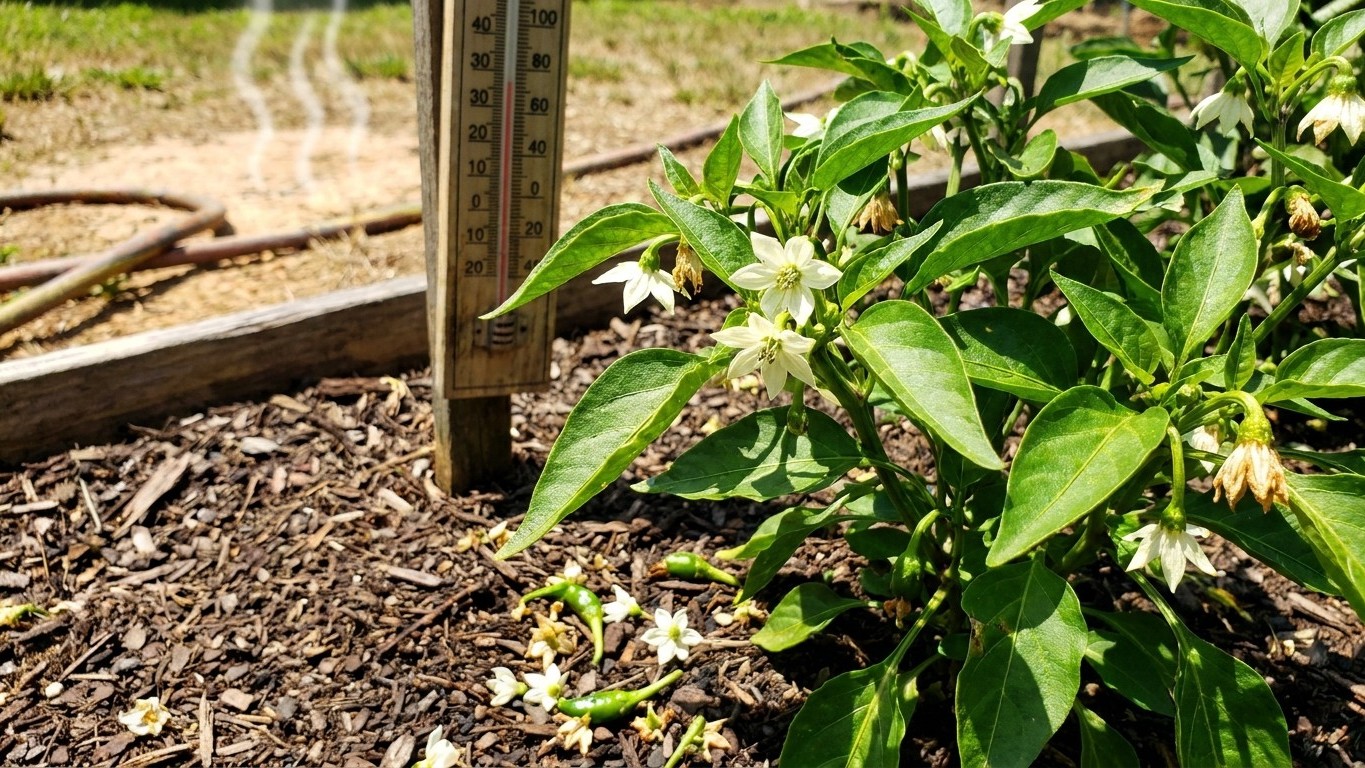

Peppers in Quebec struggle less with heat than gardeners assume and more with the province’s short, cool-edged growing window. The reference station near Montreal averages essentially zero days a year at or above 90 F, so heat-driven blossom drop is rare here. The bigger risk is nights that dip below 55 F, a threshold this site cannot measure for your yard, so the answer depends on what your own thermometer tells you after dark.
The short answer
Start with the number that matters most for the hot end of fruit set: the Montreal reference station averages 0.0 days a year at or above 90 F, based on the 1981-2010 Canadian Climate Normals. For pepper growers, that’s close to a non-issue. Utah State University Extension notes that pepper flowers abort and fruit set stalls once daytime highs push past 90 F for a stretch, because the plant redirects energy away from pollen viability and toward survival. In a territory with essentially no days that hot on the long-term average, that particular failure mode isn’t the one keeping your pepper patch fruitless most seasons.
The other end of that same threshold is the one Quebec gardeners actually need to watch. The same Utah State University Extension guidance is explicit that pepper fruit set fails at both ends: nights below 55 F stall pollen the same way extreme heat does, just through a different mechanism. Cool nights slow pollen tube growth and can cause flowers to drop before they’re ever fertilized, even when the daytime weather looks perfect for a garden photo. This is where the data gets trickier, because this site tracks daytime heat extremes by territory but does not carry summer night minima for Quebec or any other region.
That gap isn’t an oversight to shrug off. A province’s latitude tells you almost nothing reliable about a given June or July night’s low temperature, since local topography, water proximity, elevation, and even how open or sheltered a particular yard is can shift overnight lows by several degrees from one township to the next. A garden in a low-lying valley can run noticeably cooler after sunset than one on a nearby ridge, even though both sit at the same latitude and see the same daytime highs. Guessing at night temperatures from a map is a common mistake, and it’s exactly the kind of shortcut that leads to unexplained blossom drop later in the season.
The practical move is to keep a simple min-max thermometer in the pepper bed itself, not just on a porch or windowsill, from the time flowers first appear through the peak of summer. If you’re logging repeated nights under 55 F during flowering, that’s very likely your fruit-set problem, not the plant, the soil, or the fertilizer. Given how rare 90-plus days are at the Montreal reference point, cool nights deserve more of your attention than heat does across most of the province in most years.
When to start seed here
Utah State University Extension’s guidance gives you the pieces; the arithmetic is yours to run for your own county, because Quebec is not one climate from Gaspé to the Montérégie. Here’s how to work backward from transplant day to seed-starting day using the reference figures available for this region.
- Start with the frost anchor. Environment and Climate Change Canada’s Canadian Climate Normals (1981-2010) place the mean last spring frost at the MONTREAL/ST-HUBERT A station on May 6. That’s a mean, not a guarantee: by definition, in one year out of two the last frost falls later than that date. Treat May 6 as the midpoint of a risk window, not a green light to transplant.
- Add a safety margin for the “one year in two” problem. Because frost can and does arrive after the mean date roughly half the time, many Quebec gardeners push transplanting into the back half of May rather than betting the plants on an average that fails as often as it holds. How much margin you add depends on your own frost history and your tolerance for risk, but the mean date alone is not a safe planting day.
- Check soil temperature, not just the calendar. Utah State University Extension is specific that peppers should go in the ground only after frost has passed and once soil temperature reaches 60 F. A warm afternoon air temperature doesn’t mean the soil four inches down has caught up yet, particularly in a spring that started cold. A simple soil thermometer pushed into the bed is the only way to confirm this rather than assume it.
- Subtract 8 to 10 weeks for the indoor head start. Once you’ve settled on a realistic transplant date, that same Extension guidance calls for starting pepper seed indoors 8 to 10 weeks before that date. If your working transplant target lands in the back half of May, counting 8 to 10 weeks back lands seed-starting somewhere in the second half of March, give or take depending on which end of that window you choose and how much frost margin you built in at step two.
- Re-run the math for your specific township. The Montreal-area frost date is a reference point, not a province-wide rule. Districts north of the St. Lawrence lowlands, or at higher elevation, typically see later last frosts and cooler soil in spring, which pushes both your transplant date and your indoor seed-starting date later still. Use your own local frost记录 and soil readings rather than applying the Montreal figure directly if you garden well outside that area.
What goes wrong here
Quebec’s specific climate profile, cool-leaning nights, a genuinely short frost-free season, and only rare stretches of extreme daytime heat, produces a particular pattern of pepper failures. Here’s what tends to show up and what to do about each one.
- Blossom drop from a hot spell. Even in a territory averaging essentially zero days at 90 F or above, a short heat spike during flowering can still push local temperatures high enough to abort flowers, especially in a sheltered, sun-baked bed. If a hot stretch coincides with bloom, light afternoon shade cloth over the row for a few days can reduce stress until temperatures settle back down.
- Blossom drop from a cool night. This is the more common Quebec problem given the region’s climate, and it happens when nighttime lows fall below 55 F during flowering, an outcome this site cannot forecast for your specific yard since it doesn’t track summer night minima. Log your own overnight lows with a min-max thermometer at the bed, and if cool nights are frequent during bloom, consider floating row cover pulled over the plants in early evening and removed by mid-morning to trap a few extra degrees of warmth.
- Sunscald on exposed fruit. Even where extreme heat days are rare, direct sun on fruit that’s lost leaf cover, from pruning, wind damage, or disease, can scald the skin and leave pale, papery patches. Keep the plant’s natural leaf canopy intact rather than over-pruning, and avoid stripping foliage to “let more light in,” which usually does more harm than good.
- Blossom-end rot. This shows up as a sunken, dark patch on the fruit’s blossom end and traces back to inconsistent watering that disrupts calcium uptake, not a soil calcium deficiency in most cases. Even moisture, delivered through consistent watering rather than a feast-or-famine schedule, is the more reliable fix than adding calcium products to the soil.
Common questions
Do peppers need full sun in Quebec, or does some afternoon shade help?
Peppers generally perform best with full sun given how rare extreme heat days are at the regional reference point. Afternoon shade only becomes useful as a short-term tool during an unusual hot spell at flowering time, not as a standing feature of the bed.
Why didn’t my peppers set fruit even though the days felt normal?
Check your nighttime lows during the flowering stretch. Because this site doesn’t track summer night minima, and because pepper fruit set fails when nights drop below 55 F, a run of cool nights is a very plausible explanation even in a season that felt otherwise unremarkable.
Is May 6 a safe date to transplant peppers outdoors?
No. May 6 is the mean last spring frost date at the Montreal-area reference station, which means frost arrives later than that in roughly half of all years. Treat it as the middle of a risk window and confirm soil temperature has reached 60 F before transplanting.
How long after flowering should I expect peppers to actually appear?
Utah State University Extension’s guidance on fruit set timing runs from flowering, not from sowing or transplanting, so count from the first open blossoms rather than from the day you put plants in the ground when estimating your harvest window.