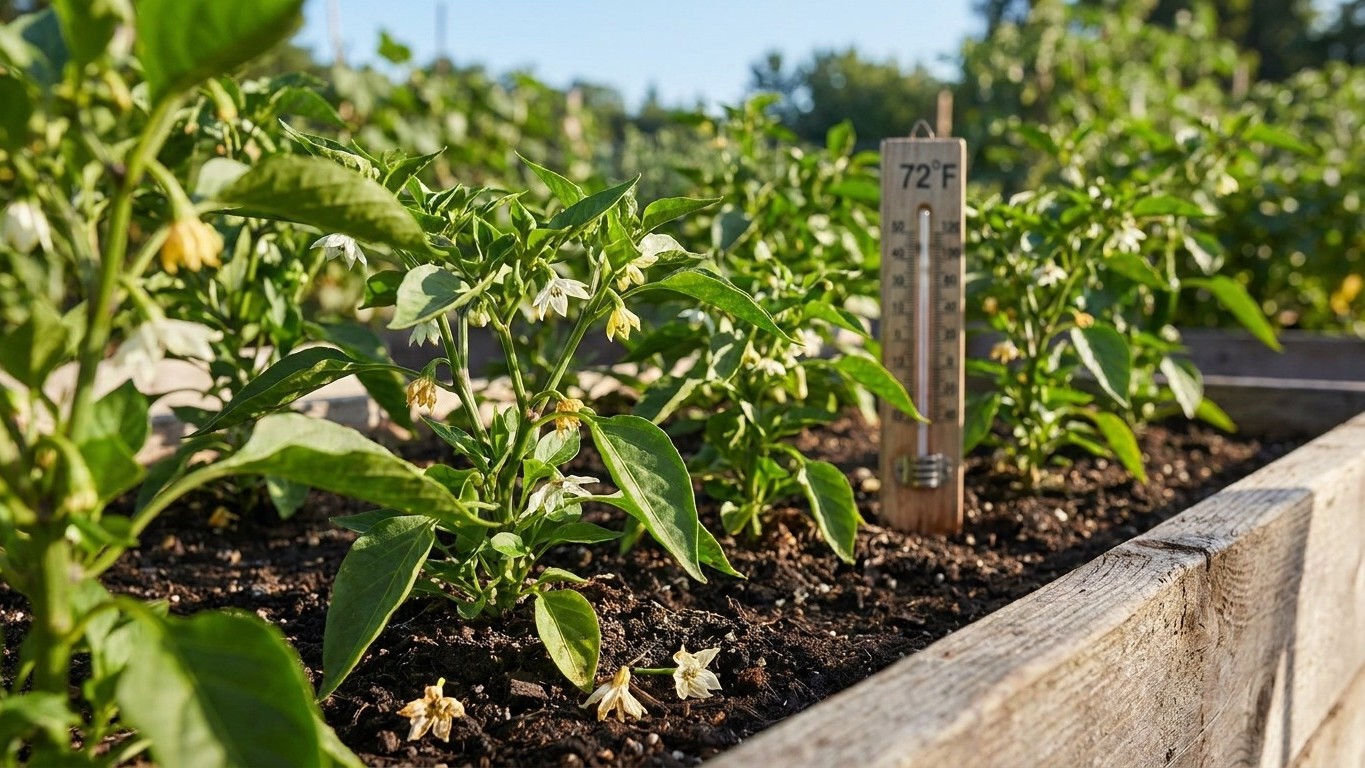

For most of Quebec, pepper seed goes into trays in early to mid-March, about 8 to 10 weeks ahead of transplant day. That transplant date falls after frost has cleared and once the soil has warmed to 60°F, which for the southern part of the province usually lands in late May or early June. The arithmetic starts from a single station near Montreal, and it shifts if you garden further north.
The short answer
Start with the heat side of the equation, because in Quebec it barely registers. The reference station near Montreal recorded a mean of 0.0 days a year at or above 90°F over the 1981-2010 climate normals period. For pepper growers, that number matters more than it looks. Fruit set on peppers stalls when daytime highs climb past 90°F, so a province where that threshold almost never gets touched removes one entire failure mode from the equation. You are not fighting heat stress here the way a grower in Arizona or south Texas might. Blossoms are not going to drop because a July afternoon spiked into the 90s, because that afternoon essentially does not happen at the Montreal reference point.
The other end of the range is where Quebec growers actually need to pay attention, and it is also the end this site cannot answer for you. Pepper fruit set fails just as surely when nights drop below 55°F as when days climb above 90°F, according to Utah State University Extension. Cool nights in the 40s or low 50s are common in Quebec well into late spring and can return early in fall, and they will cause blossoms to abort or Fail to Set Fruit even while the plant looks perfectly healthy otherwise. The problem is that this site tracks daytime heat thresholds by territory, not summer night minimums. Nobody here can tell you, with any real precision, how many nights in your county will drop under that 55°F line in June or in early September.
That is not a gap you can paper over with a guess based on how far north you live. A river valley, a hillside, and an open field ten minutes apart can post very different overnight lows on the same night, and latitude alone tells you almost nothing about which one you are gardening in. The only reliable fix is to watch your own thermometer once plants are in the ground, especially through the first three or four weeks after transplant and again as nights start cooling in late summer. If you see a run of nights dipping into the 40s or low 50s right when your plants are flowering, expect some blossom drop regardless of how mild the daytime highs have been.
When to start seed here
Working backward from transplant day is the only method that holds up across a province as varied as Quebec. Here is how the count actually runs.
- Start with the mean last frost date. At the MONTREAL/ST-HUBERT A station, Environment and Climate Change Canada’s 1981-2010 climate normals put the average last spring frost at May 6. That is a midpoint, not a guarantee. In one year out of two, frost arrives after that date, sometimes well after it, so treat May 6 as the center of a window rather than a line you can plant right up against.
- Wait for the soil, not just the calendar. Pepper transplants need soil that has warmed to 60°F, per Utah State University Extension. Air temperature can feel like spring while the ground underneath is still cold from months of frost and snowmelt, so soil in Quebec typically takes additional time after the frost-free date to reach that 60°F mark. A soil thermometer pushed a few inches into the bed, checked over several mornings, beats guessing by the sight of a bare, sunny yard.
- Mark your realistic transplant date. Combining the frost timing with the soil-warming lag, most gardeners working from the Montreal-area normals land on a transplant window running from late May into early June, adjusted year to year by how the season is actually behaving rather than by the calendar alone.
- Count back 8 to 10 weeks for sowing. Utah State University Extension recommends starting pepper seed indoors 8 to 10 weeks before that transplant date. Counted back from a late-May to early-June transplant, that lands seed-starting squarely in early to mid-March for most of southern Quebec.
- Shift the whole window if you’re not near Montreal. The May 6 date comes from one station in the St-Hubert area. Northern regions, the Gaspé, and higher-elevation districts run their frost-free date weeks later, which pushes both the transplant window and the seed-starting window back to match. A province is not one climate, and the normals from a single southern station should be treated as a starting point to adjust, not a fixed rule for wherever you happen to garden.
What goes wrong here
- Blossom drop from a cool night. Nights under 55°F, which are common in Quebec through late spring and again as September approaches, cause flowers to abort even on healthy-looking plants. The remedy is timing and cover: hold transplants until soil has genuinely reached 60°F rather than rushing them out on the first warm afternoon, and keep row cover or cloches on hand to throw over plants if a cold night is forecast during flowering.
- Blossom drop from an unusual hot spell. Even though days above 90°F are effectively absent from the Montreal-area normals, an isolated heat spike can still occur in any given year, and pepper fruit set fails on the hot end too, per Utah State University Extension. If a stretch of unusually hot days lines up with flowering, expect some blossom loss regardless of how rare that heat normally is here. Light shade cloth during the hottest afternoons and consistent watering reduce the stress that pushes flowers to drop.
- Sunscald on exposed fruit. Where pepper plants get heavily pruned, or where a plant loses foliage to wind, disease, or over-eager trimming, fruit left exposed to direct sun can develop pale, papery patches on the skin. Leaving natural foliage in place to shade developing peppers, and avoiding aggressive pruning once fruit has set, keeps the canopy doing its job.
- Blossom-end rot on the fruit tip. Irregular watering, common when a rainy stretch is followed by a dry one, disrupts calcium uptake and shows up as a dark, sunken patch at the blossom end of the fruit. Mulching to even out soil moisture and watering on a consistent schedule rather than in occasional heavy soakings addresses the root cause more reliably than treating the fruit itself.
Common questions
Can I Start Pepper Seed earlier than March to get bigger transplants?
Starting much earlier than the 8 to 10 week window that Utah State University Extension recommends usually backfires, because transplants held too long indoors before soil and air conditions are ready tend to become leggy and stressed, which sets them back more than a slightly later start would have.
Is the May 6 frost date safe to plant by every year?
No. It is a mean date from Environment and Climate Change Canada’s 1981-2010 normals for one station near Montreal, and frost falls later than that date in roughly half of all years. Treat it as the middle of a range, not a safe cutoff, and watch the actual forecast as the date approaches.
Why does this site not give a night temperature threshold for my area?
This site tracks daytime heat load, specifically the count of days at or above 90°F, by territory, but it does not carry summer night minimum data. Since pepper fruit set also fails below 55°F at night, that half of the equation depends on your own observation of nighttime lows through the growing season.
Does soil warming to 60°F happen at the same time as the last frost?
No, and this is one of the more common mistakes. Air can clear of frost risk while soil several inches down is still cold from the winter. Checking soil temperature directly with a thermometer, rather than relying on the frost date alone, gives a more accurate signal for when to transplant.