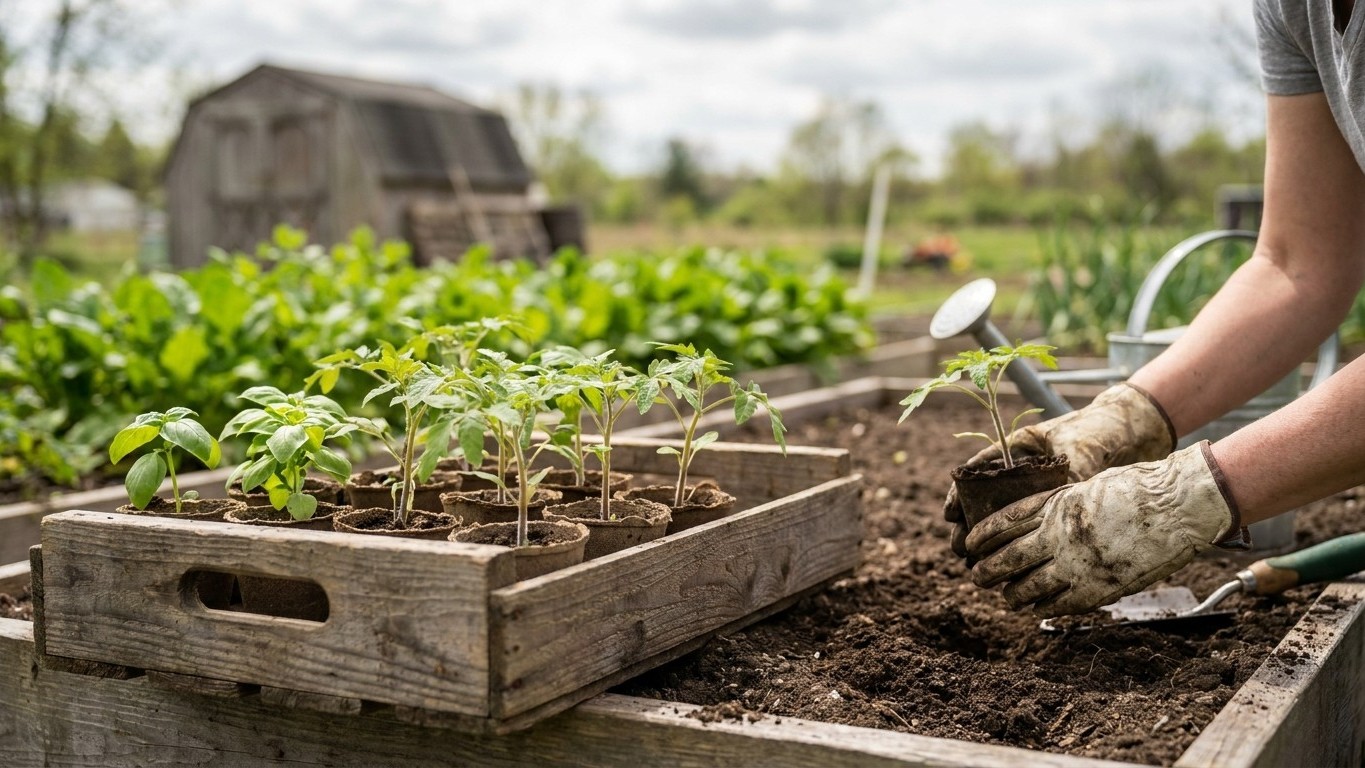

May in Quebec sits right on the frost line. The average last spring frost for the province’s most-populated corridor falls around May 6, which means the first half of the month is still frost territory in most years, and only cold-hardy crops belong in open ground before then. Cold-tolerant greens, peas, and alliums can go in through May; tomatoes, peppers, beans, and squash should wait for warmer soil and a wider safety margin.
What goes in the ground in May
The mean last frost date for the Montreal/St-Hubert area is May 6, drawn from the 1981-2010 Canadian Climate Normals. That word “mean” matters more than it looks. A mean date is a midpoint, not a guarantee: in roughly half of all years, frost arrives after May 6, sometimes well after. Treat the date as the center of a window, not a green light stamped on the calendar.
That single fact splits the month’s planting list in two. On one side sit the crops that shrug off a light frost: spinach, arugula, lettuce, kale, Swiss chard, and mustard greens can all go into the ground as direct-sown seed through May, even in the first half of the month when frost risk is still real. Peas are just as tough and actually prefer the cool soil. Onion sets, shallots, and leek transplants tolerate a cold snap without much drama, and root crops like carrots, beets, radishes, and turnips germinate fine in soil that’s still on the cool side.
On the other side sit the crops that a single frosty night can kill outright: tomatoes, peppers, eggplant, cucumbers, squash, melons, beans, and corn. These need both warm air and warm soil, and planting them into ground that’s still cold does more harm than waiting, since seeds rot rather than germinate and transplants stall instead of growing. Given that the mean frost date is May 6 and real frost can land later, moving these crops outdoors early in the month is a gamble, and even late May carries some residual risk depending on the specific spring.
A simple way to sort the list
| Safe through May | Wait for settled warmth |
|---|---|
| Spinach, lettuce, arugula, kale, chard | Tomatoes, peppers, eggplant |
| Peas, onion sets, shallots, leeks | Cucumbers, squash, melons |
| Carrots, beets, radishes, turnips | Beans, corn |
Garlic planted the previous fall is already up and growing by May and needs nothing more than weeding and a check for scapes later on. Bare-root fruit trees, cane fruit, and dormant perennials can still go in early in the month if the ground wasn’t workable earlier in spring.
What to start under cover
The arithmetic for indoor sowing runs backward from the frost window, not forward from a fixed date. Tomatoes, peppers, and eggplant need roughly six to eight weeks indoors before they’re ready to go outside, and since the safe outdoor window doesn’t really open until well past the May 6 mean frost date, anyone starting these from seed indoors in May is cutting it close for a full harvest, unless the goal is a later transplant with a shorter season ahead.
Cucumbers, summer squash, zucchini, and melons need far less lead time, usually three to four weeks, which makes May a reasonable month to start them under cover for transplanting once the frost risk has genuinely passed. The same logic applies to a second round of broccoli or cabbage for a fall crop: start it under cover now, and count forward to the first fall frost, on average October 5, to make sure there’s enough season left for the plant to mature.
The two ways this goes wrong are mirror images of each other. Start too early, and tomato and pepper seedlings sit in small pots for weeks past their prime, turning leggy and rootbound before the ground is ever warm enough to take them. Start too late, particularly with melons or winter squash, and the plant runs out of runway before the average October 5 fall frost shuts the season down. Counting weeks from both ends, the last spring frost and the first fall frost, is the only reliable check, since the calendar date alone doesn’t account for how variable a Quebec spring can be.
A cold frame or unheated greenhouse buys a few extra weeks on both ends, letting hardy transplants harden off outdoors before the ground is fully frost-free and stretching the fall crop later once cool nights return.
What is ready to pick
May is early in the Quebec growing season, so the outdoor harvest list stays short, but it isn’t empty. Established asparagus beds start producing spears in May, and once a bed is a few years old, spears can be cut every day or two while they’re still tight and firm at the tip; a spear that’s begun to open and feather at the top is past its best. Rhubarb is another May staple, with stalks thick enough to harvest by mid to late month depending on how the spring has gone; pull rather than cut, and leave a few stalks per plant so it keeps producing through summer.
Perennial herbs planted in previous seasons, chives, sorrel, and mint among them, are usually well up and cuttable by May, offering fresh green flavor while the annual vegetable garden is still just seedlings. Anything overwintered under a cold frame or low tunnel, spinach or hardy lettuce sown the previous fall, can still be producing leaves into May before it bolts with the lengthening days.
Inside, it’s worth a walk through the root cellar or storage area. Stored squash, potatoes, and onions from the previous season are at their most vulnerable this time of year: check for soft spots, sprouting eyes on potatoes, or a musty smell that signals rot has started, and pull anything questionable before it spreads to the rest of the batch.
The jobs that matter this month
Soil preparation tops the list, and timing depends on the ground being workable rather than the calendar. Squeeze a handful of soil: if it crumbles, it’s ready; if it forms a tight, sticky ball, working it now compacts the structure and costs yield all season. Once it’s ready, working in compost ahead of the heavy planting to come sets up everything that follows.
Staking and support structures for peas and any early brassicas should go in before the plants need them, not after they’ve flopped over. It’s a five-minute job in May that saves an afternoon of untangling stems in June.
Hardening off is a May-specific chore that gets skipped too often. Any seedling started indoors, whether it’s cold-hardy greens or the warm-season crops waiting for their window, needs seven to ten days of gradually increasing outdoor exposure before it goes into the ground permanently. Skip this step and even frost-tolerant plants can sunburn or wilt from the shock of direct sun and wind.
Succession sowing keeps the harvest steady rather than lumped into one glut: a new row of radishes, lettuce, or spinach every two weeks through May keeps something new maturing right through the season instead of everything bolting at once.
Pest scouting matters more in May than most gardeners expect, since early damage is easiest to control. Flea beetles go after young brassica leaves almost as soon as they emerge, leaving a shotgun pattern of small holes, and asparagus beetle shows up right alongside the first spears. Catching either early, by hand-picking or with a floating row cover, beats trying to control a full-blown infestation in July.
What not to do in May
The most common mistake is trusting the air temperature over the soil temperature. A run of warm, sunny days in early May can feel like summer, but the ground underneath is often still cold from winter, and warm-season seeds planted into it simply rot instead of sprouting. Wait for the soil itself to warm, not just the afternoon air.
A close second is pulling row covers or opening cold frames too early after a mild stretch. Since the mean last frost date of May 6 is only a midpoint, a warm week doesn’t mean the frost risk has passed, and plants that were protected and then exposed can lose everything in one cold night that arrives after the covers came off.
Overfeeding nitrogen early in the month is another trap. A heavy dose of nitrogen fertilizer on young transplants pushes soft, leafy growth that’s more vulnerable to a cold snap and slower to set fruit later, since the plant’s energy goes into leaves instead of roots and flowers. Hold off on nitrogen-heavy feeding until plants are established and the frost risk has genuinely passed.
Direct-sowing beans, corn, or squash into cold soil rounds out the list of avoidable losses. These seeds need soil that’s reliably warm to germinate; planted too early, they either rot in the ground or come up so weak that later-sown seeds in warmer soil overtake them within weeks.
Checking this against your own county
Every figure above is a starting point, not an instruction, because Quebec’s climate varies enormously across the province. The mean frost dates cited here come from the Montreal/St-Hubert area; regions to the north, at higher elevation, or further from the moderating effect of the St. Lawrence River can run two to four weeks behind that timeline, while some southern pockets run slightly ahead of it. The Canadian hardiness zone of 5b cited for this reference area is likewise specific to that location, not the whole province, and it’s a Canadian zone rating built on seven climate variables, not a USDA zone, so it shouldn’t be compared directly to US hardiness figures.
For a planting calendar tuned to a specific county or region, Quebec’s Ministry of Agriculture, Fisheries and Food (MAPAQ) publishes region-specific guidance worth checking against the general dates here.
Common questions
Can I plant tomatoes outdoors in Quebec in May?
It’s risky for most of the month. The mean last frost date is May 6, and since that’s a midpoint rather than a guaranteed cutoff, frost can still occur after that date in many years. Tomatoes are best transplanted once the frost risk has clearly passed and both air and soil have warmed.
What is Quebec’s plant hardiness zone?
The reference city used for this page sits in Canadian hardiness zone 5b, based on Natural Resources Canada data. This is the Canadian zone system, built on seven climate variables, and it does not convert directly to a USDA zone.
What can I direct-sow in Quebec in early May?
Cold-hardy crops handle the frost risk of early May well: spinach, lettuce, arugula, kale, peas, and root vegetables like carrots, beets, and radishes can all go into the ground as seed even before the mean frost date passes.
When does the growing season end in Quebec?
The average first fall frost for the Montreal/St-Hubert area is October 5, based on the same 1981-2010 climate normals. As with the spring date, this is a mean, so frost can arrive earlier or later depending on the year and the specific region.