
January in Quebec means frozen ground from the Ottawa Valley to the Gaspé, so nothing goes into open soil this month. What you can do is force rhubarb and chicory indoors, start the slowest-growing seedlings like onions and leeks under lights, and get the season’s real head start on pruning, tool care, and seed orders before the good varieties sell out.
What goes in the ground in January

The soil across Quebec is frozen solid this month, often under a foot or more of snow, and that single fact settles the question before it’s asked. There’s no workable ground from Montreal to Quebec City, let alone farther north or at higher elevation. Garlic and shallots, which do go into the ground in this region, are a fall job finished back in October, not a January one. Anyone hoping to sneak a late clove in now will find a shovel bouncing off frozen clay.
That doesn’t mean the season is empty. What genuinely happens in January is forcing: bringing dormant rhubarb crowns or witloof chicory (Belgian endive) roots in from a cold garage, root cellar, or the ground itself if they can still be dug, then setting them in a dark, cool space indoors, around 50 to 60 degrees Fahrenheit, kept moist. Within a few weeks the chicory throws up pale, tightly wrapped shoots, and rhubarb sends up rose-pink stalks with no sunlight required. It’s one of the few ways to pull a fresh harvest out of a Quebec winter, and it costs almost nothing beyond a bucket, some sand or soil, and patience.
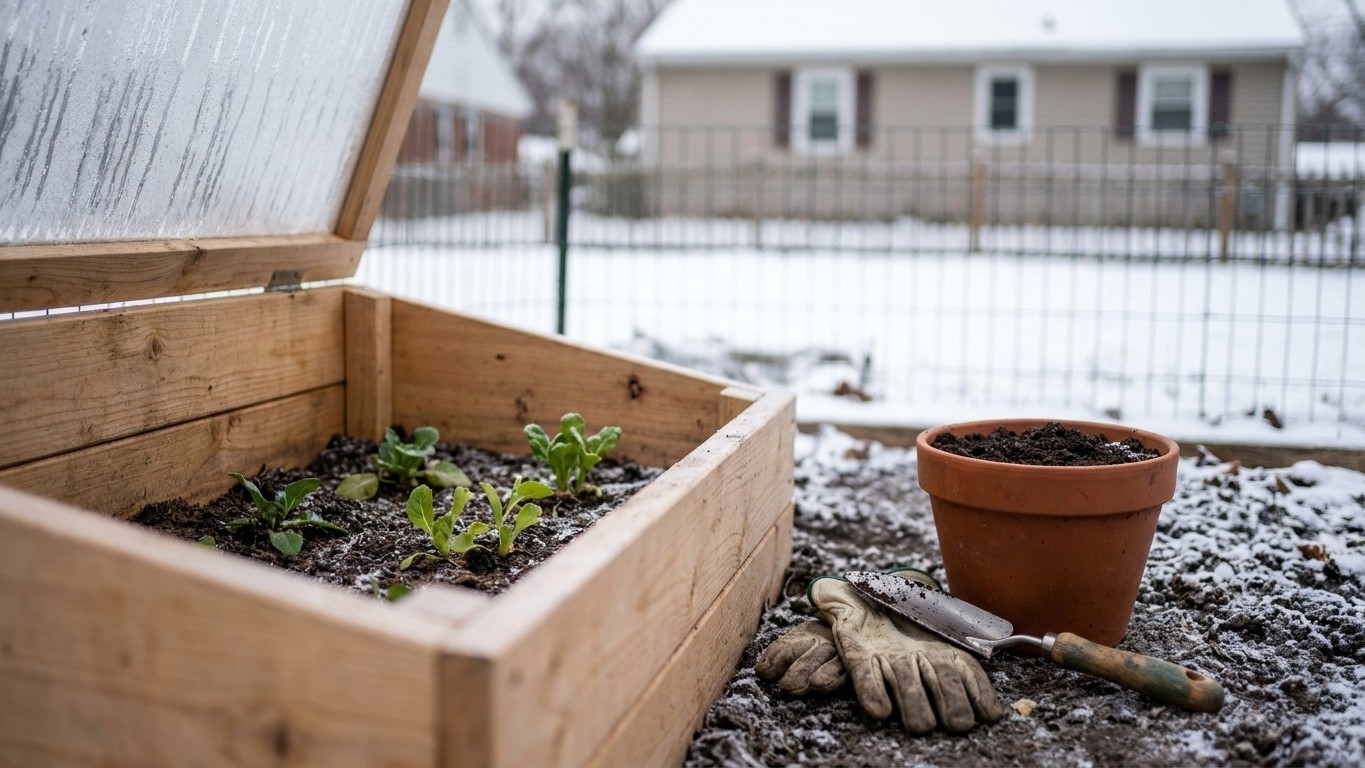
Cold frames and low tunnels matter here only if they were set up back in fall over crops already growing, things like mâche or spinach seeded in September. Snow cover actually helps them, acting as insulation, but this is not the month to build new structures or plant anything fresh under glass outdoors. Bare-root fruit trees and shrubs, similarly, are a project for the thaw, not for a month when the ground can’t be dug at all. The honest answer for outdoor soil in January is nothing, and the useful answer is: force what you already have stored, and wait.
What to start under cover
Indoors, under grow lights or on a sunny sill, January is where the slowest crops of the year begin, and the arithmetic runs backward from the last-frost window rather than from any date on a calendar. At the reference station used for this region, the average last spring frost falls around May 6, but that’s a mean date from a thirty-year record, meaning in roughly half of all years frost arrives later than that. Treat it as the middle of a window, not a guarantee, and add a cushion.
Onions and leeks grown from seed are the classic January starts here because they’re unusually slow, needing something like ten to twelve weeks of indoor growth before they’re sturdy enough to harden off and transplant near that early-May window. Counting back from a mid-May transplant date puts the sowing window in late January to early February, which is exactly why seed catalogs push onion and leek varieties hardest this month. Some slow-growing flowers destined for outdoor beds later, like certain perennials started from seed, follow the same backward math.
The two ways this goes wrong are worth naming plainly. Start too early, particularly with anything faster-growing like tomatoes or peppers (which belong to February and March, not January), and you end up babysitting leggy, rootbound plants for weeks longer than they can tolerate, stretching toward the window in search of light. Start the true slow crops too late, on the other hand, and there simply isn’t enough of the short Quebec growing season left to bring them to a useful size before the return of fall frost, averaging around October 5 at that same reference station. Onions and leeks are the safe January bet precisely because they need every one of those extra weeks.
What is ready to pick
Outdoors, the honest answer is little to nothing. Whatever wasn’t harvested before the ground froze is now locked under snow and ice, and digging for it risks damaging both the crop and the bed. Leeks mulched heavily in fall can sometimes still be pulled where snow cover has kept the ground from freezing rock-hard, but in a typical Quebec January that window closes fast, and it’s not something to count on province-wide.
What actually feeds the household this month comes from storage and from indoors. The rhubarb and chicory being forced in a dark corner, as covered above, become a real harvest within a few weeks of starting them. Sprouts and microgreens, grown in trays on a counter, add fresh green volume in days rather than weeks, and they’re one of the few crops that go from seed to plate entirely within January itself.
The other job this month is quality control on what’s already in the cellar or the cold room. Squash should be firm with no soft spots or sunken patches near the stem; any that feel even slightly give-y should be used first before they turn. Potatoes need checking for sprouting eyes and for the green tinge that signals light exposure, both of which mean use them soon. Onions with soft necks or a sour smell are past saving and should come out before they spread rot to the rest of the bin. A five-minute check of the storage shelves once a week catches problems before they cost a winter’s worth of food.
The jobs that matter this month

January carries more real garden work than its frozen ground suggests, and most of it has a genuine deadline attached. Dormant pruning of apple and pear trees, and of raspberry or currant canes, can happen through winter, but wood is brittle in deep cold, so the practical move is to prune on the milder days within the month rather than in the coldest snap, and to finish before buds start swelling later in the season.
Seed ordering belongs squarely here too. The most popular onion, leek, and heirloom tomato varieties sell out from Quebec seed suppliers by late winter, and ordering in January, rather than waiting until the itch to plant actually arrives, is the difference between getting the variety wanted and settling for whatever’s left.
Planning next season’s crop rotation is a January desk job, best done with a notebook and last year’s map of what grew where, since diseases and pests specific to a plant family (blights on tomatoes and potatoes, for instance) build up in soil that hosts the same crop repeatedly. Soil testing can also be arranged now, since samples can be sent to a lab even in winter and results come back in time to plan spring amendments.
- Turn or insulate the compost pile so it keeps working through the cold rather than freezing solid.
- Clean and sharpen pruning shears, loppers, and spades before the spring rush.
- Repair raised beds, trellises, and fencing while there’s no growth in the way.
- Recheck stored crops weekly for the early signs of rot described above.
None of this is filler. Skip the pruning window and canes get tangled and unproductive by summer; skip the seed order and the variety wanted simply isn’t available later; skip the tool sharpening and every spring cut tears rather than slices, inviting disease into the wound.
What not to do in January
The most common mistake this month is starting warm-season seeds, tomatoes, peppers, basil, far too early because the itch to grow something outweighs the calendar math. Sown in January, these crops become leggy, stressed plants by the time it’s actually safe to set them outside near that early-May mean frost date, and a stressed transplant rarely outproduces one started on schedule a few weeks later.
A second mistake follows any stretch of unusually mild weather in the middle of winter: pulling back mulch or opening cold frames because the air felt like spring. Quebec’s winter thaws are rarely permanent, and a hard freeze returning to newly exposed crowns or roots does more damage than the cold ever would have done left alone. The safer move is to leave winter protection in place until there’s a sustained, multi-day warm-up, not a single mild afternoon.
Feeding nitrogen to garden beds or to dormant fruit trees this month is another false start. Plants aren’t actively growing, so nitrogen applied now either leaches away with snowmelt before roots can use it or, worse, pushes soft, tender growth right before a return to hard cold, which then damages that new tissue. Nitrogen belongs later, tied to the actual start of active growth, not to a gardener’s own restlessness in the dead of winter.
Checking this against your own county
A province-wide January picture is a starting point, not an instruction sheet. Quebec runs from the milder river valleys around Montreal to much colder inland and northern districts, and elevation, lake effect, and simple distance from the St. Lawrence can shift frost windows by weeks in either direction. The reference figures used here (last frost around May 6, first fall frost around October 5, hardiness zone 5b in the Canadian system) come from a single station near Montreal and don’t describe the whole province.
Before acting on any of this, check it against local conditions through the Ministère de l’Agriculture, des Pêcheries et de l’Alimentation du Québec (MAPAQ), which covers regional planting guidance specific to Quebec’s growing conditions.
Common questions
Can garlic still be planted in January in Quebec?
No. Garlic goes into the ground in fall, before the ground freezes. By January the soil is frozen solid across the province, so garlic planting has to wait until spring if fall planting was missed.
Is it too early to start tomato and pepper seeds in January?
For most of Quebec, yes. These crops don’t go outdoors until well after the mean last-frost date around May 6, and starting them this early usually produces leggy, stressed plants rather than an earlier harvest.
What can actually be harvested in a Quebec garden in January?
Realistically, nothing directly from outdoor soil. Indoors, forced rhubarb and chicory, along with sprouts and microgreens grown on a counter, are the crops that produce a genuine January harvest.
Does the Canadian hardiness zone number matter for January planting decisions?
It matters more for what survives winter than for what to plant this month. The reference zone here, 5b in the Canadian system, describes average winter severity and is not comparable to USDA zone numbers used elsewhere; it doesn’t change the fact that January soil is frozen province-wide.
Gardeners who plant by the Moon can check the January 2027 moon planting calendar, a tradition rather than a proven method.