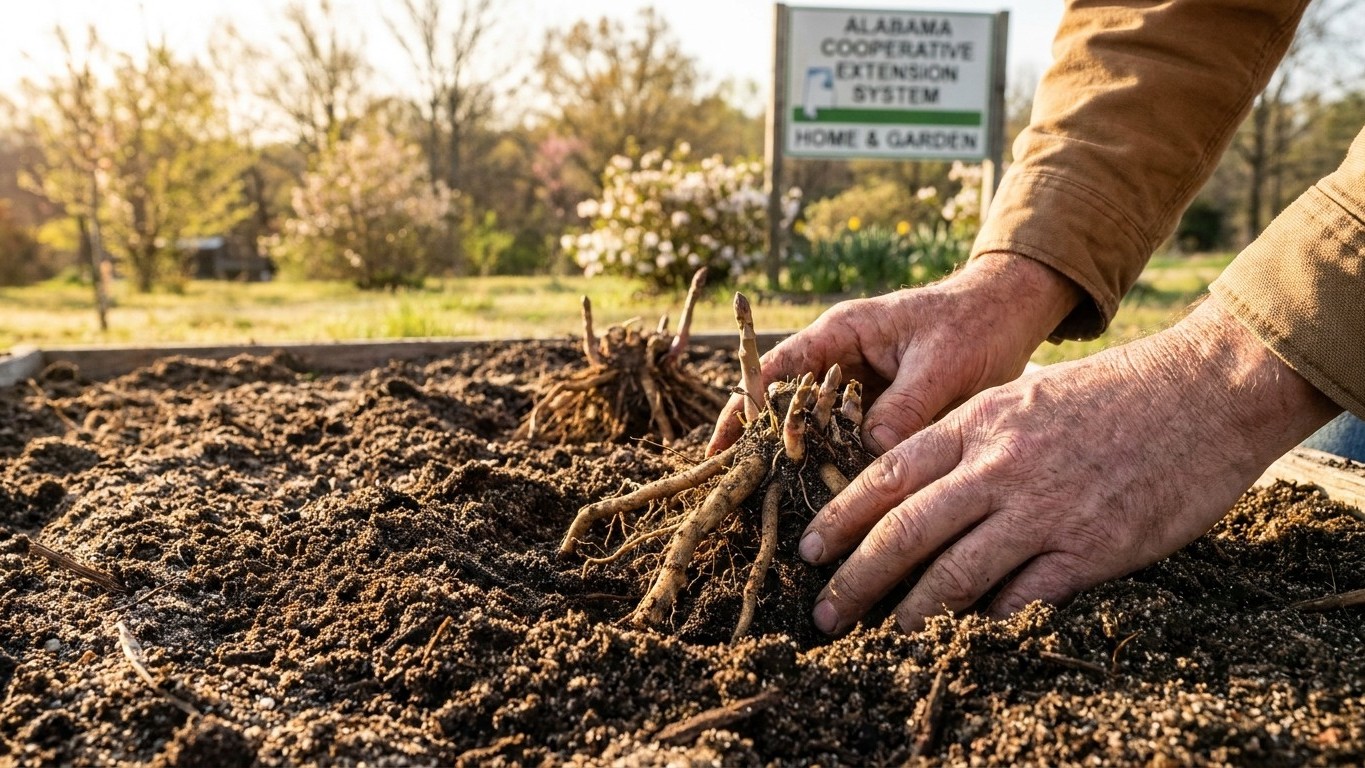

Plant asparagus crowns in Rhode Island in early spring, timed to the region’s last frost window of April 7 to April 17. Choose a spot with well-drained soil, since the bed will sit there for 10 to 15 years once it’s producing. The reference-city frost dates are a starting point; check your own county before you dig.
The short answer
Before you pick a spot, think about what that spot has to do for the next decade and a half. Asparagus is planted as crowns, set into furrows about 8 inches deep, and it won’t give you a single spear to eat until year three. After that, a well-tended bed produces for 10 to 15 years, according to Utah State University Extension. That’s not a season’s commitment. That’s closer to the length of a mortgage refinance, or the age gap between a toddler and a driver’s license. Whatever ground you choose has to work for that entire stretch, because moving an established asparagus bed isn’t really an option.
The one soil condition the source insists on is drainage. Most soils will grow asparagus fine, provided they don’t stay soggy. This is where Rhode Island gardeners get a reasonably good hand. The soil series USDA lists as representative of the state, the Narragansett series, is classified well drained. It’s a young soil, an Inceptisol that hasn’t had time to develop the strong layered horizons older soils show, running loam to silt in texture: about 34 percent sand, 60 percent silt, and only 6 percent clay in the surface layer. That low clay number matters, because clay is what holds water and suffocates roots. A soil this light on clay generally lets water move through rather than pool.
That surface layer also carries organic matter around 4.0 percent and a pH near 5.3, which is strongly acid. Soil pH isn’t part of what the asparagus source specifies, so no pH target is given here, but a strongly acid reading is worth knowing before you plant anything long-term, and a soil test through your local extension office will tell you where your own ground stands.
Here’s the catch worth repeating: the Narragansett series is what USDA maps as representative of Rhode Island as a whole. It is not a diagnosis of your backyard. A river bottom, a hillside, or any lot a builder has graded and filled can behave completely differently from the state’s representative profile. If you dig a test hole and it fills with water and stays that way for a day, don’t fight it. Build a raised bed at least a foot high, or pick higher ground on the same property. A raised bed also gives you control over what fills it, which matters more here than almost anywhere else on your property, since you won’t be amending this spot again next spring the way you might a tomato patch.
Will the summer here water it for you?
An asparagus bed has a two-stage thirst. For its first two years, it wants 1 to 2 inches of water every other week. Once established, that eases to roughly the same amount every three weeks. Rhode Island’s summer rainfall, based on 1991-2020 normals from the reference station, averages about 10.3 inches across June, July, and August, broken down as 3.81 inches in June, 2.91 in July, and 3.59 in August. July is consistently the dry stretch. Here’s how that stacks up against what the bed actually needs:
- In June, average rainfall of 3.81 inches roughly matches or slightly exceeds what a young bed needs on the every-other-week schedule, so supplemental watering may be light if rain arrives on a normal pattern.
- In July, the driest month at 2.91 inches, a newly planted bed on its two-year establishment schedule is likely to fall short of its 1-2 inch every-other-week target, especially if rain comes as one or two heavy storms rather than steady showers.
- In August, rainfall climbs back to 3.59 inches, which helps, but heat-driven evaporation in high summer means a portion of that rain never reaches the root zone.
- For an established bed past year two, watering every three weeks means the plant needs far less total water, and normal Rhode Island summer rainfall is more likely to cover it without a hose.
- None of these averages describe your own yard. A rain shadow, a slope, tree cover, or simply a dry week when the bed needed water most can throw the math off. A rain gauge staked in the bed itself is the only way to know if you actually need to add water this week, and sandy, well-drained soil like the region’s representative series will let rain through faster than a heavier soil would.
When to put the crowns in
Crowns go into the ground in early spring, and for Rhode Island that means working around the last frost window the reference station shows: April 7 to April 17. That’s a mean date, an average built from three decades of records at one weather station, not a guarantee for your particular morning. Treat it as a target window to aim for, and lean toward the later end of it if your property sits in a low spot or away from the coast, where frost tends to linger longer than it does at an airport weather station.
The planting method itself follows the same 8-inch furrow described earlier: crowns go in at that depth, and rather than filling the trench in all at once, you backfill it gradually across the year, adding about two inches of soil every other month as the shoots grow taller. This gradual approach protects the emerging spears while still letting the crown settle at proper depth by the time the season winds down.
Crowns aren’t the only route in. Asparagus can also be started from seed, which is the slower alternative. Seed-grown plants take longer to reach the point where crowns would already be planted at their proper depth and size, which is part of why most home gardeners choose crowns instead. Either way, the target planting window stays anchored to that same early-spring, post-frost stretch.
One more thing worth flagging directly: the source used for asparagus care here is silent on any winter chilling requirement and silent on soil pH. Rhode Island’s hardiness zone tells you about winter cold, but it does not translate into a published chilling number for asparagus, so no such figure appears here. If you’re choosing a variety, Utah State University Extension names four by sex only: Jersey Giant and Jersey Knight are all-male varieties, while UC 157 F1 and Purple Passion are male-female mixes. No flavor comparison, yield figure, or preference between them is published by that source, so none is claimed here.
Common questions
How soon after planting can I harvest asparagus in Rhode Island?
Not until year three, regardless of how vigorous the bed looks in year one or two. This isn’t a soft guideline. Cutting spears early weakens the root system the plant needs to build before it can support repeated harvesting for the following decade-plus.
How long does a harvest season last once the bed is established?
Harvest windows lengthen gradually as the bed matures: roughly four weeks in the first harvest year, then six weeks, then eight weeks in later years. The stopping point isn’t a date on the calendar. You stop cutting once most of the spears coming up are thinner than a pencil, which signals the plant needs to redirect its energy into foliage rather than more spears.
What if my soil doesn’t drain well?
Given that a bed occupies the same ground for 10 to 15 years, a spot that stays wet after rain isn’t worth fighting season after season. A raised bed built at least a foot high, filled with a well-drained mix, sidesteps the problem permanently rather than requiring repeated amendment.
Does Rhode Island’s acidic soil rule out asparagus?
The representative state soil runs strongly acid at a surface pH around 5.3, but the asparagus source used here doesn’t specify a pH requirement or a target range, so no claim is made here about whether that pH helps or hurts. A soil test through your local extension service is the way to get an actual reading for your own bed, rather than relying on a statewide representative figure that may not match your yard at all.