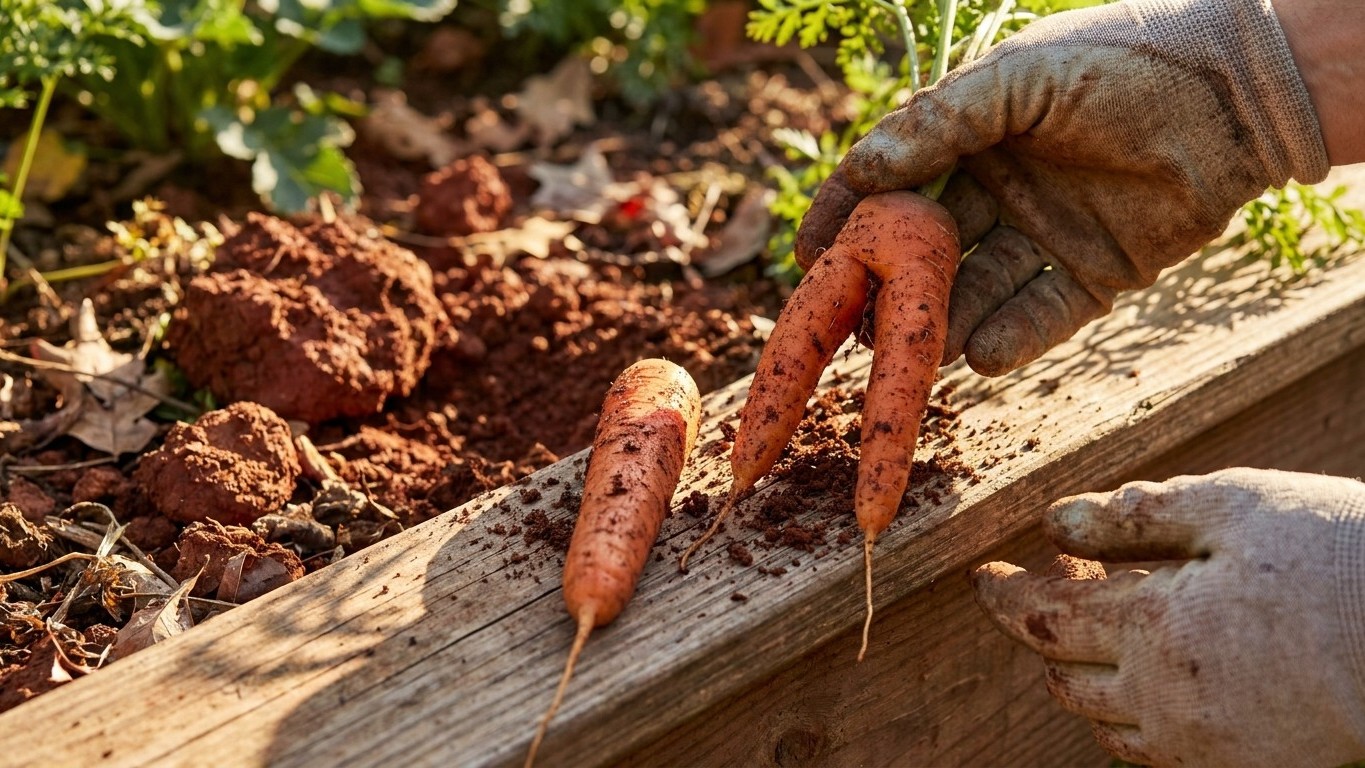

The soil that represents Rhode Island, the Narragansett series, is well drained, low in clay and closer to loam than to heavy ground. On that benchmark, a carrot growing straight in the ground is unlikely to fork badly. But that soil is a statewide average, not a guarantee for any one backyard. Compacted fill, riverbank sediment or a construction-scraped lot in the same state can behave nothing like it, and forking follows the ground you actually have.
The short answer
USDA’s representative numbers for the Narragansett series put the surface horizon at 34 percent sand, 6 percent clay and 60 percent silt, with organic matter around 4.0 percent and a surface pH near 5.3, which counts as strongly acid. The series is classified as an Inceptisol, meaning it’s a young soil that hasn’t built up the strong, distinct layers older soils show, and it drains well. Those numbers describe silt loam territory more than heavy clay, and that distinction matters more than almost anything else when it comes to carrot roots.
Utah State University Extension is blunt about what makes a carrot fork: heavy or rocky soil forces the taproot to split or branch around obstructions it can’t push through. Carrots want ground that’s deep, loose, sandy and well drained, with organic matter worked in. On paper, a silt loam running 60 percent silt and only 6 percent clay, well drained and already carrying a decent 4.0 percent organic matter, is a lot friendlier to a straight taproot than a dense clay soil would be. Low clay content means less of the sticky, compacting mineral that locks together when wet and hardens into clods when dry, the exact texture that stops a carrot cold and sends it forking around a clump.
That said, silt loam isn’t automatically carrot-perfect. Silt-heavy ground can still compact under foot traffic or heavy rain, and a strongly acid pH near 5.3 sits below where many root crops prefer to grow, though the source behind these numbers doesn’t specify a variety or give guidance on adjusting that pH, so no fix is offered here beyond noting the acidity exists. What the Extension guidance does confirm is the general remedy for any soil leaning toward the heavy side: work in plenty of compost, and double dig the bed so the taproot has loosened ground to grow through rather than hitting a wall of undisturbed subsoil eight or ten inches down.
None of this is a verdict on your specific garden. Rhode Island, like every state, spans hundreds of mapped soil series, and the Narragansett series is simply the one USDA lists as representative of the state as a whole. A yard two towns over, or even the far corner of the same property, can sit on a completely different series with a different clay percentage, different drainage, different pH. This section is a starting point for what the region’s ground tends to do, not a diagnosis of the dirt under your own carrots.
The test that settles it in your own garden
State-level averages can’t tell you what’s six inches under your own carrot bed. The only way to know is to look, feel and watch how your specific patch of ground behaves.
- Dig a hole where you plan to sow, going as deep as a spade will comfortably go. Note where the soil changes color or gets noticeably harder to dig, since that’s often where a taproot will hit resistance and start forking.
- Check that same hole for depth and stones. Pull out anything solid you hit, from pebbles to buried roots to construction rubble, and take stock of how far down loose, diggable soil actually goes before you hit something a carrot can’t push through.
- Grab a handful of moist soil from the hole and squeeze it. Soil that forms a sticky, ribbon-like clump when rubbed between your fingers is leaning clay-heavy; soil that falls apart and feels grainy is leaning sandy. Loam sits in between, holding a loose shape without turning slick.
- Fill the hole with water and watch how fast it disappears. Water that sits for a long stretch signals poor drainage and compacted or clay-heavy ground below the surface. Water that vanishes quickly points to loose, well-drained soil, closer to what a straight carrot root wants.
- Repeat the dig-and-feel check in two or three spots around the bed, not just one. Garden soil is rarely uniform, especially near foundations, old pathways or spots where topsoil was ever added, removed or piled during landscaping work.
What goes wrong here
A soil description and a Extension guideline only go so far. On the ground, most carrot trouble in Rhode Island gardens comes down to one of a handful of repeat offenders.
- Forking in heavy or compacted patches. Even where the mapped series runs light on clay, individual yards get compacted by foot traffic, old fill dirt or a driveway grade nearby. The taproot hits resistance and splits. The fix Utah State University Extension points to is working in compost generously and double digging the bed before sowing, so the root has loose ground to grow straight through instead of undisturbed hardpan.
- Poor germination during a hot, dry stretch. Carrot seed is small and sits near the surface, and a crusted, dried-out top layer of soil can keep it from sprouting at all. Keeping the seedbed consistently damp until seedlings emerge matters more with fine-seeded carrots than with almost any other garden crop, since they’re sown directly in place with no transplanting to fall back on if the first sowing fails.
- Splitting from uneven watering. A root that grows through a dry spell and then gets soaked, or the reverse, tends to crack along its length as it swells unevenly. Steady, even moisture from seeding through harvest, rather than a feast-or-famine watering schedule, keeps that swelling consistent.
- Rocky or debris-filled beds. Any soil, whatever its mapped texture, can carry buried stones, old brick or leftover construction gravel, especially in yards that were graded or filled at some point. Every one of those obstacles is a potential fork point, which is exactly why the hand-dig check described above matters more than any soil map.
Common questions
Is Rhode Island’s soil good for carrots without any amendment?
The state’s representative soil, the Narragansett series, is well drained with low clay and decent organic matter, which favors straight roots more than heavy clay would. But it’s strongly acid at a surface pH near 5.3, and any individual garden can differ sharply from that state average, so testing your own bed still matters before skipping amendments.
Do I need to double dig every carrot bed in this state?
Not if your own soil test shows loose, deep, stone-free ground already. Double digging is the remedy Utah State University Extension recommends specifically for heavy or rocky soil that would otherwise force the taproot to fork, so it’s worth doing where your dig-and-feel check turns up compaction or debris, not as a blanket rule everywhere.
Can I fix forking by switching carrot varieties instead of the soil?
The Extension source behind the guidance on this page doesn’t name any variety or claim that variety choice solves forking. The cause it points to is the soil itself, heavy or rocky ground blocking the root, and the remedy it gives is compost and double digging, not a different seed.
How long after sowing should I expect to harvest?
Carrots are sown directly in the ground, with no transplanting step, and typically take 70 to 100 days from that seeding to reach harvest size. Soil texture and moisture consistency affect how straight and well-formed the roots turn out, but they don’t meaningfully shorten or stretch that seeding-to-harvest window on their own.