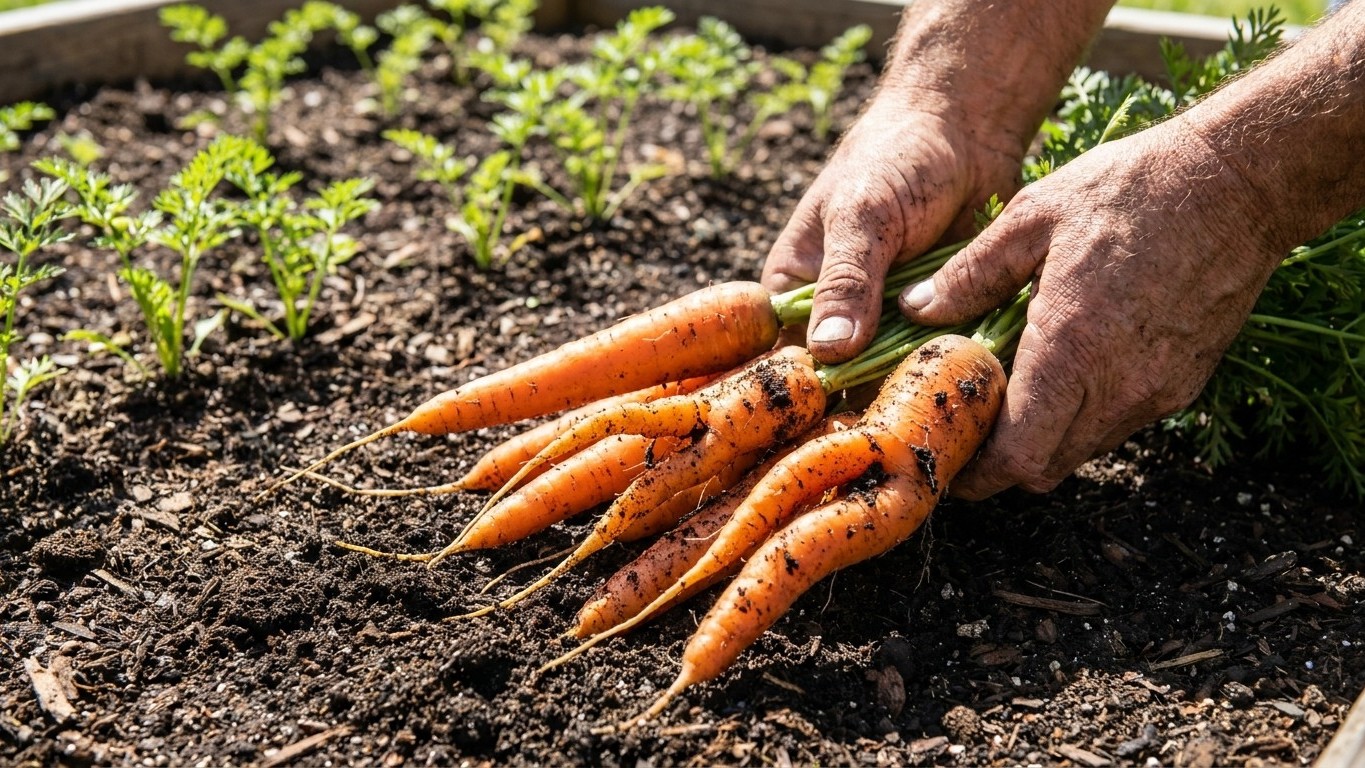

Rhode Island’s carrots don’t fail because gardeners plant on the wrong day. They fail because of what’s under the surface. The state’s representative soil, the Narragansett series, is a well-drained loam that actually favors long, straight roots, provided you deal with its strongly acid pH first. Counting back from your last frost matters, but it’s the ground itself that decides whether the count pays off.
The short answer
The soil that USDA NRCS lists as representative of Rhode Island is called the Narragansett series, an Inceptisol, which is a young soil that hasn’t had time to build strong internal layers. The surface horizon runs 34 percent sand, 6 percent clay and 60 percent silt, which puts it solidly in loam-to-silt territory. Organic matter sits around 4.0 percent, and the surface pH averages about 5.3, which counts as strongly acid. Drainage is classified as well drained.
For carrots, that combination is mostly good news. Utah State University Extension is blunt about what ruins a carrot root: heavy or rocky soil makes it fork, splitting into two or three legs instead of growing down as one clean taproot. With only 6 percent clay, Narragansett soil isn’t the dense, sticky ground that traps a taproot and forces it sideways. The silt content (60 percent) means it can still compact if you work it wet or walk on a bed too often, but it doesn’t carry the forking risk of a true clay soil.
The pH is the part that needs attention. At 5.3, this soil is more acidic than most vegetables prefer, and carrots grow best in soil that isn’t pushed to that extreme. A soil test through your local extension office will tell you exactly how much lime a bed needs to bring pH up, and that’s a better use of a spring weekend than guessing. Combine that with compost worked into the top several inches, both to feed the crop and to keep the silt fraction from sealing over after rain, and you’ve addressed the two real weaknesses of this ground: acidity and a tendency to crust.
If your yard sits on a soil with more clay than this, the fix Utah State recommends still applies here: plenty of compost, double digging to break up compaction below the surface, or simply building a raised bed filled with a loose, sandy mix. None of that is specific to Rhode Island. It’s what heavy ground requires everywhere carrots are grown.
None of this is a verdict on your particular yard. Rhode Island, like every state, spans hundreds of mapped soil series, and coastal sand, river-bottom silt, and fill dirt behind a newer house can all look nothing like the Narragansett profile above. Treat these numbers as a regional starting point, not a soil report for your own beds.
The test that settles it in your own garden
State soil data tells you what’s typical. It doesn’t tell you what’s six inches below your own carrot bed. A short dig-and-feel session settles that in about fifteen minutes.
- Dig a test hole at least a foot deep where you plan to sow. Note where the soil changes color or gets noticeably harder. That’s often where a taproot will stop or bend.
- Check for stones and rubble as you dig. Anything larger than a marble in the top 10 to 12 inches is a candidate for forking a carrot root, since Utah State University Extension identifies rocky soil as a direct cause of the problem.
- Feel the texture between your fingers. Grab a moist handful and squeeze. Soil that forms a slick, dense ribbon is clay-heavy. Soil that falls apart and feels gritty leans sandy. Something in between, holding a loose shape but crumbling easily, is closer to loam, the texture carrots do best in.
- Watch how water moves through it. Pour a bucket of water into the same test hole and time how long it takes to drain away. Water that sits for hours signals poor drainage and a bed that needs to be raised or amended before carrots go in.
- Compare what you found to a lab soil test. A test from your local extension office will give you an actual pH number and nutrient levels for your bed, which is the only way to know if you’re dealing with something like the state’s strongly acid 5.3 average or a completely different number.
What goes wrong here
- Forking in heavy or compacted ground. Even soil that starts out loamy like Narragansett can compact into something closer to clay if it’s worked wet or walked on repeatedly. The root hits resistance and splits. The remedy is the one Utah State University Extension gives for heavy soil generally: work in generous compost and double dig the bed before sowing, or skip the problem entirely with a raised bed filled with loose, stone-free soil.
- Poor germination during a hot stretch. Carrot seed is sown directly in place, and it germinates slowly under the best conditions. A run of hot, dry days after sowing can dry out the top inch of soil before seedlings ever break through, especially in a silty soil that crusts over. Keep the seedbed consistently damp with light, frequent watering until seedlings are up, rather than one heavy soak.
- Splitting from uneven watering later in the season. Roots that go through a dry spell and then get soaked, a common pattern with New England’s on-and-off summer rain, tend to split lengthwise as they swell too fast after being stressed. Even, regular watering through the growing season prevents the swing that causes it.
- Stunted or bent roots in shallow soil. If your test hole hit hardpan, rock, or old fill within the top foot, the taproot has nowhere to go and curls or stops short. This is exactly what the digging step in the soil test is meant to catch before you sow, not after.
Common questions
Do I need to till the whole garden, or just the carrot bed?
Just the bed you’re sowing into. Carrots go in a narrow row or block, so double digging or amending the full garden isn’t necessary. Focus the compost and loosening on the top 12 inches where the root will actually grow.
Will adding sand fix acidic, clay-heavy soil?
Sand changes texture but does nothing for pH. If a soil test shows acidity close to the 5.3 average USDA records for this region’s representative soil, lime is what raises it. Sand and compost address structure and drainage, which is a separate issue from pH.
Can I sow carrots directly into a bed that’s mostly compost?
Straight compost tends to be too loose and nutrient-heavy on its own and can encourage forked or hairy roots. A blend, mostly existing soil amended with compost, works better than compost alone.
How do I know if my soil drains well enough without a lab test?
The bucket-drain check described above is a reasonable home version. If water disappears within a couple of hours, drainage is workable for carrots. If it’s still standing well after that, a raised bed solves the problem faster than trying to amend your way out of poor drainage.