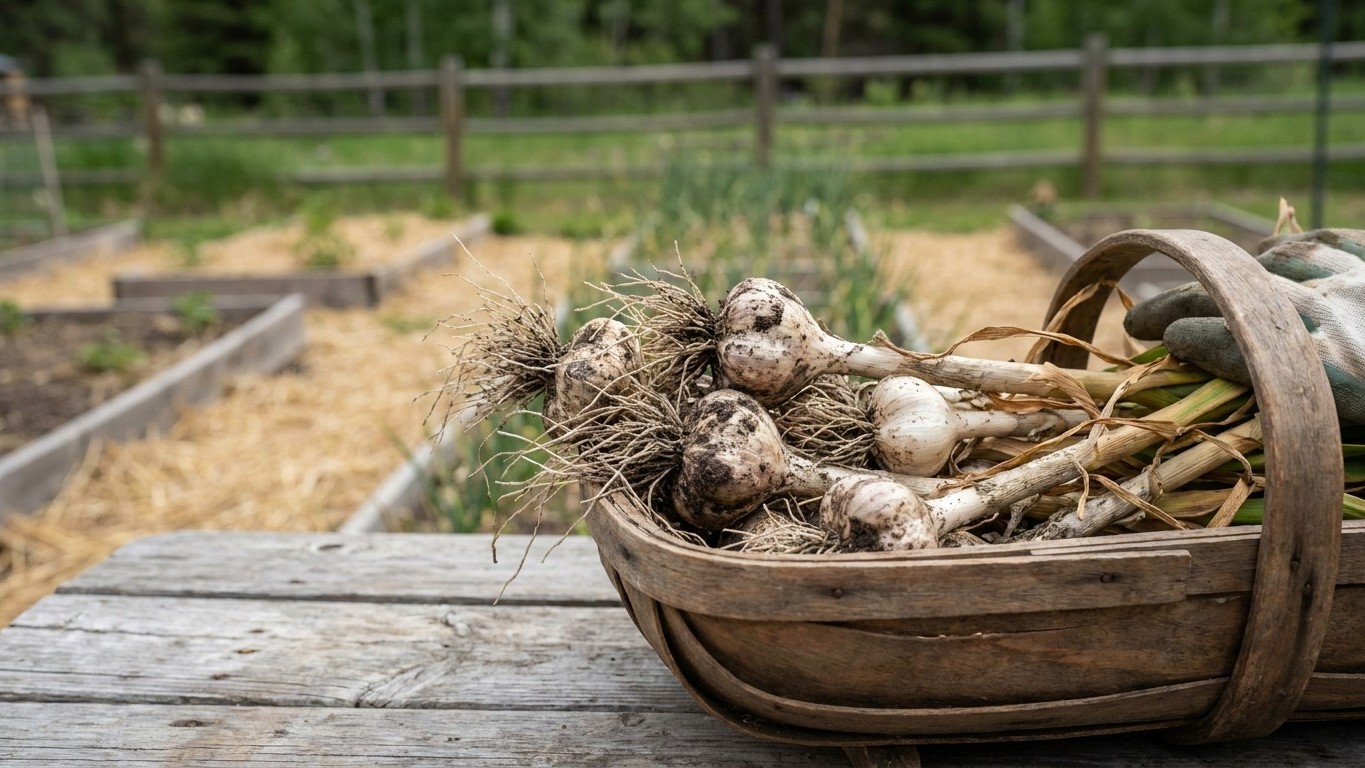

In Rhode Island, garlic planted the previous autumn is usually ready to lift when the lower third to half of the leaves have turned brown while the upper leaves stay green. That’s a visual cue, not a calendar date, because the exact week shifts with planting time, soil warmth, and how wet the spring turned out. Curing follows immediately: a few weeks of shade, airflow, and patience before storage.
When garlic is ready to lift in Rhode Island
Garlic doesn’t announce harvest day with a bell. The plant tells you through its foliage. Once roughly half the leaves have browned and dried while the rest remain upright and green, the bulb below has usually finished dividing into cloves and stopped drawing much more from the soil. Pull one test bulb, brush off the dirt, and look at the wrapper. If the cloves are distinct and the skin around them is intact rather than papery-thin, you’re close.
Waiting too long is its own problem. Once nearly all the foliage collapses, the outer wrappers start splitting and the bulb loses the protective layers that would otherwise carry it through months of storage. A garlic bulb pulled two weeks late in a humid Rhode Island July can look fine on the outside and still turn out to be a bulb of loose, unwrapped cloves once you get it into the shed.
Working backward from the planting date
The timing of harvest traces back to when the cloves went into the ground the previous fall. Rhode Island gardeners generally plant garlic in the weeks bracketing the region’s average first fall frost, which at the reference weather station falls between October 24 and November 3, according to NOAA NCEI’s 1991-2020 U.S. Climate Normals. That’s a midpoint, not a guarantee. In roughly half of all years, the first freeze arrives later than that window, sometimes by a week or more, and gardens away from the coast or up in elevation tend to freeze earlier than the airport station the data comes from. If you’re not sure how your own yard compares, the University of Rhode Island Cooperative Extension is the resource to check against local conditions rather than guessing from a statewide average.
A garlic clove planted close to that frost window has roughly eight months underground before it’s ready to come up, most of that time dormant or building roots. That long runway is also why the exact lift date drifts from one plot to the next even within the same town: soil drainage, mulch depth, and how sheltered the bed is all nudge the timeline a few days in either direction.
Curing it, and where to hang it here
Curing is the step that turns a freshly pulled bulb, still full of moisture, into something that will keep. Skip it or rush it, and garlic that looked perfect at harvest goes soft or moldy within weeks. The process itself is simple: get the bulbs out of the sun, into moving air, and leave them alone for a few weeks.
Resist the urge to wash the bulbs. Shake off loose soil, trim excessive roots if you like, but leave the wrapper skins and a good length of stem attached. Water on the skin during curing invites the rot you’re trying to prevent. Lay the bulbs out in a single layer, or hang them in loose bunches, somewhere shaded and dry with air moving through, not a sealed box or a plastic bin.
Finding the right spot in a Rhode Island yard
This is where the state’s coastal humidity works against you. A garage with the door cracked, a covered porch out of direct sun, a shed with a window screen, or a barn with cross-ventilation all work better than a closed basement, where stagnant, damp air slows drying and raises the odds of mold forming on the outer wrappers. A small box fan set to run a few hours a day, aimed across rather than directly at the bulbs, helps a lot during muggy stretches in July and August when the outdoor humidity itself is working against the cure.
Curing typically takes several weeks. You’ll know it’s progressing when the outer wrappers turn papery and dry, the roots shrivel, and the neck (if you’re planning to braid softneck varieties) goes from limp to firm enough to work without snapping. Don’t rush this by moving bulbs into storage early just because the outside looks dry. The inside, particularly around the neck, needs to catch up, and that’s exactly where undetected moisture causes trouble months later.
Storing it through a Rhode Island winter
Once cured, garlic wants three things it won’t reliably get in most kitchens: cool temperatures, low humidity, and darkness. A pantry shelf near the stove, or a spot on the counter in a sunny window, will shorten storage life noticeably compared to a cooler, drier corner of the house.
A basement stairwell, an unheated mudroom, an attached garage that doesn’t freeze solid, or a north-facing closet in an older Rhode Island farmhouse can all work, provided the space doesn’t swing into damp or humid conditions for long stretches. Mesh bags, loose baskets, or braided strings all allow air to keep circulating around the bulbs, which matters more than the specific container. Sealed plastic bags or airtight containers trap the moisture bulbs continue to release even after curing, and that trapped moisture is what starts sprouting or soft rot from the inside.
Checking on stored bulbs
Worthwhile to look through stored garlic every few weeks rather than assuming it’s fine until you need a clove. Set aside anything that’s gone soft, or that’s showing a sprout pushing up through the top, since one deteriorating bulb sitting against others in a bag or basket can spread rot faster than you’d expect. Softneck varieties, with their tighter, more numerous wrapper layers, generally hold up longer in storage than hardneck types, which tend to dry out or start sprouting sooner even under the same conditions.
Set aside your best, firmest bulbs for the next planting rather than whatever’s left over by fall. Since that seed stock will go back into the ground around the same October-to-November frost window discussed above, choosing strong bulbs now is really the first step of next year’s harvest, not an afterthought.
What goes wrong here
Most storage failures trace back to one of two mistakes: curing was cut short, or the storage spot stayed too warm and too damp. Both are common in a state where summer humidity lingers into September and where basements, the most obvious storage option in a lot of older homes, often run damper than they look.
Harvest timing errors compound the problem. Garlic pulled while too much green foliage remains hasn’t finished forming its protective wrapper layers, and that thinner skin dries out or lets in moisture faster in storage. Garlic left too long in the ground, past the point where most leaves have collapsed, tends to arrive at curing with wrappers already split or staining, which shortens shelf life before curing even starts.
On pests, the picture is limited. University of Rhode Island Cooperative Extension and URI Biocontrol Lab documentation for this region covers a specific list: cicada killer wasp, crypt gall wasp on oaks, lily leaf beetle (Lilioceris lilii), rose sawfly (rose slugs), viburnum leaf beetle, white grubs including Japanese beetle, and winter moth (Operophtera brumata). That list skews toward ornamental plants rather than vegetable crops, and garlic specifically isn’t named among the documented hosts. Of that group, white grubs are the one with any plausible overlap, since grubs feeding in soil can damage roots and bulbs of various plants while garlic is still growing. No documented pest on that list is tied specifically to stored garlic, so storage losses in Rhode Island are overwhelmingly a moisture and airflow problem rather than an insect one.
Common questions
How long does cured garlic actually keep in Rhode Island storage conditions?
That depends heavily on how dry the curing process was and how stable the storage spot stays through winter. Bulbs kept cool, dark, and dry with good airflow last markedly longer than those exposed to temperature swings or humidity, which is why checking stored bulbs periodically matters more than picking a fixed shelf-life number.
Can I plant cloves from garlic I grew and stored myself?
Yes, and many Rhode Island gardeners do exactly that, setting aside their firmest, largest bulbs at harvest specifically for the next planting around the region’s fall frost window rather than buying new seed stock each year.
Is a refrigerator a reasonable place to store garlic long term?
Refrigeration tends to trigger sprouting in whole bulbs faster than a cool, dry room does, since the cold combined with the fridge’s humidity mimics the conditions garlic reads as a signal to start growing again. A dry, cool room out of direct light generally works better for whole bulbs than the refrigerator does.
What should I do if I find mold on a bulb during storage?
Remove that bulb from the storage container right away and check the bulbs it was touching, since mold and soft rot spread through contact in tight baskets or bags. Bulbs stored loose with airflow around each one are far less likely to pass a problem from one to the next than bulbs piled together.