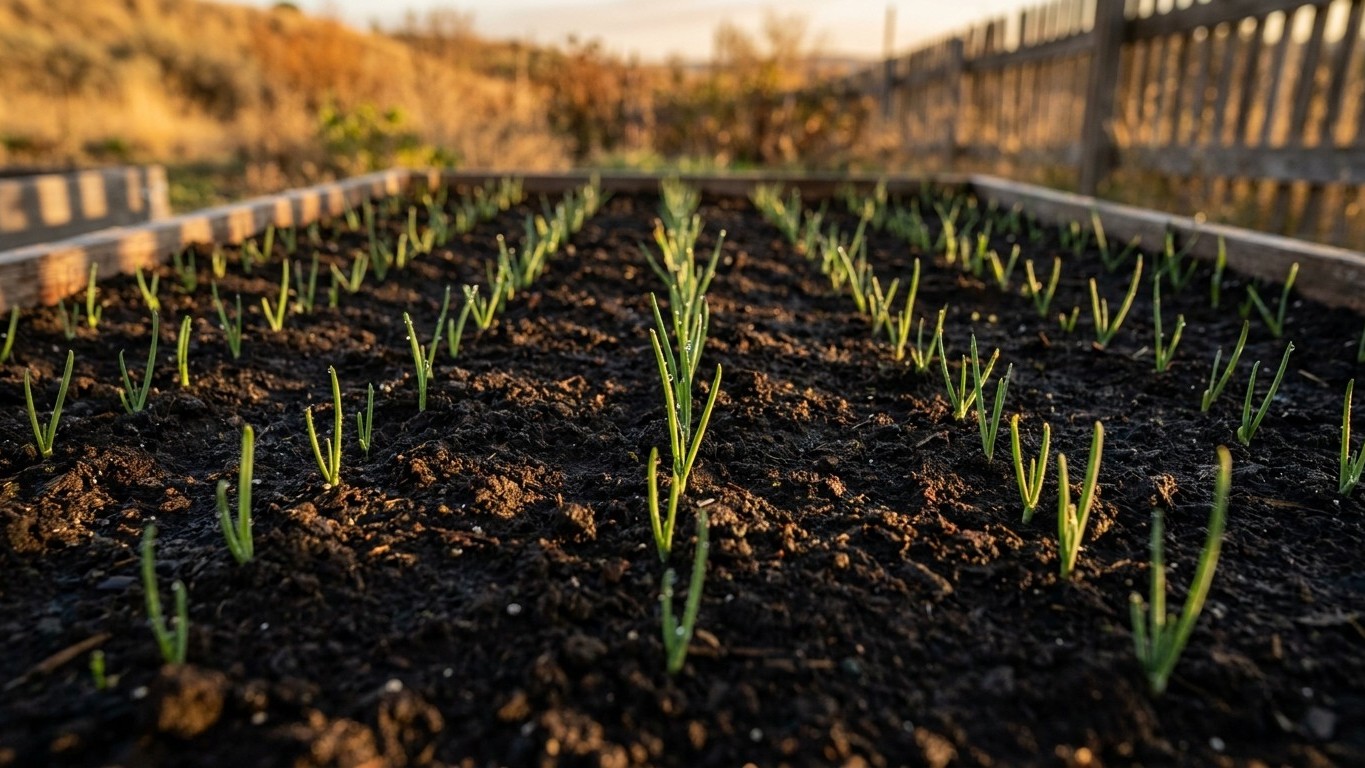

Garlic in Rhode Island is bothered by a short list of troublemakers: digging animals in the fall, chewing and sucking insects on the leaves in spring, and soil and bulb pests that show up before the summer lift. The planting window closes around the first fall freeze, which lands between October 24 and November 3 at the reference airport station, so the pest calendar starts earlier than most gardeners expect.
Which pests attack garlic in Rhode Island
The University of Rhode Island Cooperative Extension is the service that documents which garlic pests are active in the state, and it is the place to confirm any name before you act on it. What it and other Northeast extension programs describe falls into a few groups, and sorting by group is more useful than memorizing insect names.
The first group is the leaf feeders. These are small insects that rasp, suck or chew on the foliage once the plants are growing again in spring. They are tiny, often hiding where the leaf blades meet at the base, and most gardeners notice the damage long before the insect.
The second group lives below ground. Soil-dwelling larvae, microscopic roundworms and mites attack the roots, the basal plate and the cloves themselves. Garlic is a long-season crop, in the ground from autumn until the following summer, so these pests have months to work. A bed that held onions, leeks or garlic the year before is the usual place for trouble to build.
The third group is animals. Squirrels and voles dig up freshly planted cloves, especially in loose, mulched soil. Deer, which flatten many other garden crops, generally leave garlic alone.
Rule of thumb: match the pest to the plant part. If the insect or animal described feeds on leaves, roots or bulbs of onion-family crops, it is relevant. If it feeds on bark, fruit or vine crops, skip it. For the cultural side of the crop, see Growing Garlic in Rhode Island.
When each one shows up, and what it does first
The calendar hangs on the first fall freeze. NOAA NCEI’s U.S. Climate Normals for 1991-2020 put the first 32F freeze at the reference airport station between October 24 and November 3, the 30 to 70 percent probability band. That is a midpoint, so the first freeze may come later or earlier, and you should check your own county. Suburban and rural gardens, particularly inland and on higher ground, typically freeze one to two weeks earlier than the airport. Your own bed may be on a different clock than the reference city, so count from what your county sees. The full planting logic is in When to Plant Garlic in Rhode Island: Counting Back From the First Frost.
Fall: from planting to the first freeze
Digging animals come first. The earliest symptom is disturbed soil, scattered mulch or an empty hole where a clove should be. Later, the row emerges with gaps. Gaps can also come from rot or bad seed, so look for the dug-out hole and any tossed clove before you blame an insect. Soil pests are present too, but they rarely show above ground this early.
Spring: when growth restarts
Once the shoots push up again after winter, leaf feeders become active. The first sign is usually pale, silvery flecking or streaking on the leaves, often with the tips curling or twisting. Chewing damage looks different: ragged edges, small windows in the blade, or tunnels inside the hollow leaf.
Soil pests announce themselves differently. A plant that yellows from the bottom up and pulls out of the ground with almost no resistance has lost its roots to something. The damage is down at the base, and you will see it only if you lift the plant.
Early summer: the weeks before lifting
As the bulbs size up and the lower leaves naturally brown, bulb pests finish what they started. Look for plants that die back well ahead of their neighbors. At lifting, soft or tunneled cloves, a dusty residue between the wrappers, or a bulb that feels light for its size all point to pests that fed underground. Some of these carry into storage, which is why a bulb that looks fine in July can fall apart by winter.
Telling the damage apart from everything else
Garlic leaves turn yellow for a dozen reasons, and most of them have nothing to do with insects. Nutrient shortage, a wet spring, a dry spell, a fungal disease and a hoe nick all produce the same yellow tips. The table sorts the common symptoms by what separates them.
| What you see | Other causes besides insects | What settles it |
|---|---|---|
| Yellow leaf tips, whole row evenly affected | Low nitrogen, cold spring soil, dry soil | Even patterns across the whole bed usually point to soil or weather. Check moisture a trowel’s depth down and look at the roots. |
| Yellow plants scattered here and there | Fungal disease, poor drainage in one spot | Pull one plant. Roots chewed or missing at the base suggest a feeder. Fluffy white growth or a mushy base suggests disease. |
| Silvery or streaked leaves | Sun scorch, wind damage, some leaf diseases | Look at the leaf bases with a hand lens. Orange powdery pustules are a disease sign, tiny moving specks are not. |
| Ragged or torn blades | Hail, wind, hoe or string-trimmer damage | Mechanical damage shows clean, one-time tears, while feeding damage keeps spreading to new leaves. |
| Missing plants in the row | Rotted cloves, frost heave, poor seed | A dug hole and tossed clove point to animals. A heaved clove lying on the surface points to freeze and thaw. |
| Soft, collapsed cloves at lifting | Wet-soil rot, poor curing | Cut one open. Tunnels, tiny worms or frass are pest signs. A uniformly mushy interior with no tunnels is not. |
Pull a plant before you decide anything. A leaf can mislead you, but the roots and the base of the bulb tell the story. Take the whole plant, soil and all, and keep it in a bag instead of cleaning it up first. The extension office can then look at it and say what is there, which keeps you from treating a nutrient problem as an insect one.
What actually works here, and what is a waste of time
On a crop that spends the winter in the ground, a physical barrier placed at the right moment beats nearly any treatment. In autumn, a layer of hardware cloth or sturdy netting pinned over the planted bed keeps squirrels from digging, and it can come off once the ground has frozen and the animals lose interest. Putting a thick mulch down early invites voles to nest underneath, so wait until the soil has chilled.
In spring, a floating row cover laid over the bed as growth restarts keeps flying leaf and bulb pests from reaching the plants to lay eggs. The timing matters more than the fabric: the cover has to be on before the first adults arrive, with every edge buried or pinned down. A cover put on after damage appears only traps the pests with the crop. And since the cover goes on a bed where garlic or its relatives did not grow the previous year, rotation and covers work as a pair.
Crop rotation is the quiet workhorse. Keep onion-family crops out of a bed for several years after garlic, because soil pests build up where their food source stays put. Start with clean seed garlic from a reputable supplier, and throw out any soft, discolored or dusty cloves instead of planting them. After lifting, clear all plant debris from the bed, and cure the bulbs fully before storing them.
Several popular habits waste time. Spraying on a calendar with no diagnosis kills beneficial insects along with the pest, and it does nothing about roots already damaged. Homemade sprays and sprinkled kitchen products rarely reach insects at the base of the plant, and they cannot touch what is feeding underground. Planting later to dodge pests tends to backfire, since garlic needs fall root growth before the ground freezes.
If a treatment looks necessary, the choice of material belongs to the extension service. Only it knows what is registered for garlic in Rhode Island and what label rules apply.
Where to check this for your own county
Start with University of Rhode Island Cooperative Extension, then find the extension office closest to your garden through its pages. Staff there can identify a sample, tell you what has been showing up in nearby gardens this season, and say which options are legal for home use in the state.
That local answer matters because pests vary inside a single state. Gardens near the coast on Narragansett Bay, where winters are milder and the first freeze arrives later, do not share the same conditions as inland towns. A pest documented somewhere in Rhode Island may never reach your neighborhood, and one that is barely mentioned statewide may be common on your street.
If you are choosing what to plant before you worry about pests, the Garlic Varieties That Suit Rhode Island Winters guide covers the types that fit the climate. For a contrast with a much shorter, colder season, see the Saskatchewan guides on When to Plant Garlic in Saskatchewan: Counting Back From the First Frost and Garlic Varieties That Suit Saskatchewan Winters.
The next step is simple. Before you plant this fall, check which beds held onions, leeks or garlic in recent years and pick one that did not. Then, in spring, pull a single plant that looks off and bring it, roots included, to the extension office.
Common questions
When should I start watching for garlic pests in Rhode Island?
Start the day you plant. Squirrels and voles are a fall problem, and the first freeze at the reference airport station falls between October 24 and November 3, with inland gardens often freezing one to two weeks earlier. Insect pests become a concern once the shoots restart growth in spring.
Why are my garlic leaves turning yellow if I see no insects?
Yellow leaves have many non-insect causes, including nutrient shortage, a wet or dry spell, disease and mechanical damage. Pull one plant and look at the roots and the base of the bulb. If you cannot tell what you are seeing, take the plant to your extension office.
Do I need to spray garlic to protect it?
Not as a routine. Barriers, rotation and clean seed stock do most of the protective work. If a pest is confirmed and treatment looks necessary, the extension service can tell you what is registered for garlic in Rhode Island.
Can I replant cloves from garlic that had pest damage?
Avoid it. Cloves from a damaged crop can carry mites or microscopic worms into a fresh bed, and soft or discolored cloves rot in the ground. Buy clean seed garlic from a reputable supplier and plant only firm, healthy cloves.