
Rhode Island sits far enough north that onions need to go in the ground before spring even feels like spring. That timing comes down to two numbers: a reference latitude of 41.72 degrees north, and 15 hours and 2 minutes of daylight on the longest day of the year. Together they push Rhode Island gardens toward long-day and intermediate-day onions, planted late winter through early spring rather than in fall.
The short answer for Rhode Island

The figures come from a weather station near Providence, at 41.72N, and they tell you something warmth never will: onions decide when to stop growing leaves and start forming a bulb based on how many hours of daylight they’re getting, not how hot the soil is. On the longest day of the year in Providence, the sun is up for 15 hours and 2 minutes. That’s well past the roughly 12-hour threshold that triggers bulbing in short-day types, and it lands squarely in the range that long-day and intermediate-day onions are bred to use.
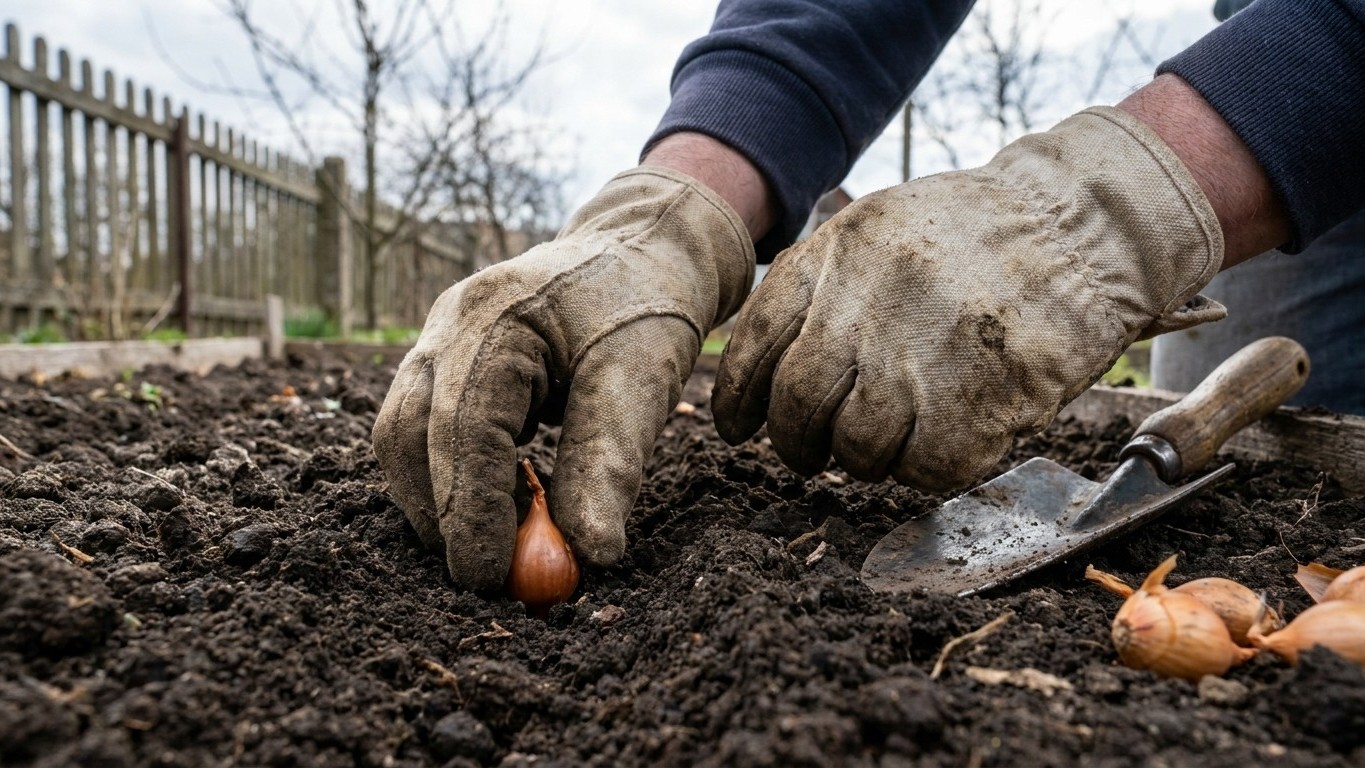
What that means for timing is straightforward, even if it runs against instinct. In mild-winter states, gardeners often plant onions in fall and let them overwinter as small plants, ready to take off the moment days lengthen in spring. Rhode Island’s winters are too cold and too unpredictable for that approach to work reliably; a young onion plant left outside through a Rhode Island January is more likely to die than to survive and resume growth. So the planting window here runs late winter to early spring instead: seeds started indoors in February, transplants or sets going into the ground in April once the soil can be worked, timed so the plants have built real size before the long June days switch them from leaf-making to bulb-making.
That’s the whole logic in one sentence: the bigger the plant is when daylight tells it to bulb, the bigger the onion. Everything else in growing onions in Rhode Island flows from getting that timing right, and from choosing varieties whose daylight requirement actually matches what southern New England summers provide.
What will not work here
Short-day onions are built for latitudes far south of Rhode Island, where 12 hours of daylight arrives early in the season while the plant is still small. Plant them here and the daylight in Rhode Island stays under that threshold for months longer than it does in, say, Texas or Georgia, so by the time bulbing finally kicks in, the plant hasn’t had the growing season it needs. The result isn’t a smaller success. It’s a variety mismatch that no amount of fertilizer or watering fixes.
- Candy (intermediate-day, published range 33-40N): the range tops out south of Rhode Island’s 41.72N, so it bulbs too early here and stays undersized.
- Gabriella (short-day, 20-35N): a full six-plus degrees south of the reference latitude; will not receive the short-day trigger it needs at the right time.
- Madalyn (short-day, 20-35N): same mismatch as Gabriella, bred for latitudes far closer to the Gulf Coast than to Narragansett Bay.
- Red Rock (short-day, 30-36N): triggers to bulb long before a Rhode Island plant reaches size.
- Red Sensation (short-day, 25-35N): same problem, too far south in its published range.
- Texas Grano 1015Y (short-day, 25-35N): a classic Deep South variety, out of range here by a wide margin.
- Vidora (short-day, 25-35N): bulbs on a schedule that has nothing to do with a New England summer.
- White Castle (short-day, 30-38N): its upper bound still sits south of Rhode Island.
The other trap is timing, and it catches gardeners who choose the right variety but plant it late. Delaying the planting date doesn’t push the harvest back by the same number of days. It shrinks the harvest, because whatever size the onion plant has reached when the daylight hits the bulbing threshold is the size the bulb will be, permanently. A plant that goes in three weeks late doesn’t catch up later in the season; it simply bulbs early relative to its own growth, and the result is a smaller onion, not a later one.
What changes across Rhode Island
Rhode Island is the smallest state by area, but it still isn’t one single latitude. The coastline near Block Island and Westerly sits around 41.1 to 41.3 degrees north, while the northern border near Woonsocket climbs closer to 42 degrees. That’s less than a full degree of spread, modest compared to states that stretch across several degrees, but it’s not nothing when a plant is reading daylight down to the minute.
| Area | Approximate latitude | What it changes |
|---|---|---|
| Southern coast (Block Island, Westerly, Newport) | ~41.1-41.5N | Slightly shorter longest-day length than Providence; negligible practical difference for variety choice, but frost tends to arrive a bit later in spring near the coast |
| Providence (reference station) | 41.72N | The figures on this page apply directly here |
| Northern Rhode Island (Woonsocket, Pawtucket area) | ~41.9-42.0N | A touch more summer daylight than Providence; inland frost dates run slightly earlier in fall and later in spring, which can push the planting window a few days later than the coast |
The practical upshot is that a gardener in Woonsocket isn’t gardening under a different rulebook from one in Newport. Long-day and intermediate-day onions work across the entire state, and the four varieties sitting near the edge of their published ranges (Powell, 43-47N; Redwing, 43-65N; Safrane, 42-50N; Talon, 42-50N) may bulb in Rhode Island but sit close enough to their lower bound that results can be inconsistent, especially inland where the growing season runs a little shorter than it does along the bay.
Sweet now, or onions that last
Every onion gardener eventually runs into this trade-off, and it isn’t a matter of luck or variety marketing. It’s chemistry. The volatile sulfur compounds that give an onion its bite are the same compounds that protect the bulb in storage, so a sweet onion, one bred with fewer of those compounds, tastes great sliced raw in July but breaks down in the pantry by October. A pungent onion is sharper on the cutting board and lasts through the winter because those same sulfur compounds work against rot and sprouting.
Day length lines up with this almost perfectly. Short-day varieties, grown in the South, tend to run sweet and short-keeping. Long-day varieties, suited to latitudes like Rhode Island’s, tend to run sharper and store longer. That’s not a coincidence of breeding preference; it’s the same daylight signal shaping both bulb size and bulb chemistry.
For a Rhode Island garden, that means leaning toward the long-day and intermediate-day side of the spectrum gives a pantry that still has onions in March, not a crisper drawer of soft, sprouting bulbs by New Year’s. University of Missouri Extension puts it plainly: “As a rule, ‘sweet’ onions do not store as well as the more pungent types.” A Rhode Island gardener who wants onions to cook with through a New England winter should expect sharper flavor in exchange for a bulb that holds up in a cool, dark closet for months rather than weeks.
Checking this against your own garden
The 41.72N figure describes Providence, not every backyard in the state, and the daylight math built on it assumes a clear geometric horizon, not the exact conditions of a particular yard tucked under trees or against a hill. Before committing a planting date or a variety list to memory, a few checks take less time than reading a seed catalog:
- Look up the latitude of your own town if you’re near Block Island, Westerly, or the northern border, rather than assuming Providence’s numbers apply exactly.
- Check your local frost dates through the University of Rhode Island Cooperative Extension, since coastal and inland frost timing in this state can differ by a week or more.
- Confirm which day-length group any onion variety you’re considering belongs to before ordering seed, not after.
- Note whether your planting site gets full sun through June, since shade from buildings or trees delays the plant from reaching size before the daylight trigger arrives.
- Ask your county extension office about soil temperature guidelines for starting onion transplants outdoors in your specific part of the state.