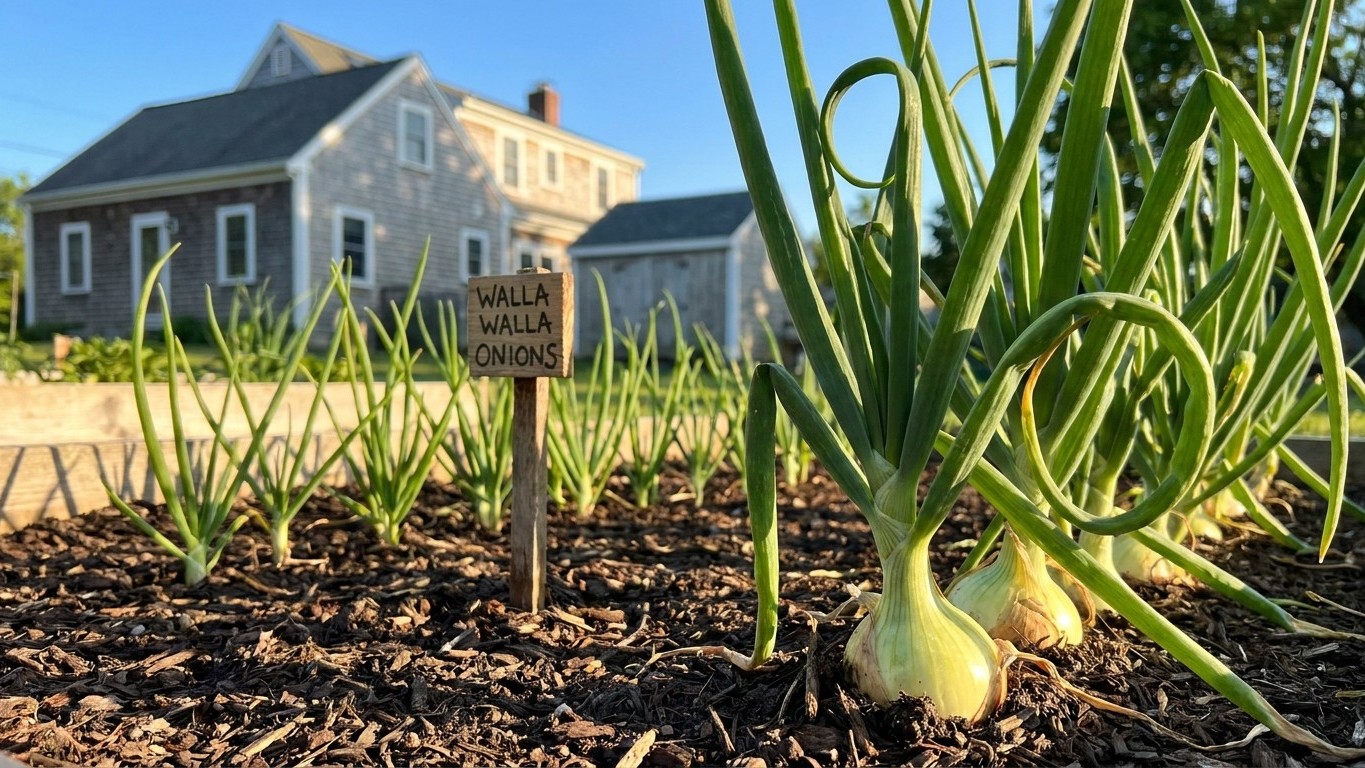

Rhode Island gardeners work with roughly 15 hours of daylight at the summer solstice, measured at the Providence station. That single number decides which onion varieties will actually form a bulb here and which ones will just sit there making leaves all summer. Below: the varieties that match this day length, the ones that don’t, and When to Plant Onions in Rhode Island.
How long your longest day is

The reference station for this territory sits at 41.72 degrees north latitude, and on the longest day of the year it gets 15 hours and 2 minutes of daylight. That’s the number an onion plant actually reads. Onions don’t bulb because the soil warms up or because you fed them well. They bulb because the length of daylight crosses a threshold that tells the plant to stop growing leaves and start packing sugars into a bulb instead.
At 15 hours and 2 minutes, Rhode Island sits solidly in long-day territory, with room for a good chunk of intermediate-day varieties too. Short-day onions, the type that dominates grocery store bags from the Southeast, need only about 12 hours of daylight to trigger bulbing. That threshold arrives here in early spring, long before the plant has built enough leaf mass to make a decent-sized bulb. Plant a short-day variety in Rhode Island and you get a walnut-sized onion, not because you did anything wrong, but because the daylight math never favored it.
Long-day varieties, by contrast, wait for something closer to 14 to 16 hours before they’ll bulb. Rhode Island’s solstice daylight clears that bar. Intermediate-day types, which need somewhere in between, also work here comfortably.
One caution worth repeating: 41.72 degrees north is the latitude of the reference station, not a blanket figure for the whole state. Rhode Island is small, so the spread is modest compared to a state like California or Texas, but a garden near the Connecticut border or up toward the Massachusetts line isn’t sitting on the exact same line of latitude as the airport station these numbers come from. If you’re near an edge of the state, it costs nothing to look up your own coordinates and compare. For nearly everyone in Rhode Island, though, the daylight profile is close enough to the reference figure that the variety guidance below applies directly.
Which varieties bulb in Rhode Island
Of the 28 onion varieties documented on this site, 19 have a published latitude range that covers 41.72 degrees north. That’s the list to shop from if you want a full-sized bulb by late summer, and you can see the full breakdown in The Best Onion Varieties for Rhode Island.
- Ailsa Craig (long-day, 38-60N)
- Barolo (long-day, 38-55N)
- Blush (long-day, 38-55N)
- Bridger (long-day, 35-50N)
- Cabernet (intermediate-day, 35-45N)
- Calibra (intermediate-day, 35-45N)
- Elsye (intermediate-day, 32-45N)
- Expression (intermediate-day, 32-45N)
- Frontier (long-day, 40-50N)
- Monastrell (intermediate-day, 35-46N)
- New York Early (long-day, 38-50N)
- Patterson (long-day, 38-55N)
- Red Carpet (long-day, 40-45N)
- Red Long of Florence (intermediate-day, 38-50N)
- Red Long of Tropea (intermediate-day, 35-48N)
- Rossa di Milano (long-day, 38-50N)
- Scout (intermediate-day, 32-46N)
- Sierra Blanca (intermediate-day, 32-45N)
- Walla Walla Sweet (long-day, 35-55N)
Four more sit right at the edge of their published range: Powell (long-day, 43-47N), Redwing (long-day, 43-65N), Safrane (long-day, 42-50N), and Talon (long-day, 42-50N). Rhode Island’s 41.72 degrees falls just under the lower bound for all four. These aren’t a flat no, since the published bounds describe a continuum rather than a hard cutoff, but a Rhode Island grower is working at the margin with these. Treat them as a gamble rather than a sure thing, and don’t build your whole onion patch around them.
The varieties that will not bulb here
This is the part that matters most if you’ve ever bought a bag of onion sets at a garden center and ended up with skinny, non-bulbing plants. Five varieties documented here have a published range set below 41.72 degrees north, which means Rhode Island’s daylight never reaches their bulbing trigger early enough, or triggers it too early for the plant to have grown enough to matter:
- Candy (intermediate-day, 33-40N)
- Gabriella (short-day, 20-35N)
- Madalyn (short-day, 20-35N)
- Red Rock (short-day, 30-36N)
- White Castle (short-day, 30-38N)
Plant any of these in a Rhode Island garden and the pattern is predictable: strong, healthy-looking green tops all summer, then a sudden shift as day length crosses the plant’s threshold too early, triggering a bulb that never gets past marble size before the leaves flop over and the whole thing starts to rot in the ground. It’s not a fertility problem, and it’s not something you can fix with more compost. It’s a mismatch between the variety’s genetics and the sky overhead.
When to plant onions in Rhode Island
Planting time for onions follows day length too, which is why the calendar looks completely different depending on where in the country you garden. In mild-winter regions of the Deep South, growers tuck onion sets or transplants into the ground in the fall, letting them overwinter and bulb the following spring. Rhode Island doesn’t have that option. Winters here are cold enough that fall-planted onions would be killed outright, so the planting window shifts to late winter and early spring instead.
The frost dates from the reference station give a working frame. The average last spring frost falls between April 7 and April 17, and the average first fall frost lands between October 24 and November 3. Onions tolerate a light frost better than most garden vegetables, which is why transplants or sets typically go in a few weeks before that last frost date, once the soil can be worked. Many Rhode Island gardeners start onion seed indoors in late January or February, then move hardened-off transplants outside in early to mid-April, right around or slightly ahead of that average last frost.
Those frost dates are averages built from 30 years of data at one airport weather station, and they describe probability, not a guarantee. A 30 to 70 percent freeze probability band means exactly what it sounds like: frost is a coin-flip proposition on either edge of that window, not a hard line. Suburban and rural gardens away from the immediate coast, and especially any garden with some elevation, commonly see their last spring frost arrive later and their first fall frost arrive earlier than the airport figures suggest, sometimes by a week or two. Treat these dates as a planning frame, not a promise, and keep some frost cloth handy if you’re planting on the early side.
Sweet onions or onions that keep
What kind of onion harvest can a Rhode Island garden realistically deliver? Something in between the two extremes, leaning toward the keeping side, and the reason has nothing to do with luck or skill.
Onion flavor and onion storage life are governed by the same chemistry, working in opposite directions. The compounds that give an onion its bite, the volatile sulfur compounds that make you cry when you slice one, are the same compounds that protect the bulb from rot during long storage. According to University of Missouri Extension, “as a rule, ‘sweet’ onions do not store as well as the more pungent types.” A sweet onion has fewer of those sulfur compounds, which is exactly what makes it pleasant to eat raw on a burger, and exactly what leaves it vulnerable to breaking down in the pantry a few weeks after harvest.
That trade-off lines up neatly with day length. Short-day varieties, grown mostly in warmer, southern climates, tend to run sweet and short-keeping. Long-day varieties, the kind that dominate the list for Rhode Island, tend to run more pungent and store considerably longer. Since Rhode Island’s daylight profile rules out short-day types almost entirely, the practical result is that a Rhode Island onion patch is built almost by default around long-day and intermediate-day varieties, the sharper-tasting, longer-storing kind.
What that means for your pantry: don’t expect the mild, almost fruit-sweet eating experience of a classic Southern-grown onion straight off the vine. What you can expect, if you cure your long-day onions properly after harvest, is a bulb with real staying power. Onions like Ailsa Craig, Patterson, or Rossa di Milano, grown and cured well, can reasonably be expected to hold in a cool, dark spot well past the New Year and, for the sharpest keepers, into March. A Rhode Island onion harvest trades a little sweetness at the table in July for a bag of onions still worth cooking with in the dead of winter.