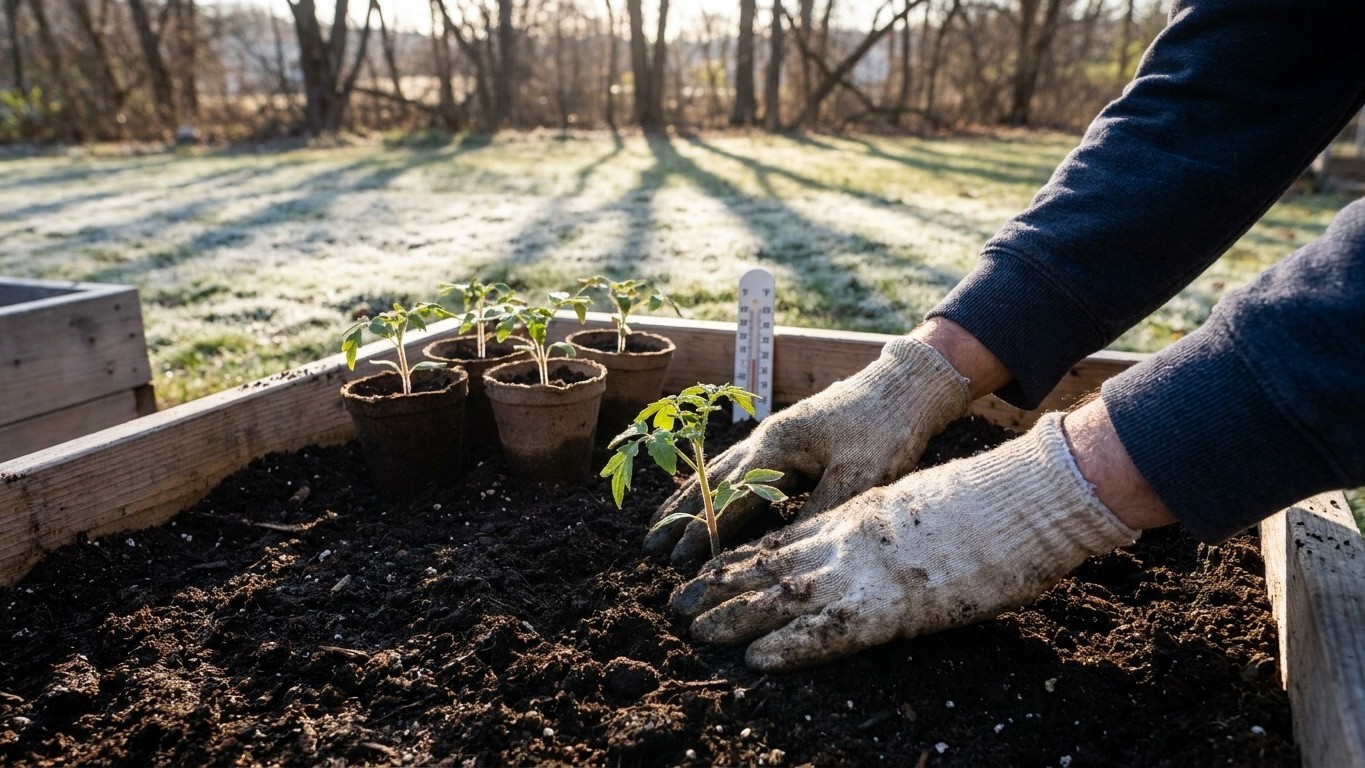

Rhode Island’s growing season runs on three numbers: a hardiness zone that spans nearly two full USDA bands, a last spring frost date that lands in early-to-mid April, and a first fall frost that arrives before Halloween in most years — a timing detail that also shapes When to Carve a Pumpkin in Rhode Island if you’re growing your own. Together they set a frost-free window of roughly six months, which decides what you can plant and what you can’t before you even pick a seed packet.
How long your season really is

Start with the numbers, because they’re the whole conversation before you get to soil or sun. The USDA Plant Hardiness Zone Map (2023 edition, built on 1991-2020 normals) places Rhode Island across zones 6a to 7b. NOAA’s Climate Normals, drawn from the Providence-area station, put the average last spring frost between April 7 and April 17, and the average first fall frost between October 24 and November 3.
| Measure | Value |
|---|---|
| USDA Hardiness Zone | 6a to 7b |
| Average last spring frost | April 7 to April 17 |
| Average first fall frost | October 24 to November 3 |
Subtract one from the other and you get a frost-free window of roughly 190 to 210 days, depending on where in that range your particular spring and fall land. That’s a genuinely long window by New England standards, comfortable for tomatoes, Growing Peppers in Rhode Island, squash, and most of what a home vegetable garden asks for — including warm-season favorites like Growing Sweet Corn in Rhode Island, as well as cool-season staples like Growing Potatoes in Rhode Island, Growing Beets in Rhode Island, Growing Carrots in Rhode Island, Growing Parsnips in Rhode Island, and Growing Spinach in Rhode Island, which fit neatly into the early part of that window, alongside perennial favorites like Growing Asparagus in Rhode Island, while the same season length also leaves enough room for warm-season vines like Growing Pumpkins in Rhode Island to mature before the fall frost. It’s not long enough to gamble on crops that need a full eight months of warmth without protection, and it’s not a guarantee that applies evenly across the state.
Here’s the part that trips people up: those dates are averages, not promises. By definition, roughly half of all years bring a frost later than the “average” last spring frost, or earlier than the “average” first fall frost. Treating April 12 as a safe planting date because it’s the midpoint of the range is how a tray of transplants gets wiped out in a cold snap that arrives right on schedule, statistically speaking. Gardeners who push the edges of the window routinely keep row cover or old bedsheets on hand for the two or three weeks on either side of the average dates, just in case that particular year falls on the losing half of the coin flip.
What the summer does to a garden here
A long frost-free window doesn’t mean a long stretch of ideal growing weather. Providence averages 9.4 days a year at or above 90F, and the coldest month’s average daily minimum sits at 22.1F. Neither number sounds dramatic on its own, but together they describe a climate that swings from genuinely cold winters to summer stretches hot enough to stall a garden mid-season.
Nine or ten days above 90F isn’t a lot compared to states further south, but it doesn’t take a heat wave to shut down certain plants. Tomatoes stop setting fruit reliably once daytime highs push past roughly 90F, even though the vines keep growing and flowering. Lettuce, spinach, and other cool-season greens bolt to seed and turn bitter under the same conditions. The practical result is that Rhode Island’s growing year isn’t one uninterrupted stretch of production. It behaves more like two productive shoulder seasons, spring into early summer and then late summer into fall, with a midsummer stretch where certain crops simply pause or fail regardless of watering.
That 22.1F winter minimum matters for a different reason: it’s the figure that decides whether a perennial, shrub, or fruit tree survives the cold at all, separate from whatever the record low or the average monthly temperature might suggest. A plant rated for zone 6 conditions is being asked to tolerate winters where the coldest month’s typical low sits well below freezing on most nights, not just on the occasional bad one. Planning around both numbers, the heat load and the winter minimum, does more for a garden here than picking varieties by name alone.
What tends to go wrong in Rhode Island
The University of Rhode Island Cooperative Extension and its Biocontrol Lab flag a handful of pests that show up consistently in home gardens across the state. This isn’t every insect a gardener might encounter, but it’s the short list worth knowing before you’re staring at damaged leaves trying to guess what happened.
- Winter moth: caterpillars emerge in early spring, right as buds open, and chew ragged holes in the new leaves of trees and shrubs before anything else is active.
- Lily leaf beetle: appears in mid-spring on lilies, with adults and larvae stripping leaves through early summer.
- Viburnum leaf beetle: larvae feed on viburnum foliage in late spring, then adults return in late summer to finish the damage.
- White grubs, including Japanese beetle: adults skeletonize leaves on roses, grapes, and many ornamentals through midsummer, while grubs damage turf roots earlier and later in the season.
- Rose sawfly (rose slugs): larvae skeletonize rose leaves in late spring into early summer, leaving a lace-like pattern behind.
- Crypt gall wasp: causes twig dieback on oaks, most noticeable as branches brown out over summer.
- Cicada killer wasp: large, intimidating but generally non-aggressive, active in bare or sandy soil through mid-to-late summer.
None of this is a treatment calendar, and it shouldn’t be treated as one. Pest pressure shifts from one part of the state to another and from one year to the next, which is exactly why identification matters more than memorizing a spray schedule off a webpage.
Where to check before you plant
Everything above describes Rhode Island as a whole, and a whole state is a rough average of a lot of different backyards. The hardiness zone range alone, 6a to 7b, tells you conditions differ meaningfully between the coast and the inland edges of the state, and the frost dates come from one reference station, not from every county. Suburban and rural gardens typically see later spring frosts and earlier fall frosts than the reference-station dates suggest, sometimes by one to two weeks, and more at higher elevation.
The University of Rhode Island Cooperative Extension is the state’s land-grant authority on gardening conditions, and its county-level offices track local frost patterns, soil conditions, and pest reports that a state-wide average can’t capture. A planting calendar built for the reference station near the coast can run two or three weeks off for a garden thirty miles inland or up in elevation, which is enough to lose a tray of seedlings to a frost that “shouldn’t” have happened yet, or to miss a fall harvest window entirely.
Before committing to specific planting dates, it’s worth a call or a visit to your county extension office, or a look at their published local frost data if it’s available. The state-level figures here are the right starting frame. Your own yard is where the final decision gets made.
Where to Go Next for Specific Crops
Everything above is really about timing your reads on the season correctly, and that gets more specific once you pick an actual plant. If you’re eyeing bulbs for fall, growing garlic in Rhode Island walks through why the state’s winters give cloves more cold than they even need, and what that means for planting dates and varieties. If it’s the lawn you’re wrestling with, Rhode Island lawn care explains why cool-season grass is the only real option once you look at how low the coldest month actually drops. And if tomatoes are the goal, growing tomatoes in Rhode Island takes apart that Providence last-frost window everyone quotes, and why a single airport station shouldn’t be deciding your planting date. Each of these pages does what this hub only sketches out — it takes the general climate picture and turns it into the actual dates, varieties, and decisions for one crop. Start with whichever one matches what’s already in your beds or on your seed list.