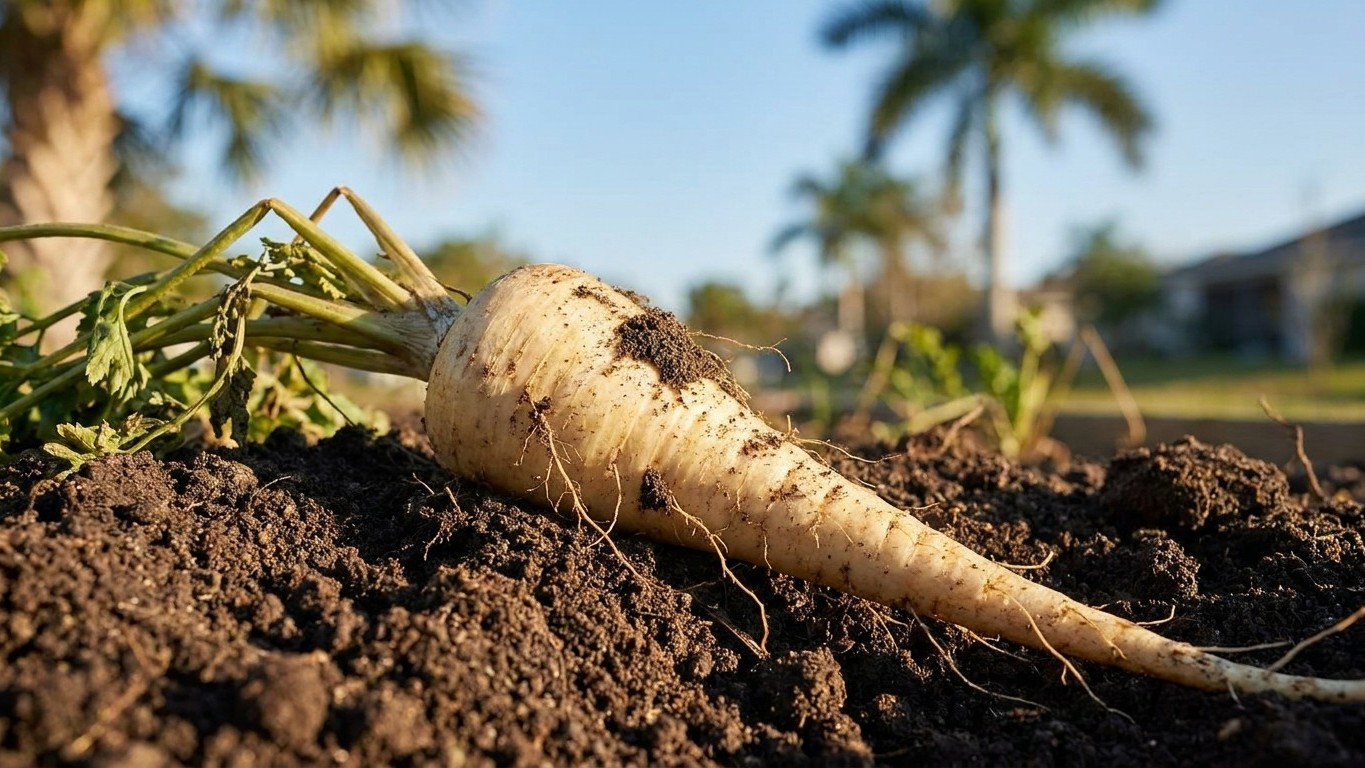

The University of Rhode Island Cooperative Extension and URI Biocontrol Lab track seven insects statewide, but only one of them has any real bearing on a parsnip row: white grubs, including the larvae that become Japanese beetles, feeding on roots underground. The rest of that list belongs to oaks, lilies, roses, and viburnum. Parsnip itself runs on its own clock, 100 to 120 days from seeding, sweetening only after weeks of frost, forking from heavy soil or overwatering rather than from any insect.
Which pests attack parsnip in Rhode Island
University of Rhode Island Cooperative Extension and URI Biocontrol Lab document seven insects for Rhode Island: the cicada killer wasp, the crypt gall wasp on oaks, the lily leaf beetle (Lilioceris lilii), the rose sawfly (rose slugs), the viburnum leaf beetle, white grubs including Japanese beetle, and the winter moth (Operophtera brumata). That’s the whole roster this state’s extension service tracks, and it’s short on purpose. URI publishes no single garden-pest list built around vegetables, so this composite skews toward the ornamentals planted closest to the house.
Sorting through it for a parsnip bed means dropping most of the names on sight. The cicada killer wasp digs burrows in bare, sandy soil and hunts cicadas to feed its young; it never chews a leaf or a root, and a parsnip planting means nothing to it. The crypt gall wasp lives its whole cycle inside oak twigs and acorns, so a root crop growing thirty feet from the nearest oak sits entirely outside its world. The lily leaf beetle feeds almost exclusively on true lilies and fritillaria, and parsnip is a carrot relative with no draw for it. Rose sawfly larvae skeletonize rose foliage specifically, and without roses nearby they have nothing to eat. The viburnum leaf beetle will strip a viburnum hedge bare while leaving the vegetable rows untouched a few feet away. The winter moth’s caterpillars climb into swelling tree and shrub buds, favoring oaks, maples, and blueberry, feeding well off the ground rather than in a low vegetable bed.
That leaves one entry with any documented relevance to a root crop: white grubs, including the larvae of the Japanese beetle. Only white grubs and the Japanese beetles they become have any documented link to root vegetables in Rhode Island gardens. Adult beetles chew foliage above ground in summer, and their larvae, the grubs, spend part of the year feeding on roots in the soil, which puts them in direct contact with a crop that spends its entire life underground.
When each one shows up, and what it does first
Parsnip is sown directly in place, never transplanted, and the calendar starts there. Gardeners typically seed two to three weeks before the last spring frost, which at the Providence reference station falls between April 7 and April 17, though gardens away from that station commonly see their own last frost one to two weeks later. Germination takes 14 to 21 days, and a bare-looking row at day ten is not a failed sowing, just an unfinished one.
Once the seedlings are up, the first insect activity to watch for isn’t underground at all. Adult Japanese beetles emerge from the soil once it has warmed through the growing weeks that follow, and their feeding shows up as ragged, lace-like holes chewed between the leaf veins, often with beetles visible on the foliage in the middle of the day. That’s the early, above-ground sign.
The below-ground stage comes later and is harder to catch early. White grub larvae feed on roots through the back half of the season, into the weeks approaching the first fall frost, which falls between October 24 and November 3 at the same reference station. A plant that wilts despite regular watering, or one that pulls loose from the soil with a chewed, ragged root surface instead of a smooth one, is showing the grub-stage symptom. Because parsnip needs its full 100 to 120 days from seeding and tastes best after several weeks of frosty weather have converted stored starch to sugar, most gardeners leave the roots in the ground well past the first frost, which is also the stretch when any remaining grub activity in the soil is worth checking before a full harvest.
Telling the damage apart from everything else
Not every rough root or slow start traces back to an insect. Parsnip carries a few problems that mimic pest damage closely enough to fool a quick look, and the table below separates them by what actually distinguishes one from another.
| Symptom | Likely cause | What tells it apart |
|---|---|---|
| Ragged holes chewed between leaf veins | Japanese beetle adults feeding | Beetles often visible on the foliage at midday, damage concentrated during their emergence weeks |
| Chewed, ragged root surface, wilting despite watering | White grub feeding underground | Cream-colored, C-shaped grubs turn up in the soil around the root when dug for |
| Forked or split root | Heavy or stony soil, or overwatering | These are two separate causes: dense or rocky ground forces the root to split as it searches for a path, while uneven watering makes an already-formed root crack and fork as it swells. Neither one involves an insect. |
| No visible seedlings after ten days | Still germinating, not a failed sowing | Parsnip germination takes 14 to 21 days according to Utah State University Extension; digging before that window closes only disturbs viable seed |
| Full-size root, bland or starchy flavor | Lack of frost exposure | Sweetening depends on several weeks of frosty weather converting starch to sugar, not on the plant’s size or the season’s hardiness zone |
Digging one test root before pulling the whole row catches root-stage problems early, since none of this shows up in the foliage until the damage is already done. A county extension office can confirm which of these is actually present; a symptom list only narrows the possibilities.
What actually works here, and what is a waste of time
On a crop with a short, fixed window from seeding to harvest, timing does more work than any treatment applied after the fact. A floating row cover set over the bed before adult beetles begin emerging blocks the above-ground feeding entirely, since the cover simply keeps the insect off the leaves. Covers left on too long trap heat against the soil and slow root development during the weeks that matter most, so they need to come off once the peak emergence period has passed and pollination or airflow isn’t a concern for a root crop like this one.
Handpicking adult beetles off the foliage in the early morning, when they’re sluggish, works reasonably well on a small planting and costs nothing. Keeping the soil evenly moist rather than letting it swing between bone-dry and soaked addresses the overwatering side of root forking, and working deep, loose, sandy soil ahead of seeding, or double digging where the ground is heavy, addresses the other side of that same problem. None of that touches an insect, but it removes one whole category of damage that otherwise gets blamed on pests.
What wastes time is treating the soil broadly once grub damage is already found in a root that’s ready to pull. By the point the roots are being harvested after frost, the season for intervening in that generation of grubs has effectively closed. Any product applied to the soil, and which one is legal to use in a home garden, is a question for the local extension office rather than a guess made at a garden center, since registrations and rules vary by state and change over time. Applying something without checking first isn’t just a waste of effort; it can be a waste of money on a product that was never appropriate for this use in the first place.
Where to check this for your own county
The statewide list kept by University of Rhode Island Cooperative Extension and URI Biocontrol Lab describes what’s been documented across Rhode Island as a whole, not what’s necessarily present in any one yard. Pest presence shifts from one property to the next depending on soil, sun, nearby host plants, and plain chance, so a garden with no oaks or roses nearby has already ruled out several names on that list without any testing at all.
The next step is a call or a sample brought to the county office of University of Rhode Island Cooperative Extension, rather than a guess based on a symptom that looks similar to something described here. Extension staff can confirm whether a root is showing grub damage, soil-related forking, or something else entirely, and they know which control options are currently registered for home garden use in the state, which changes over time in ways a general article can’t track.
Bringing an actual sample, root, grub, or a few damaged leaves, gets a faster and more specific answer than a description over the phone. That’s the difference between a statewide list and an answer that applies to one particular row of parsnips.
Common questions
Do white grubs kill parsnip plants outright?
Grub feeding damages the root surface and can stunt or wilt a plant, but it doesn’t necessarily kill it. The bigger issue is usually a root that’s no longer worth harvesting because of the chewed, ragged surface.
Should parsnip be sown earlier to avoid pest overlap?
Sowing follows the frost window, not the pest calendar. Seeding two to three weeks before the last spring frost still gives the crop its full 100 to 120 days, and adult beetle emergence tends to fall later in the season regardless of when the seed went in.
Does a mild winter mean more grubs the following summer?
That connection isn’t part of what’s documented here for Rhode Island. The coldest month’s average minimum locally runs around 22.1°F, but no source cited on this page ties that figure to grub survival, so it shouldn’t be treated as a prediction.
Is a forked parsnip root safe to eat?
Yes. Forking from heavy soil or uneven watering is a cosmetic and cutting inconvenience, not a sign of insect damage or spoilage.