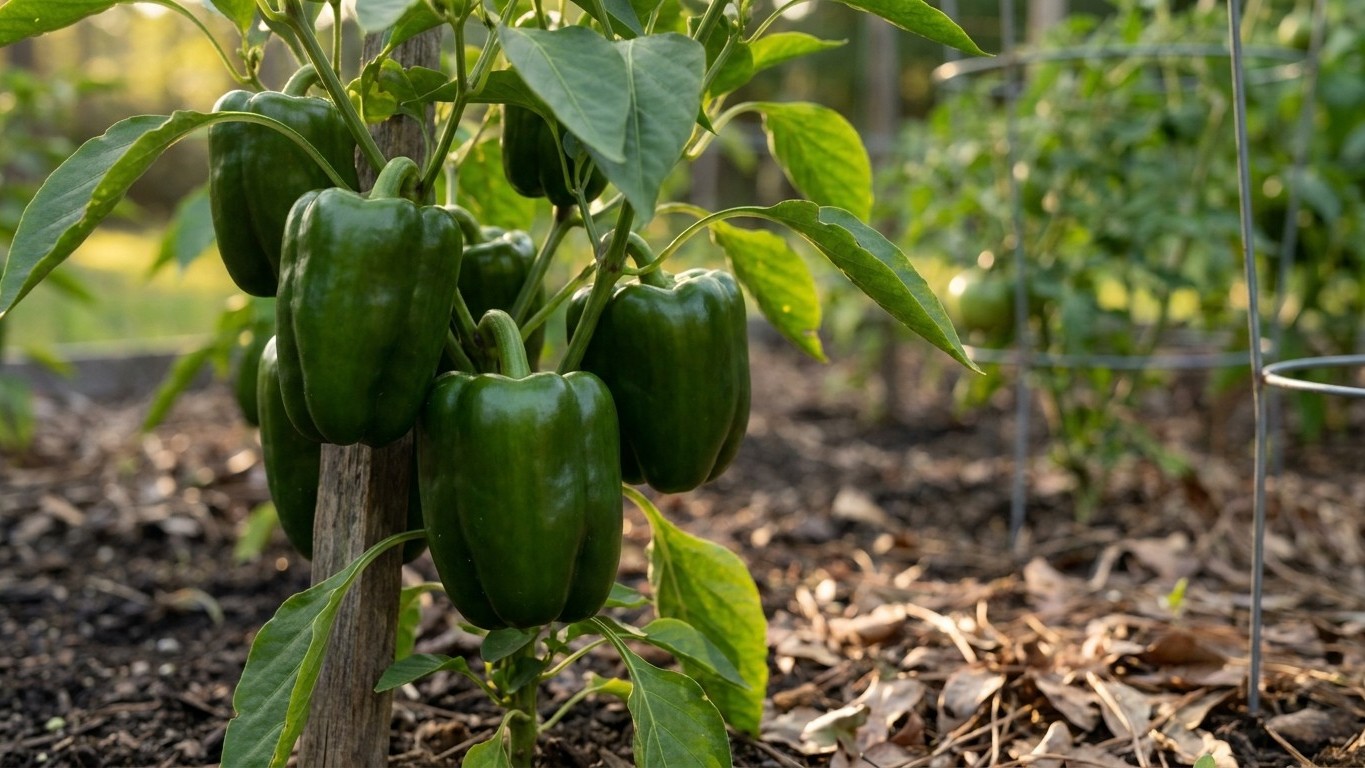

Peppers in Rhode Island lose more fruit to weather than to anything that chews. Flowers drop when days climb past 90 F or nights sink below 55 F, and young plants stall when they go out too early. This page follows that calendar: which stress hits when, how to count back from transplant day to seed day, and which failures to expect. It carries no insect calendar.
The short answer
Providence, the reference station for this state, averages 9.4 days a year at or above 90 F, according to NOAA NCEI climate normals. That is fewer than two work weeks of heat spread across a whole year. For a crop that stops setting fruit on days above 90 F, it is a light load. The average doesn’t say whether those days arrive scattered or in one stretch, and a pepper plant in bloom during a three-day run feels the stretch, not the yearly average.
The heat figure is only half the picture. According to Utah State University Extension, pepper fruit set fails at both ends: days above 90 F, and nights below 55 F. Rhode Island gardeners tend to watch the hot end because it makes headlines. The cool end can be just as costly, because a plant can flower heavily in June and set almost nothing if the nights stay chilly.
This site does not carry summer night minimums for Rhode Island, and nights can’t be guessed from the state’s latitude or from how cold its winters get. So you have to watch your own. A min/max thermometer on a fence post near the bed costs a few dollars and gives you the real number each morning. Write down the overnight low for the two weeks after the first flowers open. If it dips under 55 F on several nights, expect blossoms to fall off and set fruit later, or not at all.
The spring side of the calendar
The last spring frost at the reference station falls between April 7 and April 17, based on NOAA NCEI 32 F freeze probabilities in the 30 to 70 percent band (NOAA data file). Treat that as the reference-city figure, not a promise for the whole state. The station sits at an airport, and suburban and rural gardens typically see the last spring frost one to two weeks later. Check your own county before you commit to a planting date.
Frost-free is also not the same as pepper-ready. Transplants go out when the soil reaches 60 F, after frost, per the same Utah State guidance. In a cold spring, the soil can lag the calendar by weeks. For a wider look at the crop in this state, see Growing Peppers in Rhode Island. If you’re choosing what to grow, Pepper Varieties That Ripen in a Rhode Island Season covers that side.
When to start seed here
The arithmetic runs backward from the day the plants go into the ground. Transplants need 8 to 10 weeks indoors, so you pick the transplant date first and subtract. Here is the count in steps you can redo for any county:
- Find your last spring frost. At the Providence reference station it falls between April 7 and April 17. Add one to two weeks for a suburban or rural yard, and the window slides to roughly April 14 through May 1. Your county extension office or a local frost-date lookup will narrow it further.
- Wait for 60 F soil. Push a soil thermometer a few inches down in the morning, at the depth of a transplant’s root ball. The transplant date is whichever comes later, the end of frost risk or the day the soil reaches 60 F. Soil often warms after the frost date has passed, and peppers sitting in cold ground just stall.
- Subtract 8 weeks for the late end and 10 weeks for the early end. Suppose, purely as an illustration and not as a Rhode Island claim, that your soil hits 60 F on May 20. Eight weeks back is March 25. Ten weeks back is March 11. Your sowing window is March 11 to March 25.
- Redo the count with your own date. Take your transplant date, move back 56 days for the short end, and 70 days for the long end. Mark both on the calendar and sow somewhere between them. Seedlings started inside that window have time to develop before they go out.
- Check the back half of the season. Clemson Cooperative Extension says peppers should be ready for harvest about 70 to 85 days after transplanting. Count that forward from your transplant date and compare it with your county’s first fall frost, which typically comes one to two weeks earlier in suburban and rural spots than at the airport. This page does not carry a fall frost date, so look up your own.
One point trips up plenty of first-year growers. The clock that counts days to fruit starts at flowering, not at sowing or transplanting. A plant that goes out in late May may not bloom for a few weeks, and only then does the countdown toward a ripe pepper begin. If you want a fuller picture of how flowering and fruit connect, Why Peppers Fail to Set Fruit in Rhode Island goes deeper.
If a cold snap arrives right as your transplant date does, hold the trays indoors another few days instead of forcing the schedule. A seedling that waits is usually better off than one that sits in cold soil.
What goes wrong here
Three failures show up again and again in Rhode Island pepper beds. Each one links to the weather or to watering habits, and each has a fix you can start on now.
- Blossom drop in a hot spell or on a cool night. Flowers fall off instead of turning into fruit when days top 90 F or nights go below 55 F. With 9.4 such hot days in an average year at the reference station, the heat side is usually brief, but a bloom period that overlaps a hot run will lose flowers. Remedy: keep the soil evenly moist through a hot stretch, use afternoon shade cloth on the worst days, and cover plants on cool nights with floating row cover. Keep your own night log so you know whether the cool end is your problem. Plants usually resume setting fruit once conditions return to the 55 to 90 F range, though the flowers that dropped are gone.
- Sunscald where the sun is strong. Pale, papery, sunken patches appear on the shoulders of fruit that face the sun, especially where leaves have been lost to disease or heavy pruning, or where plants sit against a south-facing wall or on reflective ground. Remedy: leave the leaf canopy alone, do not strip foliage to “help” fruit ripen, and stake or cage plants so branches don’t flop open and expose the fruit. Shade cloth helps in the hottest part of the afternoon.
- Blossom-end rot. A dark, leathery, sunken spot forms on the bottom of the pepper, opposite the stem. It is tied to uneven watering, which interferes with how the plant moves calcium into the fruit, more than to a lack of calcium in the soil. Remedy: water deeply and on a steady schedule, mulch to hold moisture, and run a soil test before adding any calcium. Pick off affected fruit so the plant puts energy into healthy ones.
Because several of these share a cause, a single habit, steady moisture and a plant that keeps its leaves, prevents a fair share of them.
Common questions
How many days at or above 90 F does Rhode Island get?
At the Providence reference station, the average is 9.4 days a year, from NOAA NCEI climate normals. That figure measures summer heat load. It is not an average summer temperature, and inland or rural spots may differ from the airport reading.
Is April 7 to April 17 safe for my garden?
Those dates are the last spring frost window at the reference airport station, not a statewide guarantee. Suburban and rural gardens usually get their last frost one to two weeks later, and higher ground can see it later still. Check your own county, then wait for soil to reach 60 F before transplanting.
Can I store harvested peppers in the refrigerator?
A regular refrigerator is too cold for peppers. Clemson Cooperative Extension gives the best storage conditions as 45 to 50 °F with 80 to 90 percent relative humidity, which is warmer than a home fridge. Below about 45 °F peppers develop pits and go soft from chilling injury. Clemson’s figure of two to three weeks is a maximum under ideal conditions, not a guarantee, so use them sooner when you can. Their full guidance is on the Clemson pepper factsheet.
How do I know if cool nights are hurting my plants?
Record the overnight low with a min/max thermometer placed near the bed. Fruit set fails on nights below 55 F, and this site does not publish summer night minimums for Rhode Island, so your own readings are the only reliable check. If flowers keep dropping while daytime highs stay under 90 F, cool nights are the first thing to rule out.