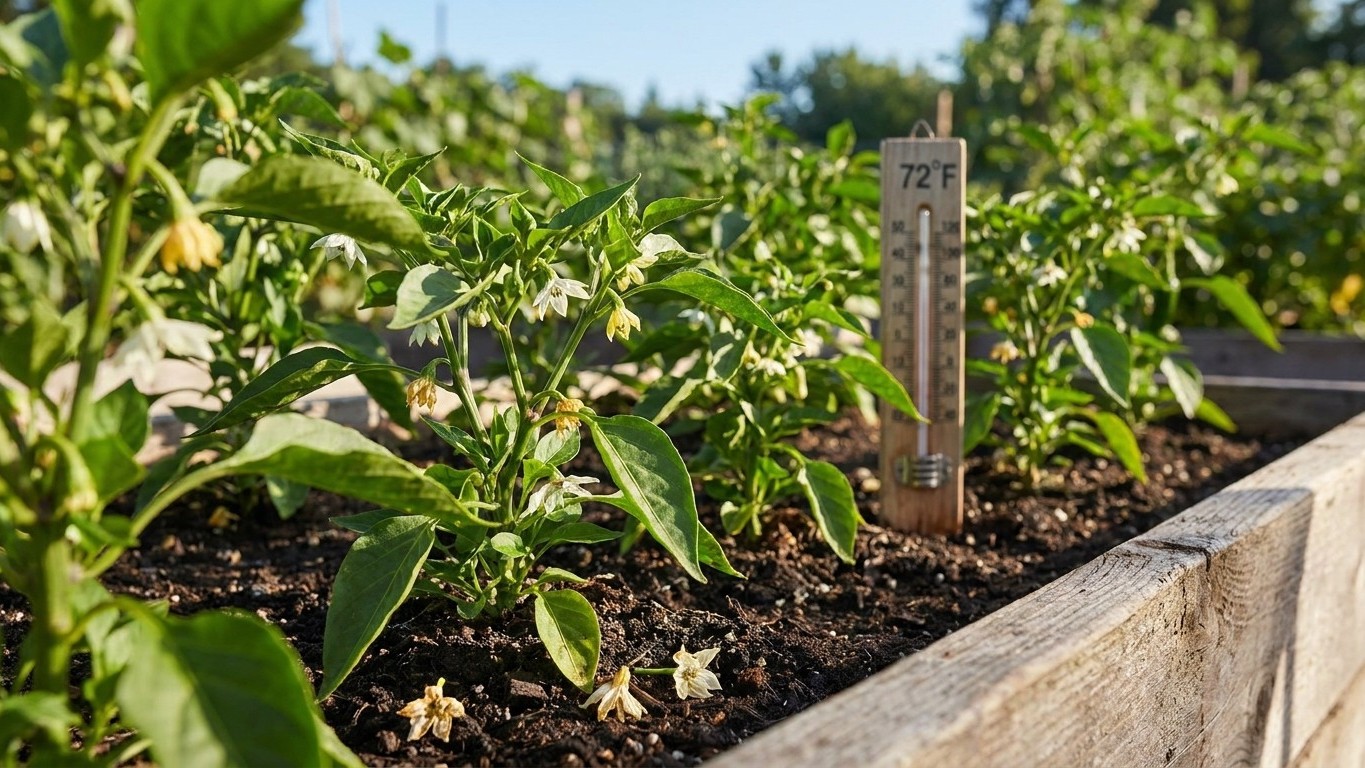

Rhode Island’s short answer: start pepper seed indoors around late February to mid-March, roughly 8 to 10 weeks before you plan to move transplants outside. That outdoor date depends on two things happening together: the frost risk has passed and the soil has warmed to 60 F. Neither one alone is enough.
The short answer
Providence averages 9.4 days a year at or above 90 F, based on NOAA NCEI Climate Normals for 1991-2020. That’s not a lot of days on paper, but it’s enough to matter for peppers, because pepper fruit set fails once daytime temperatures push past that 90 F mark. Flowers can open, look fine, and still drop without setting fruit if a heat spell lands during bloom. Nine or ten days scattered through July and August sounds minor until one of them coincides with the week your plants are flowering hardest.
The flip side gets less attention but causes just as much trouble. Peppers also stall out when nighttime temperatures drop below 55 F, and that threshold can show up on both ends of the season, in a cool June stretch or a chilly late-summer night in September. This site tracks days above 90 F for Rhode Island, but it does not carry summer night minima for this location. That’s a gap worth naming plainly rather than papering over with a guess.
Don’t fill that gap by estimating from latitude or from how cold January gets. Coastal Rhode Island, inland valleys, and higher ground a few miles apart can post very different overnight lows in the same July week, and a state’s general latitude tells you nothing reliable about a specific garden’s nighttime pattern. The only real fix is watching your own thermometer, ideally with a min-max reading unit left outside near the pepper bed, so you know when a cool night is actually a threat to fruit set rather than just an uncomfortable evening for you.
Put the two thresholds together and the picture is this: Rhode Island’s heat load, at 9.4 days above 90 F, is moderate rather than extreme, so hot-end blossom drop is a real but occasional problem here rather than a season-long fight. The cool end is the one local gardeners need to self-monitor, especially with transplants that go out early hoping to beat the heat, since an early outdoor date can trade one risk for the other. There’s no way around tracking both ends locally, because a garden that never sees 90 F can still lose a fruit set to a 50 F night in a cold pocket near a river or a low spot in the yard.
When to start seed here
The math for a start date is arithmetic you can redo for your own county, and it only needs three numbers: your last spring frost date, the point where soil hits 60 F, and the 8 to 10 week indoor window peppers need before they’re ready to go outside.
- Anchor to the frost window. Providence’s last spring frost, per NOAA NCEI’s 1991-2020 normals (32 F freeze probability, 30-70% band), falls between April 7 and April 17. That’s the airport station figure. Suburban and rural gardens across Rhode Island commonly see their last frost later than that, sometimes by one to two weeks, and more if the property sits at higher elevation or in a low-lying frost pocket. Treat April 7-17 as a reference point, not a guarantee for your own yard.
- Wait for 60 F soil, not just a frost-free calendar date. Utah State University Extension is clear that pepper transplants belong in the ground when soil temperature reaches 60 F and frost risk has passed, whichever comes later. In a cool, wet spring, soil can lag behind the calendar by a week or two even after the air has warmed, so a soil thermometer pushed a few inches into the bed beats guessing from the date alone.
- Count back 8 to 10 weeks from that transplant date. If your working transplant target lands in the last week of April to mid-May (adjusted for your own county’s frost pattern and soil check), counting back 8 to 10 weeks puts the indoor seed-starting window at late February through mid-March for most Rhode Island gardens. Gardeners in a documented cooler pocket should shift toward the later end of that window and lean toward 10 weeks rather than 8, since a transplant that’s ready too early just sits indoors getting root-bound.
Redo this each year with your own frost observation and your own soil thermometer reading rather than relying on a fixed date. A backyard half a mile from the next one over can run a full week apart in spring soil warm-up, especially where one sits in full sun on a slope and the other holds cold air in a low corner.
What goes wrong here
- Blossom drop during a hot spell. When daytime temperatures climb past 90 F, even for a handful of days, flowers open and fall without setting fruit. Rhode Island’s average of 9.4 such days a year means this is an occasional event rather than a constant threat, but it tends to hit hardest if it lines up with peak bloom. The remedy is timing transplants so the heaviest flowering doesn’t fall squarely inside the hottest stretch of July, and providing afternoon shade cloth over plants during a forecasted heat run.
- Blossom drop during a cool night. The same failure shows up at the opposite extreme, when night temperatures fall below 55 F. Because this site doesn’t track summer night minima for Rhode Island, the fix starts with the reader’s own observation: a min-max thermometer near the bed flags cool nights before they cost a fruit set. Row cover pulled over plants on a night that’s forecast to run cool can hold enough heat to protect open blossoms.
- Sunscald on exposed fruit. Strong summer sun on fruit that isn’t shielded by foliage can bleach or blister the skin, especially on plants that have been over-pruned or that lost leaves to disease. Leaving natural foliage in place to shade developing peppers, rather than trimming for looks, is the simplest remedy, along with avoiding heavy leaf loss from disease left untreated.
- Blossom-end rot. This shows up as a dark, sunken patch at the fruit’s bottom end and traces back to uneven water delivery disrupting calcium uptake, not to a soil calcium shortage in most home gardens. Consistent watering on a set schedule, mulch to hold soil moisture steady, and avoiding the swing from bone-dry to soaked fixes most cases.
Common questions
Can I direct-sow pepper seed outdoors in Rhode Island instead of starting indoors?
Peppers need a long runway, 8 to 10 weeks, before they’re transplant-ready, and Rhode Island’s frost-free window isn’t long enough to get a full harvest from seed sown directly in the garden. Starting indoors and transplanting after the soil hits 60 F is the practical route here.
What if my county’s last frost date is later than Providence’s April 7-17 window?
Shift your whole schedule later by the same margin. Since suburban and rural Rhode Island properties often see frost linger one to two weeks past the Providence airport figure, push both your transplant date and your indoor seed-starting date back accordingly, and confirm with a soil thermometer rather than the calendar alone.
Does Rhode Island’s heat make blossom drop a bigger risk than the cool nights?
Not necessarily. At 9.4 days above 90 F a year, the hot-end risk here is moderate, not extreme. The cool-end risk, nights under 55 F, isn’t tracked by this site and varies a lot by yard, so it deserves just as much attention. Watch your own overnight lows rather than assuming heat is the only threat.
How do I know when my soil has actually reached 60 F?
A basic soil thermometer pushed 3 to 4 inches into the bed, checked in the morning before the sun has warmed the surface, gives the most reliable reading. Air temperature and calendar dates are guides, but they can run ahead of what’s actually happening a few inches underground, especially in a wet spring.