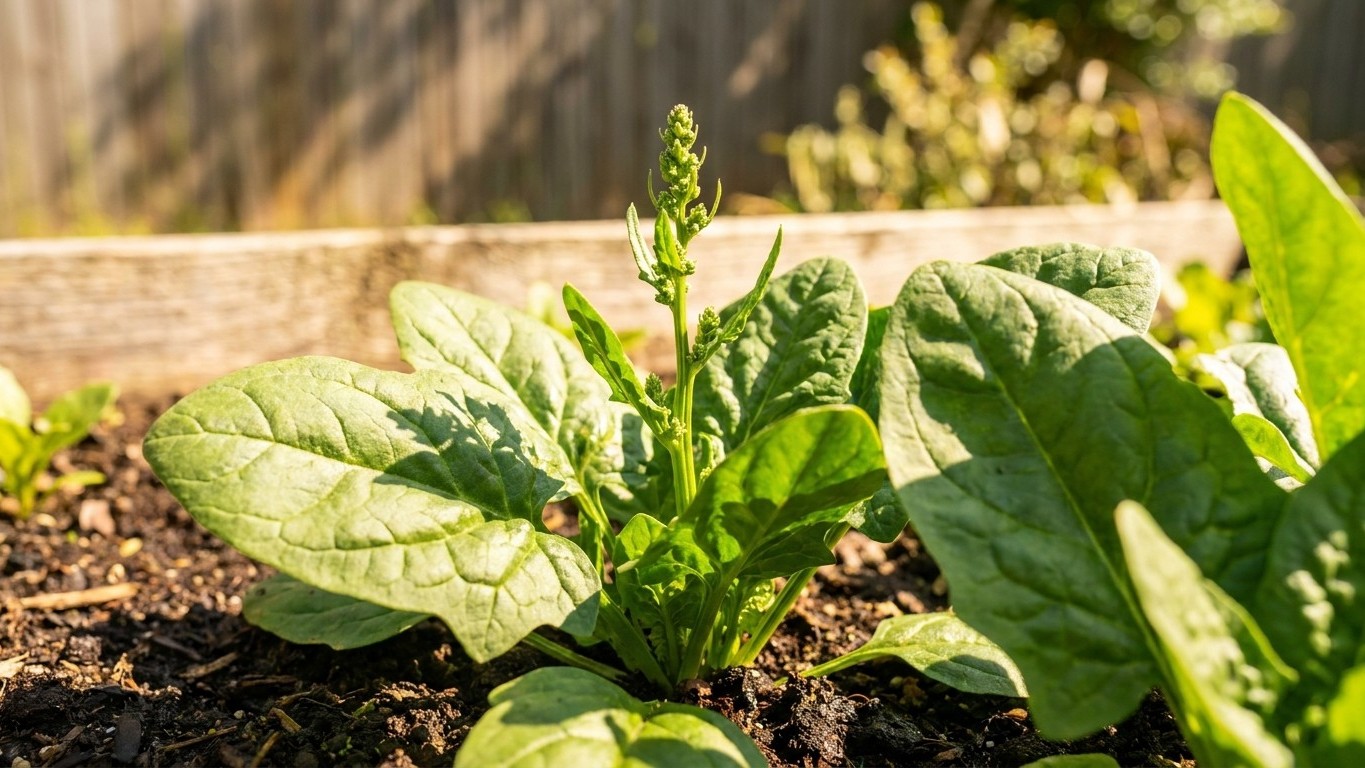

In Rhode Island, what eats a spinach crop is mostly the calendar. Long days and warm weather push the plant to flower, and once it does, the harvest is over. Growth stops being good above 75 F, which is also where bitterness starts. Spring gives you a narrow gap between frost and heat. Autumn gives you a sowing window that opens only when the soil cools. Insect pests are a separate subject, and this page does not cover them.
The short answer
On the longest day of the year, Providence gets 15 h 02 of daylight. The Homestead Post calculated that figure from the latitude of the reference weather station, using the geometric horizon, so real daylight runs about seven minutes longer. It matters because, according to Utah State University Extension, spinach bolts during long days and warm temperatures. Long days alone are enough to trigger flowering. A cool June does not buy you extra weeks, because the plant is reading the sun, not the thermometer.
So which limit applies here, day length or heat? Both. Fifteen hours of light is a long day by any standard, and it peaks at the solstice, right as the warm season gets going. Heat then does its own damage. Providence averages 9.4 days a year at 90 F or more, which is a modest summer by national standards. But spinach does not wait for 90. Utah State says it grows best where temperatures do not exceed 75 F, and the stretch between 75 and 90 is where a Rhode Island spring crop actually ends.
The source publishes no day-length threshold in hours for when spinach tips into flowering, so nobody can honestly tell you the exact week in May when the trigger trips. What can be said is simpler. Days lengthen steadily from midwinter to the solstice. Every week you delay a spring sowing, the plant grows into longer days and warmer air at the same time. That pinches the crop toward the front and back of the year: early spring, and a late-summer sowing that matures into shortening days.
For the mechanics of how quickly a stressed plant sends up a seed stalk, see Will Spinach Bolt Early in Rhode Island? For the full growing picture across the seasons, start at Growing Spinach in Rhode Island.
One caution on every date below. They come from the Providence airport station in the NOAA NCEI climate normals. Gardens in the suburbs and the rural interior often see the last spring frost later and the first fall frost earlier than the airport does, commonly by one to two weeks, and more on higher ground. Treat the dates as the reference-city figure, not a statewide guarantee, and check your own county’s records.
How long the spring window really is
Spinach goes into the ground two to three weeks before the last spring frost. That rule sets the opening of the window. Heat sets the close. Here is the arithmetic, step by step.
- Start with the frost date. At the reference city, the last spring frost falls between April 7 and April 17. Inland and rural gardens can run a week or two later.
- Count back two to three weeks. Three weeks before April 7 is March 17. Two weeks before April 17 is April 3. Sowing at the reference city therefore runs from about March 17 to April 3, a span of roughly two and a half weeks. Push both ends later if you garden inland.
- Find where the other end sits. Growth stops being good above 75 F. That is a temperature, not a date, and no source here gives a Rhode Island calendar date for it. It also marks the point where the leaves turn bitter, so one number carries two penalties.
- Measure your own gap. Note when afternoons in your yard start reaching 75 F and staying there. Count the weeks between your sowing date and that moment. That count is your usable spring.
So how many weeks does that leave? The honest answer is that the front end is fixed and the back end moves with the year. The front end is set by frost, and sowing can begin as early as mid-March. The back end arrives whenever the first run of 75 F afternoons does, and no published figure pins it to a week. What the numbers do show is that the sowing window is only about two and a half weeks wide. In a season this short, a seed that goes in on April 3 instead of March 17 gives up a big share of its growing time.
Because heat and lengthening days work together, a late-spring bed is a bad bet even when the weather looks pleasant. A 70 F day in May can feel perfect to a gardener and still be pushing the plant toward flowering. If you want the crop to reach a usable size before the heat arrives, aim for the early end of your frost-based window. The 9.4 days a year at 90 F or more are not the problem. The days in the 70s are.
The autumn crop, and when the soil lets you sow
Autumn is the better season for spinach in this state, but it comes with two obstacles that work against each other. Warm soil blocks the early sowing dates, and frost caps the late ones. The usable window sits between them.
Obstacle one: the soil is still too warm
Utah State University Extension reports that seed germination is reduced above 80 F soil. That is the surprise for most gardeners: autumn sowing is blocked by warm soil, not by cold. Late August can feel like summer with a cooler evening, and the top inch of a bed in full sun holds heat long after the air cools off. Seed sown into soil that warm germinates poorly, so the rows come up patchy or not at all.
The window opens when the soil falls below that line, and no source here publishes a Rhode Island date for it. It varies with bed exposure, mulch, and the year’s weather. A soil thermometer in the seedbed in the morning tells you more than the calendar will. If you want the sowing-date detail for the season, When to Sow Autumn Spinach in Rhode Island goes deeper.
Obstacle two: the frost that ends the season
The source’s rule for a fall crop is to plant 50 to 75 days before the date you want to harvest. It publishes no days-to-maturity figure for spinach itself, so that range is the only count to use. At the reference city, the first fall frost falls between October 24 and November 3. Treat that as the deadline for your harvest and count backward.
- Harvest by October 24: sow between August 10 (75 days back) and September 4 (50 days back).
- Harvest by November 3: sow between August 20 (75 days back) and September 14 (50 days back).
Across both dates, the full span runs from about August 10 to September 14. If your garden is inland or rural and the first frost arrives a week or two earlier, slide the whole span earlier by the same amount. The two obstacles now meet. The early end of that span, mid-August, is exactly when the soil is most likely to still be above 80 F, so the soil thermometer decides how much of the range you can actually use. The later end is safer for germination but leaves less margin before frost. Many Rhode Island gardeners end up sowing in the middle of the range, once the soil has cooled, and accepting a slightly smaller harvest in exchange for even germination.
Common questions
Does a cool Rhode Island summer keep spinach from bolting?
No. Long days trigger flowering on their own, and the longest day here brings 15 h 02 of daylight at the reference city. Cool weather helps with the heat side of the problem, but it does not shorten the day.
When should I sow spinach in spring?
Two to three weeks before the last spring frost. At the reference city, where that frost falls between April 7 and April 17, the sowing window runs from about March 17 to April 3. Inland gardens, which often see the last frost one to two weeks later, should shift that later.
Which variety resists bolting best?
Utah State University Extension names four varieties: Bloomsdale, Melody, Teton and Olympia. It gives no data on any of them, so this page cannot say which bolts later or tolerates heat better. Whatever you pick, the day-length and 75 F limits above apply to it.
How long does harvested spinach keep?
The UC Davis Postharvest Technology Center gives an optimum of 32 F at 95 to 98 percent relative humidity, and says spinach will not maintain good quality for more than 2 weeks. Treat that as a ceiling, not a plan. At the 41 to 50 F a typical fridge door holds, wilting and yellowing come on faster. The coldest spot is the back of the bottom shelf, not the door.